The Elder Futhark: history and reading of the 24 runes
The Elder Futhark is the oldest runic alphabet (2nd-8th century). Origins, inscriptions, the three families, the rune poems, and the difference between historical use and modern casting.
Key points
| Name | Elder Futhark (also fuþark, "common Germanic runic alphabet") |
|---|---|
| Number of runes | 24, divided into three families of eight (aettir) |
| Period of use | Roughly from the 2nd to the 8th century |
| Earliest secure inscription | Vimose comb (Denmark), around 160, word "harja" |
| Earliest complete series | Kylver Stone (Gotland), around 400 |
| Successors | Younger Futhark (16 runes, Scandinavia); Anglo-Saxon futhorc (up to about thirty runes) |
| Modern decipherment | 19th century, notably by Sophus Bugge (1865) |
| Rune casting | Modern practice, popularised in the 20th century |
What is the Elder Futhark?
The Elder Futhark is the oldest known runic writing system. It was used by Germanic peoples from Northern Europe, from Denmark and Scandinavia to England and the banks of the Rhine, between roughly the 2nd and the 8th century. It has 24 signs called runes.
The name "futhark" is formed from the sounds of the first six runes (f, u, þ, a, r, k), just as our word "alphabet" comes from the first two Greek letters. The word "rune" itself comes from a Germanic term meaning "secret, whisper, mystery": this is the meaning of Gothic rūna and Old English rūn.
Runes are letters before they are symbols. Each one stands for a sound and bears a name, which is an ordinary word of the language (cattle, ice, horse, day). The angular forms come from the way they were carved into wood, bone, stone or metal, where straight lines are easier to cut than curves.
Where do the runes come from, and what are the earliest traces?
The precise origin of the runes is debated. Most specialists link them to a North Italian alphabet (Etruscan, Raetic) or to the Latin alphabet, several letters of which resemble runes (f, u, r, k, h, s, b). An old theory deriving the runes from Greek is now set aside, because the oldest inscriptions predate the major contacts between the Goths and the Greek world.
The oldest securely dated inscription is that of the Vimose comb, in Denmark, around 160, which bears the word harja. Then come the Thorsberg scabbard (around 200), the Mos spearhead (around 300, the oldest runic inscription in Sweden), the Lindholm amulet, the Gallehus golden horns (around 400), and the Kylver Stone, on Gotland (around 400), which bears the first complete series of the 24 runes. A Norwegian stone, the Hole stone, is sometimes cited as older, but its dating is much disputed.
After the end of the use of the Elder Futhark, the knowledge of how to read it was lost. It was only recovered in the 19th century by linguists, including the Norwegian Sophus Bugge, who published its decipherment in 1865.
The 24 runes in a table
Here are the 24 runes in the most common order, with their phonetic value and the meaning of their name. Click a rune to open its page. The names are reconstructions: they are not attested as such in the period of the Elder Futhark, but deduced from later names.
| Rune | Sound | Reconstructed meaning of the name |
|---|---|---|
| ᚠ Fehu | f | cattle, wealth |
| ᚢ Uruz | u | aurochs |
| ᚦ Thurisaz | þ (th) | giant |
| ᚨ Ansuz | a | god (Ase) |
| ᚱ Raidho | r | riding, journey |
| ᚲ Kenaz | k | torch or ulcer |
| ᚷ Gebo | g | gift |
| ᚹ Wunjo | w | joy |
| ᚺ Hagalaz | h | hail |
| ᚾ Nauthiz | n | need, necessity |
| ᛁ Isa | i | ice |
| ᛃ Jera | j | year, harvest |
| ᛇ Eihwaz | ï | yew |
| ᛈ Perthro | p | unknown |
| ᛉ Algiz | z | elk or sedge (uncertain) |
| ᛊ Sowilo | s | sun |
| ᛏ Tiwaz | t | god Týr |
| ᛒ Berkano | b | birch |
| ᛖ Ehwaz | e | horse |
| ᛗ Mannaz | m | human being |
| ᛚ Laguz | l | water, sea |
| ᛜ Ingwaz | ŋ (ng) | hero Ing |
| ᛞ Dagaz | d | day |
| ᛟ Othala | o | inheritance, estate |
The three families (aettir)
The 24 runes are grouped into three families of eight, called aettir (singular aett, an Old Norse word meaning "lineage, family"). The first runs from ᚠ Fehu to ᚹ Wunjo, the second from ᚺ Hagalaz to ᛊ Sowilo, the third from ᛏ Tiwaz to ᛟ Othala.
We should be honest on this point: the word "aett" and the family names (of Freyr, of Hagal, of Tyr) are modern conventions. We do not know how the ancient Germanic peoples named these groups, or even whether they distinguished them. The order of the runes itself has variants: the Kylver Stone gives the sequence "j, p, ï, z", the Vadstena bracteates (6th century) give "j, ï, p, z", and the order of Dagaz and Othala is reversed there.
What the written sources say
To understand the names of the runes, we depend on much later texts. The Anglo-Saxon rune poem (a 10th-century copy; authors estimate its composition between the 7th and 9th centuries) comments on 29 runes; its only copy burned in 1731, and we know it through a 1705 edition. The Norwegian (a 17th-century copy of a 13th-century manuscript) and Icelandic (manuscripts of the 15th-16th centuries) poems comment on sixteen runes of the Younger Futhark. The Abecedarium Nordmannicum, from the 9th century, is the oldest list of rune names.
In the Poetic Edda, the Hávamál tells how the god Odin sacrificed himself to a tree in order to obtain the runes, and the Sigrdrífumál lists runes to carve on various occasions. These literary texts, composed after the period of the Elder Futhark, mainly tell us what medieval Scandinavians imagined of runic wisdom.
Finally, around 98, the Roman historian Tacitus describes in the Germania a lot-casting practised by the Germanic peoples: twigs were cut from a fruit tree, marked with signs, thrown onto a white cloth, and then a priest or head of the family picked up three and interpreted them. Tacitus does not say that these signs were runes, and nothing allows us to claim it.
From the Elder Futhark to the Younger Futhark
From the end of the 8th century, Scandinavia simplified its writing: the Younger Futhark has only 16 runes, which had to represent more sounds with fewer signs. Several runes disappeared, others changed name or form. In England and Frisia, on the contrary, the alphabet grew and became the Anglo-Saxon futhorc, with up to about thirty signs.
These writing systems survived for a long time: runes were still carved in the Middle Ages, and into modern times in some regions of Scandinavia. The letter "þ" has been kept in Icelandic to this day.
Historical use and modern casting: an essential distinction
Historically, runes were used for writing: owners' names, dedications, formulae, memorials to the dead. There are also mysterious formulae, such as the word alu, whose meaning is still debated. It is assumed that some inscriptions had a religious or magical character, but direct evidence is rare.
Rune casting, on the other hand, is a modern practice. It is not transmitted through an unbroken tradition. It developed in the 20th century, notably following the book The Book of Runes by Ralph Blum (1982), which popularised the use of tokens marked with runes to answer personal questions, drawing heavily on the I Ching (the Chinese "Book of Changes"). Other authors (Edred Thorsson, Kveldulf Gundarsson) proposed their own systems from the 1980s and 1990s. These systems differ from one another, and none is "the right one".
This does not make them absurd: many people enjoy runes as a support for reflection, meditation or symbolic reading, provided they know what they are. Our page on rune casting explains a simple method.
A necessary clarification
In the 20th century, runes were hijacked by extremist movements, which turned them into emblems. This appropriation has no basis in the historical sources, and the scientific study of runes, inscriptions and Germanic languages is entirely separate from it. Our pages follow this historical, cultural and symbolic approach.
How to read the pages of this guide
Each rune has its own page, with the same organisation: its identity, the meaning of its name, what the poems say, the traces in inscriptions, a modern reading upright and reversed, a reflection exercise, then its place in the series. When a rune is symmetrical, it has no reversed reading; this is the case of ᚷ Gebo, ᚺ Hagalaz, ᚾ Nauthiz, ᛁ Isa, ᛃ Jera, ᛇ Eihwaz, ᛊ Sowilo, ᛜ Ingwaz and ᛞ Dagaz.
Throughout, we say "in modern books" or "according to authors": the divinatory meanings are recent conventions, which vary from one book to another. Nothing is promised, nothing is predicted. To browse all the runes, see the rune guide.
Frequently asked questions
How many runes are there in the Elder Futhark?
There are 24, divided by convention into three families of eight.
Why is it called futhark?
Because the first six runes stand for f, u, þ, a, r, k: it is the same principle as the word alphabet.
Did the Vikings use the Elder Futhark?
No. The Vikings (8th-11th century) used the Younger Futhark, of 16 runes. The Elder Futhark is earlier.
Were runes used to predict the future?
No evidence establishes this for the Elder Futhark. Tacitus describes a lot-casting practice with signs, without saying they were runes. Current castings are a modern practice.
What does the word rune mean?
It comes from a Germanic word meaning secret, whisper or mystery.
Also read
The meanings mentioned belong to tradition and symbolism. They are neither promises of results nor medical advice. Back to Guide to the runes.
In the shop
Runes: our products
 Tiger's eye runes: 25 honey and bronze stones engraved in gold
59,90 €
 Amethyst runes: 25 purple stones engraved in gold
29,90 €
 Rainbow moonstone runes: 25 milky stones engraved in gold
59,90 €
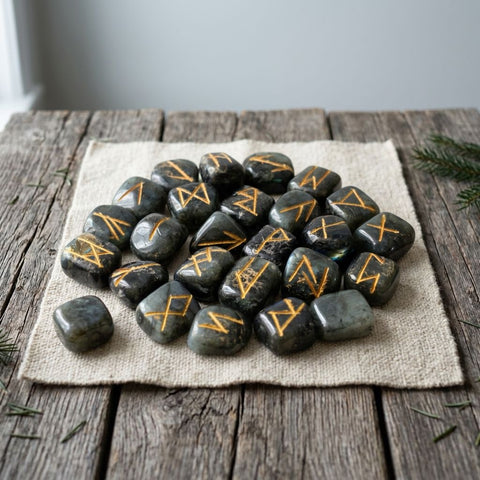 Labradorite runes: 25 dark grey stones with blue flash, engraved in gold
59,90 €
 Lapis lazuli runes: 25 royal blue stones engraved in gold
59,90 €
 Banded agate runes, 25 cream, amber and grey stones engraved in gold
29,90 €
 White agate runes: 25 porcelain white stones engraved in gold
29,90 €
 Moss agate runes: 25 grey-green stones engraved in gold
31,90 €