Ehwaz (ᛖ): meaning of the rune of the horse, trust and bond
Ehwaz, ᛖ, nineteenth rune of the Elder Futhark, named after the horse. Meaning of the name, the Anglo-Saxon poem, the role of the horse among the Germanic peoples and a modern reading.
Key points
| Rune | ᛖ (Ehwaz) |
|---|---|
| Phonetic value | e |
| Reconstructed name | *ehwaz (reconstructed) |
| Meaning of the name | horse |
| Family (aett) | Third, 3rd rune of the family |
| Position in the futhark | 19 of 24 |
| Reversed reading | Yes, used in modern readings |
Who is Ehwaz?
Ehwaz is written ᛖ: two vertical staves linked by two oblique strokes that meet in the middle, like an angular M. It is the nineteenth rune of the Elder Futhark and represents the sound e.
Its reconstructed name *ehwaz means “horse”. The Germanic peoples of ancient times depended on the horse for war, prestige and travel.
The rune's name and its meaning
The name *ehwaz is reconstructed from Old English eh and Gothic aíhwa-. It is related to Latin equus (horse): the same root is found in English “equestrian” and “equine”. The Scandinavian languages prefer other words, such as hestr or jór.
The Germanic peoples had a strong bond with the horse, which their proper names still reflect: the legendary chieftains Hengist and Horsa mean roughly “stallion” and “horse”. The god Odin rides an eight-legged horse, Sleipnir.
What the runic poems say
| Poem | What it says (summary) |
|---|---|
| Anglo-Saxon runic poem | The horse is the joy of nobles before warriors, proud on its hooves; it is also a comfort to the anxious. |
| Norwegian runic poem | No stanza: the e rune disappears from the Younger Futhark. |
| Icelandic runic poem | No stanza, for the same reason. |
The Anglo-Saxon poem stresses elegance and prestige, then the calm a horse brings: a double image that goes beyond usefulness.
Inscriptions and ancient uses
The e rune appears in the row of runes on the Kylver stone (around 400), in nineteenth position. It mainly serves to write the sound e in names.
In his Germania, around 98, the Roman historian Tacitus also describes a practice linked to the horse: in certain sacred groves white horses were kept, whose neighing and movements were observed by priests and chiefs, who regarded them as omens. This account by an outside author should be handled with caution, but it shows the symbolic place of the animal.
Ehwaz in a modern reading: upright
Reminder: rune casting is a modern practice. Here is how contemporary books read Ehwaz.
Upright, Ehwaz is associated with mutual trust, cooperation, partnership (a couple, a team, a duo) and steady progress. It suggests the idea that rider and horse move forward together, each adjusting to the other. Several authors make it a rune of loyalty.
In a spread, it may invite you to look at who is moving forward with you and how you coordinate. It does not announce an encounter: it proposes reflecting on the quality of a bond.
Reversed Ehwaz
Reversed, Ehwaz is read as an imbalance in a relationship: mistrust, mismatched rhythm, dependence, or difficulty committing. Other authors simply see in it the need to move forward alone for a while.
These are modern conventions. Keep them as starting points for a dialogue with yourself, or with the person concerned.
A reflection exercise with Ehwaz
Think of a working relationship or friendship in which you move forward in step with someone. Write down what you bring, what the other person brings, and what requires you to adjust.
Then propose a small shared activity to that person with no particular goal: a walk, a meal. Observe how you find your rhythm together.
Ehwaz's place in the futhark
Ehwaz is rune no. 19 of 24. It occupies position 3 in the third family (aett), sometimes called the Tyr family. It follows Berkano and precedes Mannaz.
Ehwaz follows Berkano. After the growing tree, the advancing horse: an easy transition to remember. The next rune, Mannaz, concerns the human being, the rider.
To see all the runes in relation to one another, see the rune guide and the page the Elder Futhark: history and reading of the 24 runes.
Frequently asked questions
What does Ehwaz mean?
The reconstructed name *ehwaz means “horse”. The rune stands for the sound e.
What is the link with Latin equus?
The two words come from a single Indo-European root that designates the horse.
Is Ehwaz the rune of the couple?
In modern use, it is readily read as cooperation and partnership, including romantic partnership. This is a symbolic reading.
What does reversed Ehwaz mean?
Modern authors see it as an imbalance in a relationship. It is a reading convention.
Also read
The meanings mentioned belong to tradition and symbolism. They are neither promises of results nor medical advice. Back to Guide to the runes.
In the shop
Runes: our products
 Tiger's eye runes: 25 honey and bronze stones engraved in gold
59,90 €
 Amethyst runes: 25 purple stones engraved in gold
29,90 €
 Rainbow moonstone runes: 25 milky stones engraved in gold
59,90 €
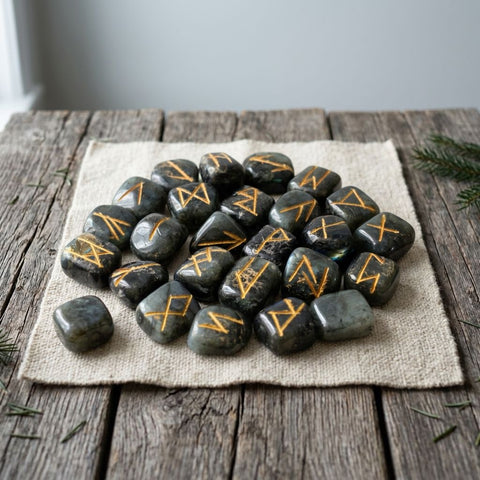 Labradorite runes: 25 dark grey stones with blue flash, engraved in gold
59,90 €
 Lapis lazuli runes: 25 royal blue stones engraved in gold
59,90 €
 Banded agate runes, 25 cream, amber and grey stones engraved in gold
29,90 €
 White agate runes: 25 porcelain white stones engraved in gold
29,90 €
 Moss agate runes: 25 grey-green stones engraved in gold
31,90 €