Raidho (ᚱ): meaning of the rune of travel and riding
Raidho, ᚱ, fifth rune of the Elder Futhark, owes its name to the idea of riding and travelling. Meaning of the name, rune poems and modern symbolic reading.
Key points
| Rune | ᚱ (Raidho) |
|---|---|
| Phonetic value | r |
| Reconstructed name | *raidō (reconstructed) |
| Meaning of the name | ride, journey |
| Family (aett) | First, 5th rune of the family |
| Position in the futhark | 5 of 24 |
| Reversed reading | Yes, practised in modern readings |
Who is Raidho?
Raidho is written ᚱ: a vertical stave, a triangular loop at the top and an oblique leg at the bottom, a bit like our letter R. It is the fifth rune of the Elder Futhark; it notes the sound r.
Its reconstructed name, *raidō, means "ride" or "journey on horseback". It is a rune of movement, which lends itself well to a modern reading built around the path, the stages and the rhythm.
If you have read the previous pages, you will notice that this time the name is an action verb rather than a being or an object.
The meaning of the rune's name
The name *raidō is reconstructed from Old English rād (riding) and Old Norse reið. It is related to familiar words in English and German: the English road comes from rād and originally meant the act of riding, and the German Reiten means to ride on horseback.
The word therefore applies to a movement with a direction, and to an animal that carries.
What the rune poems say
| Poem | What it says (summary) |
|---|---|
| Anglo-Saxon rune poem | Riding is easy for those who sit in the hall, but painful for the one who crosses long roads on a powerful horse. |
| Norwegian rune poem | Riding is said to be the worst thing for horses (according to translations). |
| Icelandic rune poem | Riding is the pleasure of the seated rider, a swift journey, and the toil of the horse. |
The three poems stress an interesting point: the same journey is not lived in the same way by the one who stays seated, the one who rides and the beast.
Inscriptions and ancient uses
The R rune exists from the first complete series, such as the Kylver stone (around 400), where it is in fifth position. It is used to write the sound r, very common in carved names and formulas.
In the Younger Futhark, the rune keeps its form and its name, reið. This is one of the most stable continuities in the whole series. No ancient inscription is known that presents it with certainty as a symbol of travel: this reading comes from the medieval poems and from modern authors.
Raidho in a modern reading: upright
Reminder: rune reading is a modern practice. The meanings that follow are those found in books of the 20th and 21st centuries, inspired by the name and by the poems.
Upright, Raidho is generally associated with travel, whether physical or symbolic: a change of place, a stage of life, a project that advances in steps. Several authors also read in it the idea of rhythm and order: one arrives when one takes the right road at the right pace.
In a reading, it may invite you to ask where you are going, with whom, and at what pace. It does not say that you will leave: it proposes that you look at your route.
Reversed Raidho
Reversed, Raidho is read as a troubled journey: delay, detour, a poorly chosen route, unnecessary movement or, on the contrary, refusal to set out. Some also see in it the idea of a relationship that no longer moves at the same pace.
These readings are conventions. They can simply serve to ask yourself: am I in a hurry for good reasons?
A reflection exercise with Raidho
Draw a straight line on a sheet of paper with a starting point, an end point and three intermediate stages. Give each stage a concrete name (a gesture, a date, a place). Find the most delicate one and note what could make it easier.
If you can, then go for a short walk, paying attention to your pace: too fast, too slow, or just right?
Raidho's place in the futhark
Raidho is rune no. 5 of 24. It occupies place 5 in the first family (aett), sometimes called the family of Freyr. It follows Ansuz and precedes Kenaz.
Raidho comes after Ansuz, speech: a common modern reading holds that one must first agree on what one wants before setting out. It is a simple way to remember their order, nothing more.
To place all the runes relative to one another, see the rune guide and the page The Elder Futhark: history and reading of the 24 runes.
Frequently asked questions
What does Raidho mean?
The reconstructed name *raidō means ride or journey on horseback. The rune notes the sound r.
Is Raidho the rune of travel?
It is the most common association in modern use, drawing on the meaning of the name and on the medieval poems.
Does Raidho announce a departure?
No: a rune reading announces nothing. It is a support for reflection on your own path.
What is the difference between Raidho and Ehwaz?
Raidho evokes the ride and the journey; Ehwaz evokes the horse itself and the relationship of trust with it.
Also read
The meanings mentioned belong to tradition and symbolism. They are neither promises of results nor medical advice. Back to Guide to the runes.
In the shop
Runes: our products
 Tiger's eye runes: 25 honey and bronze stones engraved in gold
59,90 €
 Amethyst runes: 25 purple stones engraved in gold
29,90 €
 Rainbow moonstone runes: 25 milky stones engraved in gold
59,90 €
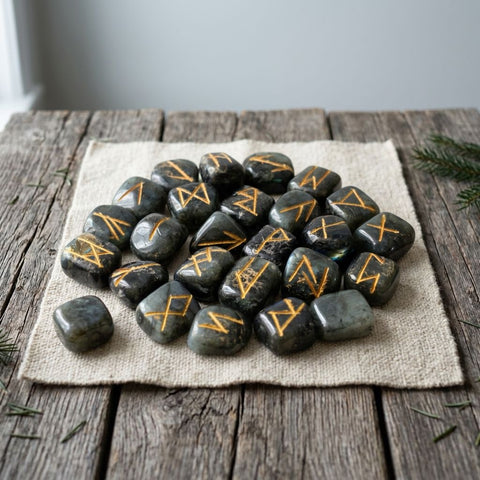 Labradorite runes: 25 dark grey stones with blue flash, engraved in gold
59,90 €
 Lapis lazuli runes: 25 royal blue stones engraved in gold
59,90 €
 Banded agate runes, 25 cream, amber and grey stones engraved in gold
29,90 €
 White agate runes: 25 porcelain white stones engraved in gold
29,90 €
 Moss agate runes: 25 grey-green stones engraved in gold
31,90 €