Ansuz (ᚨ): meaning of the rune of the god, speech and breath
Ansuz, ᚨ, fourth rune of the Elder Futhark, bears a name that refers to a god (one of the Æsir). History, rune poems, link with Odin and modern symbolic reading.
Key points
| Rune | ᚨ (Ansuz) |
|---|---|
| Phonetic value | a |
| Reconstructed name | *ansuz (reconstructed) |
| Meaning of the name | god (one of the Æsir) |
| Family (aett) | First, 4th rune of the family |
| Position in the futhark | 4 of 24 |
| Reversed reading | Yes, practised in modern readings |
Who is Ansuz?
Ansuz is written ᚨ: a vertical stave from which two parallel oblique strokes descend, like an arrow falling. It is the fourth rune of the Elder Futhark, and it notes the sound a.
Its reconstructed name *ansuz designates a god, more precisely one of the Æsir, the family of deities to which Odin, Thor or Týr belong in Norse mythology. It is therefore the first rune in the series whose name is explicitly religious.
For a present-day reader, it is readily associated with speech, breath and inspiration, because the sources that speak of it link it to Odin, god of runes and of poetry.
The meaning of the rune's name
The name *ansuz is reconstructed from Old Norse áss (plural æsir) and Old English ōs. In the Scandinavian languages, the word means "god"; in the Anglo-Saxon poem, it is read as the source of speech and wisdom, which suggests that the copyist monks understood ōs in the sense of Latin os, "mouth". This point is debated by specialists.
Another meaning appears in the Norwegian poem: óss there means "river mouth", a real word in Old Norse. There are thus three different readings of a single name: god, mouth, estuary. This shows how wary one should be of looking for a single meaning.
What the rune poems say
| Poem | What it says (summary) |
|---|---|
| Anglo-Saxon rune poem | The rune is the origin of all speech, a support for wisdom, a comfort to scholars and a hope for warriors. |
| Norwegian rune poem | According to translations: the mouth of a river is the route of most journeys, as a scabbard is for swords. |
| Icelandic rune poem | The god of the Æsir, formerly Gautr (a name of Odin), prince of Asgard and chief of Valhalla. |
The Icelandic poem is therefore the only one to link the rune directly to Odin.
Inscriptions and ancient uses
Ansuz is one of the runes for which a religious value is suspected from ancient times. On the Lindholm amulet, in Scania (Sweden), dated between the 2nd and 4th centuries, several commentators read sequences of runes including Ansuz and Tiwaz as an invocation of deities; but the inscription is short and its interpretation remains disputed.
In the medieval Icelandic text Hávamál, Odin is said to have hung from a tree for nine nights before seizing the runes and revealing them. It is this account that explains the modern link between Ansuz, Odin and knowledge, but it is much later than the first inscriptions.
Ansuz in a modern reading: upright
Reminder: rune readings are a modern practice, popularised in the 20th century. The reading of Ansuz below follows contemporary books and is not an ancient tradition.
Upright, Ansuz is often associated with communication: a message to receive or to pass on, a conversation, advice, a text, an inspiration. The idea of breath and of the poet-god contributes to this. Some authors also read in it the importance of right speech, the speech that names things.
In a reading, it may suggest an important discussion or a message you are putting off saying. It says nothing about what will be answered: it draws attention to speech itself.
Reversed Ansuz
Reversed, Ansuz is read as speech that goes astray: misunderstanding, idle chatter, a garbled communication, a message badly received. Some authors also see in it a wariness towards words that are too seductive.
These are modern conventions. Ask yourself instead: did I say clearly what I meant? Did I really listen?
A reflection exercise with Ansuz
Take ten minutes to write a letter to someone without sending it: what you would like to tell them, in your own words. Reread it aloud. Note what sounds true and what sounds false.
Then choose a simple sentence that you could actually say to that person, or to someone else, and decide when.
Ansuz's place in the futhark
Ansuz is rune no. 4 of 24. It occupies place 4 in the first family (aett), sometimes called the family of Freyr. It follows Thurisaz and precedes Raidho.
After the giant of Thurisaz, Ansuz introduces the god. In terms of names, the series thus moves from natural forces (livestock, aurochs, giant) to the divine figure, then with Raidho to travel. It is a sequence that is easy to remember, even if it is a modern reading.
To place all the runes relative to one another, see the rune guide and the page The Elder Futhark: history and reading of the 24 runes.
Frequently asked questions
What does Ansuz mean?
The reconstructed name *ansuz refers to a god of the Æsir family. The rune notes the sound a.
Is Ansuz the rune of Odin?
The Icelandic poem links it to Odin, and modern tradition readily makes it his rune. Ancient sources are less explicit.
Why is Ansuz associated with speech?
Because the Anglo-Saxon poem presents it as the origin of all speech, and because Odin is the god of poetry and of runes.
What does reversed Ansuz mean?
Modern authors see in it a misunderstanding or a garbled communication. It is a line of reflection, not a prediction.
Also read
The meanings mentioned belong to tradition and symbolism. They are neither promises of results nor medical advice. Back to Guide to the runes.
In the shop
Runes: our products
 Tiger's eye runes: 25 honey and bronze stones engraved in gold
59,90 €
 Amethyst runes: 25 purple stones engraved in gold
29,90 €
 Rainbow moonstone runes: 25 milky stones engraved in gold
59,90 €
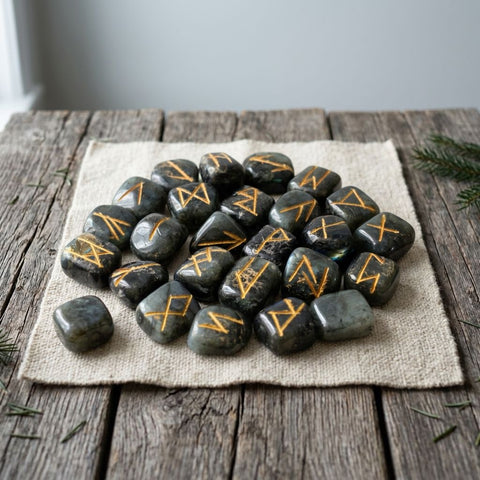 Labradorite runes: 25 dark grey stones with blue flash, engraved in gold
59,90 €
 Lapis lazuli runes: 25 royal blue stones engraved in gold
59,90 €
 Banded agate runes, 25 cream, amber and grey stones engraved in gold
29,90 €
 White agate runes: 25 porcelain white stones engraved in gold
29,90 €
 Moss agate runes: 25 grey-green stones engraved in gold
31,90 €