Thurisaz (ᚦ): meaning of the rune of the giant and the thorn
Thurisaz, ᚦ, notes the "th" sound in the Elder Futhark. Its reconstructed name refers to a giant; the Anglo-Saxon poem sees a thorn in it. History and readings.
Key points
| Rune | ᚦ (Thurisaz) |
|---|---|
| Phonetic value | þ (hard "th", as in English thin) |
| Reconstructed name | *þurisaz (reconstructed) |
| Meaning of the name | giant, fearsome being; in Old English: thorn |
| Family (aett) | First, 3rd rune of the family |
| Position in the futhark | 3 of 24 |
| Reversed reading | Yes, practised in modern readings |
Who is Thurisaz?
Thurisaz is written ᚦ: a vertical stave to which is attached a pointed triangle projecting to the right. It notes the sound þ, called "thorn" in English, pronounced like the "th" of thin. The same letter still exists in modern Icelandic.
It is the third rune of the Elder Futhark. Its reconstructed name, *þurisaz, designates a being from myth, a giant or a monster, in the Germanic languages. The shape (a point, a thorn) made it easy to link images to that name.
The meaning of the rune's name
The name *þurisaz is reconstructed from Old Norse þurs (giant, troll) and Old English þyrs; these are words for the hostile beings of the wild world. In Norse mythology, these giants, the jötnar, are at once the enemies of the gods and their neighbours, sometimes their kin or their friends, which makes the figure more subtle than simply "the villain".
In Old English, the rune is called þorn, that is, "thorn". Researchers think the Anglo-Saxon scribes renamed the rune after a more everyday word. This is a case where two traditions disagree on the meaning of the same sign.
What the rune poems say
| Poem | What it says (summary) |
|---|---|
| Anglo-Saxon rune poem | The thorn is very sharp, painful for any warrior to grasp, and harsh for whoever lies down among them. |
| Norwegian rune poem | The giant is the torment of women; very few people rejoice in misfortune. |
| Icelandic rune poem | The giant is the torment of women, the dweller of the cliffs, the husband of a giantess. |
The Scandinavian poems therefore see mainly a threatening being, the Anglo-Saxon poem a prickly plant. In both cases, the subject is a point that wounds.
Inscriptions and ancient uses
The rune appears in ancient inscriptions with the sound þ, mainly in the writing of names and common words; we do not know whether it was then also read for its name. In Anglo-Saxon England, it remained a true letter until the Middle Ages: it is found in manuscripts in Old English and, long afterwards, in certain Middle English texts. A distant legacy is visible: the abbreviation "ye" in old writing, often read as "the", is in fact a misunderstood þ.
In Icelandic, the letter þ has come down through the centuries to the present day, which makes it one of the rare runic signs still found in a modern alphabet.
Thurisaz in a modern reading: upright
Reminder: rune reading is a 20th-century practice. The meanings given below come from modern books, which draw freely on the medieval poems.
Upright, Thurisaz is most often associated with a force of rupture or defence: an obstacle, a limit to set, a sharp reaction. The image of the thorn invites one to think about what protects by pricking. The image of the giant evokes what is great, raw and hard to control.
In a reading, it invites you to look at what blocks, what irritates, what calls for a firm "no". It does not say the situation is dangerous: it proposes naming what resists.
Reversed Thurisaz
Reversed, Thurisaz is sometimes read as a poorly regulated defence: aggression that wounds without need, a conflict that lingers, a touchiness that flares up. Some authors see instead the moment to disarm.
These readings vary. Use them as a question: is my limit clear, or am I pricking everyone?
A reflection exercise with Thurisaz
Write two lists: what I want to protect and what annoys me at the moment. For each irritation, check whether it touches on a limit to be set. Formulate a calm and precise sentence that you could say or write.
If the subject is tense, do not deal with it alone through a rune reading: speak to the person concerned or to a trusted friend.
Thurisaz's place in the futhark
Thurisaz is rune no. 3 of 24. It occupies place 3 in the first family (aett), sometimes called the family of Freyr. It follows Uruz and precedes Ansuz.
Thurisaz closes a sequence of three runes that evoke wild nature: livestock (Fehu), the aurochs (Uruz), then the giant. The next rune, Ansuz, on the contrary introduces a god and speech, which makes a neat contrast that helps you remember what comes next.
To place all the runes relative to one another, see the rune guide and the page The Elder Futhark: history and reading of the 24 runes.
Frequently asked questions
What does Thurisaz mean?
The reconstructed name *þurisaz refers to a giant or a fearsome being. In Old English the rune is called "thorn", after the spiny plant.
How is the rune ᚦ pronounced?
Like the hard "th" of English thin. In Icelandic, the letter þ is pronounced in the same way.
Is Thurisaz a dangerous rune?
No. It is the name of a letter. Modern readings see in it a force of defence or rupture, to be examined calmly, without drawing any prediction from it.
Why does the letter þ still exist in Icelandic?
Because Icelandic kept a letter derived from the rune, whereas most languages abandoned it.
Also read
The meanings mentioned belong to tradition and symbolism. They are neither promises of results nor medical advice. Back to Guide to the runes.
In the shop
Runes: our products
 Tiger's eye runes: 25 honey and bronze stones engraved in gold
59,90 €
 Amethyst runes: 25 purple stones engraved in gold
29,90 €
 Rainbow moonstone runes: 25 milky stones engraved in gold
59,90 €
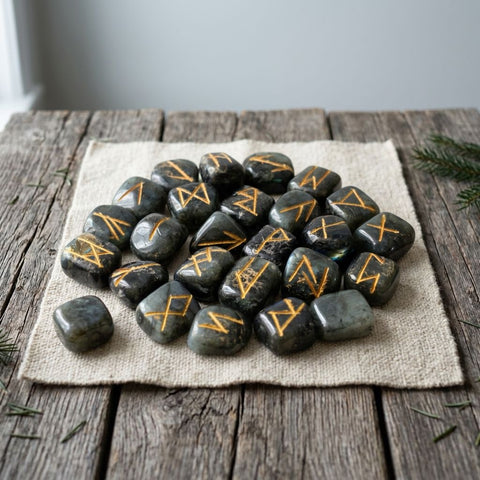 Labradorite runes: 25 dark grey stones with blue flash, engraved in gold
59,90 €
 Lapis lazuli runes: 25 royal blue stones engraved in gold
59,90 €
 Banded agate runes, 25 cream, amber and grey stones engraved in gold
29,90 €
 White agate runes: 25 porcelain white stones engraved in gold
29,90 €
 Moss agate runes: 25 grey-green stones engraved in gold
31,90 €