Uruz (ᚢ): meaning of the rune of the aurochs and of strength
Uruz, ᚢ, is the second rune of the Elder Futhark. Its name evokes the aurochs, a large wild bovine that has since disappeared. Historical sources and symbolic reading.
Key points
| Rune | ᚢ (Uruz) |
|---|---|
| Phonetic value | u |
| Reconstructed name | *ūruz (reconstructed) |
| Meaning of the name | aurochs, wild bovine |
| Family (aett) | First, 2nd rune of the family |
| Position in the futhark | 2 of 24 |
| Reversed reading | Yes, practised in modern readings |
Who is Uruz?
Uruz is written ᚢ: a vertical stave joined to a second, shorter and slanted branch, giving a form close to a large "n" or to a bow. It is the second rune of the Elder Futhark, and it notes the sound u.
Its reconstructed name, *ūruz, designates the aurochs, an immense wild bovine. The rune is therefore, originally, a word of nature and of the hunt, long before it became a symbol of divination.
Like all runes, it is both a letter (a sound) and a name (a word). Modern readers use this name to read it as a symbol, but it is worth remembering that its primary function is to write.
The meaning of the rune's name
The name *ūruz is reconstructed: it is deduced from Old English ūr (aurochs), from Old Norse úr and from other medieval forms. The aurochs (Bos primigenius) was the wild ancestor of our domestic cattle. Julius Caesar describes it in the Gallic War as an animal barely smaller than an elephant, an exaggeration, but one that conveys the impression it made.
The species died out in the 17th century: the last known female died in 1627, in a forest in Poland. For a present-day reader, the rune therefore evokes an animal that no one has ever seen alive.
Beware of a false friend: in Old Norse, the word úr took on other meanings, such as drizzle or iron slag. This shift explains why the Scandinavian poems no longer speak of the aurochs.
What the rune poems say
The poems do not agree with one another, which is instructive: the name was preserved, but not always its meaning.
| Poem | What it says (summary) |
|---|---|
| Anglo-Saxon rune poem | The aurochs is a fierce animal with high horns, which fights bravely and haunts the moors. |
| Norwegian rune poem | According to translations, it refers either to slag from poor iron or to drizzle, with the image of a reindeer running on hardened snow. |
| Icelandic rune poem | It refers to fine rain or sleet, which spoils the hay and irritates shepherds. |
The Anglo-Saxon poem is therefore the only one that remains faithful to the animal.
Inscriptions and ancient uses
Uruz is among the very first signs of the series: it appears on the Kylver stone (around 400) in second position, and on the Hole stone (Norway), which bears at least the first runes of the series and whose dating remains much debated.
The rune is mainly used as a letter in proper names and formulas. Later it remains in the Younger Futhark under the name úr, which shows a continuity of the sign more than of its meaning.
Uruz in a modern reading: upright
Reminder: reading runes is a modern habit, born in the 20th century, which draws on medieval names and on the imagination of contemporary authors. It is not a technique handed down from antiquity.
Upright, Uruz is often associated in modern books with vigour, endurance and the will to set oneself in motion. The aurochs serves as an image: raw power, far from domestic comfort. Several authors also read in it a transition, a phase in which one leaves one state for another, which can be trying.
In a reading, it can serve as a reminder: what energy do I still have at my disposal, and where should I put it? It does not promise success: it invites you to look honestly at your strengths and your limits.
Reversed Uruz
Reversed, Uruz is often read as an energy that is scattering, exhaustion, impatience, or a strength turned against oneself. Some authors also see in it a lack of grip on a situation.
As with all runes, these interpretations are modern conventions. Use them as questions: am I forcing things? Do I need to rest before setting out again?
A reflection exercise with Uruz
Choose an activity that demands steady effort (a sport, a course of learning, a project). Note in a few lines: what gave me momentum this week, what wore me out, what I could lighten.
Then go for a fifteen-minute walk, without headphones, observing an animal or a tree. Come back and write one sentence on what the idea of "wild strength" evokes for you, without looking for the right answer.
Uruz's place in the futhark
Uruz is rune no. 2 of 24. It occupies place 2 in the first family (aett), sometimes called the family of Freyr. It follows Fehu and precedes Thurisaz.
Uruz follows Fehu, the domestic livestock, and the contrast is striking: after the herd that one owns, the wild bovine that one does not own. This is a modern reading, but it helps you remember the two runes.
To place all the runes relative to one another, see the rune guide and the page The Elder Futhark: history and reading of the 24 runes.
Frequently asked questions
What does Uruz mean?
The reconstructed name *ūruz refers to the aurochs, a large wild bovine that disappeared in the 17th century. The rune notes the sound u.
Why the aurochs and not the ox?
Because the Old English ūr and the Old Norse úr come from a word that designated the wild ancestor of our cattle, not the domestic animal.
Is Uruz a rune of strength?
It is the most common modern reading, drawing on the image of the aurochs. Yet the medieval Scandinavian poems speak of drizzle or slag.
How do you read reversed Uruz?
Many authors see scattered energy or a need for rest. These are modern conventions, with no predictive value.
Also read
The meanings mentioned belong to tradition and symbolism. They are neither promises of results nor medical advice. Back to Guide to the runes.
In the shop
Runes: our products
 Tiger's eye runes: 25 honey and bronze stones engraved in gold
59,90 €
 Amethyst runes: 25 purple stones engraved in gold
29,90 €
 Rainbow moonstone runes: 25 milky stones engraved in gold
59,90 €
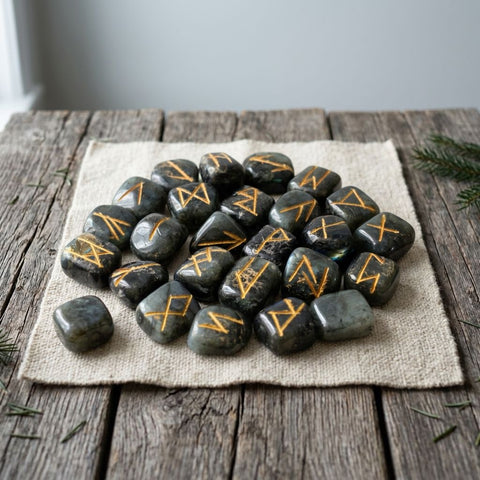 Labradorite runes: 25 dark grey stones with blue flash, engraved in gold
59,90 €
 Lapis lazuli runes: 25 royal blue stones engraved in gold
59,90 €
 Banded agate runes, 25 cream, amber and grey stones engraved in gold
29,90 €
 White agate runes: 25 porcelain white stones engraved in gold
29,90 €
 Moss agate runes: 25 grey-green stones engraved in gold
31,90 €