Fehu (ᚠ): meaning of the first rune of the Elder Futhark
Fehu, ᚠ, opens the Elder Futhark. Its reconstructed name refers to livestock, and so to movable wealth. History, rune poems and modern symbolic reading.
Key points
| Rune | ᚠ (Fehu) |
|---|---|
| Phonetic value | f |
| Reconstructed name | *fehu (reconstructed) |
| Meaning of the name | livestock, movable property, wealth |
| Family (aett) | First, 1st rune of the family |
| Position in the futhark | 1 of 24 |
| Reversed reading | Yes, practised in modern readings |
Who is Fehu?
Fehu is written ᚠ: a vertical stave from which two oblique branches rise upward, a bit like an outstretched arm carrying two horns. It is the first rune of the Elder Futhark, the runic alphabet used by the Germanic peoples roughly between the 2nd and 8th centuries. It notes the sound f, and it is from its name, joined to those of the five that follow, that the word "futhark" is formed (f, u, þ, a, r, k).
In the modern way of presenting the 24 runes, Fehu opens the first family, or aett, which has eight runes. This family is sometimes called the "family of Freyr", but that name is a recent convention: we do not know how the Germanic peoples of antiquity named these groups.
Its name is one of the best-attested in the whole series: the same words appear in several ancient Germanic languages.
The meaning of the rune's name
The name *fehu is a reconstructed form in Proto-Germanic, the common language assumed to have been spoken by the Germanic peoples before they separated. The asterisk signals that no text from that period writes it: linguists deduced it by comparing later names, feoh in Old English, fé in Old Norse, faihu in Gothic. All of them mean roughly "livestock" and then, by extension, "property, wealth".
This shift in meaning is not exotic. In a herding society, animals are the wealth that can be moved, lent, given or counted. Latin shows the same path: pecus, the herd, gave pecunia, money. German Vieh (livestock) and English fee (payment, charge) belong to the same word family as Fehu.
What the rune poems say
Three medieval poems comment on the name of the rune, each in a few lines. They are much later than the first inscriptions: they are read as late testimonies on how the names were understood, not as ancient instructions for use.
| Poem | What it says (summary) |
|---|---|
| Anglo-Saxon rune poem | Wealth brings comfort to everyone, but it must be shared generously to earn the esteem of one's lord. |
| Norwegian rune poem | Wealth is a source of quarrels between relatives. |
| Icelandic rune poem | The same idea of quarrels between kin, followed by poetic images in which gold is compared to a fire of the sea. |
Note that the tone is rather ambivalent: wealth consoles, but it also divides. Medieval poets did not make it a simple lucky charm.
Inscriptions and ancient uses
Fehu opens the oldest complete runic alphabet known, carved on the Kylver stone on the island of Gotland (Sweden), around 400. It is read there at the head of a series of 24 signs, which shows that the rune has always been the first of the series in that order.
Ancient inscriptions are short (personal names, marks on objects, formulas), and the rune mainly serves there to write the sound f. When it is used alone, we cannot claim that it refers to its name.
Fehu in a modern reading: upright
A useful reminder: rune readings are a modern practice, popularised in the 20th century. Nothing proves that the Germanic peoples of antiquity consulted runes this way. What follows is therefore a contemporary symbolic reading, to be taken as an aid to reflection.
In modern books on runes, upright Fehu is associated with resources and their circulation: money, of course, but also time, energy, skills and the bonds we maintain. Several authors read in it an invitation to look at what we own, to make it grow with care and to share it, which echoes the advice of the Anglo-Saxon poem.
In a reading, it may suggest a project beginning or an exchange of services. It says nothing about the future: it proposes a theme for reflection.
Reversed Fehu
Fehu can be read upside down, that is, with the branches turned downward. Readings vary from author to author, and none is "official". The most common themes are caution about spending, fear of lack, excessive attachment to possessions, a resource misused, or an unbalanced exchange.
Possible questions: what do I hold on to that would benefit from circulating? What do I spend without thinking?
A reflection exercise with Fehu
Take a sheet of paper and draw three columns: what I have, what I pass on, what I keep without using. Fill them in thinking broadly: objects, free time, know-how, relationships.
Then choose a line from the third column and decide on one simple, concrete gesture: give it away, lend it, show someone how to use it, or put it back into circulation. Reread the Anglo-Saxon poem in the light of your list: where, for you, is the wealth that is shared?
Fehu's place in the futhark
Fehu is rune no. 1 of 24. It occupies place 1 in the first family (aett), sometimes called the family of Freyr. It opens the series and precedes Uruz.
Fehu is the only rune whose name speaks of having: the following ones speak of strength (Uruz), of threat (Thurisaz), of speech (Ansuz). Modern authors like to see a starting point in this, but the ancient tradition says nothing of the kind: it is simply the first letter.
To place all the runes relative to one another, see the rune guide and the page The Elder Futhark: history and reading of the 24 runes.
Frequently asked questions
What does the rune Fehu mean?
Its reconstructed Proto-Germanic name, *fehu, means "livestock", then "property, wealth". It is the first rune of the Elder Futhark, and it notes the sound f.
Is Fehu a rune of money?
In modern divinatory use, it is often linked to material resources. But the medieval poems are ambiguous: wealth both consoles and divides. It is no guarantee of prosperity.
How is Fehu pronounced?
Roughly "fay-hoo". The final h is a reconstruction; in Old Norse the name became fé.
What does reversed Fehu mean?
According to modern authors, it suggests caution, fear of lack, or an unbalanced exchange. It is a line of reflection, not a prediction.
Is Fehu the first rune of every runic alphabet?
It opens the Elder Futhark (24 runes) and the Younger Futhark (16 runes). Only ancient inscriptions, such as the Kylver stone, show the complete order.
Also read
The meanings mentioned belong to tradition and symbolism. They are neither promises of results nor medical advice. Back to Guide to the runes.
In the shop
Runes: our products
 Tiger's eye runes: 25 honey and bronze stones engraved in gold
59,90 €
 Amethyst runes: 25 purple stones engraved in gold
29,90 €
 Rainbow moonstone runes: 25 milky stones engraved in gold
59,90 €
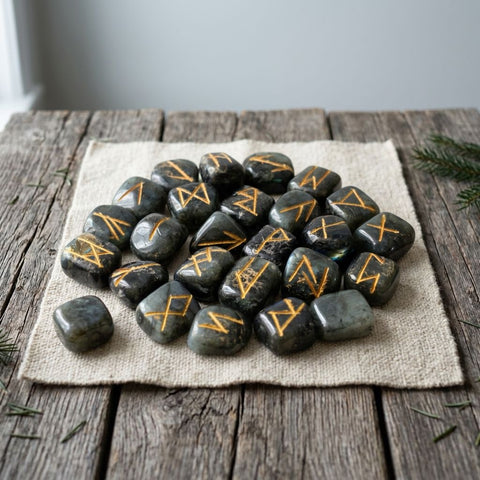 Labradorite runes: 25 dark grey stones with blue flash, engraved in gold
59,90 €
 Lapis lazuli runes: 25 royal blue stones engraved in gold
59,90 €
 Banded agate runes, 25 cream, amber and grey stones engraved in gold
29,90 €
 White agate runes: 25 porcelain white stones engraved in gold
29,90 €
 Moss agate runes: 25 grey-green stones engraved in gold
31,90 €