Rune casting for beginners: a simple method with one or three runes
Rune casting is a modern practice of reflection. Choose your set, ask a question, draw one or three runes, read them upright or reversed, and keep a journal.
Key points
| Nature | Modern practice of reflection, popularised in the 20th century |
|---|---|
| Materials | A set of 24 runes (sometimes 25 with a blank rune) and a bag or cloth |
| Simplest casting | One rune, for a reflection of the day |
| Classic casting | Three runes: situation, obstacle, advice |
| Reversed reading | Optional; 9 runes out of 24 are symmetrical |
| What casting does not do | Predict the future or replace medical, legal or financial advice |
What a rune casting is (and is not)
A rune casting consists of drawing one or more runes at random from a bag, then reading them as symbols, in connection with a personal question. It is a modern practice, popular since the 20th century, notably since The Book of Runes by Ralph Blum (1982). The ancient Germanic peoples wrote in runes; nothing proves that they cast them this way.
The only ancient text that describes a lot-casting is that of Tacitus, around 98: marked twigs thrown onto a white cloth. He does not say that these were runes. A current casting is therefore a tool for reflection, in the same way as other symbolic games: see the guide to choosing a tarot or oracle deck to compare.
Getting or making a set
A set includes 24 pieces, one for each rune of the Elder Futhark. Some sets add a 25th blank piece, the "blank rune", invented by Ralph Blum: it does not exist in the history of runes, and you may set it aside. The pieces are made of wood, stone, glass, resin or clay. You will find some in the runes section of the shop.
You can also make your own set: slices of branch, flat pebbles, thick cardboard squares. Paint or carve the shapes, check them against the pages of this guide, and keep everything in a fabric pouch. Making them yourself helps you remember their forms.
Preparing your question
The quality of the question matters more than the ritual. Prefer open questions that begin with "how", "what" or "what can I understand about..." to closed yes-or-no questions. For example: "What is holding me back in this project?" rather than "Will I succeed?".
Avoid questions about health, a treatment, a legal decision or an investment of money: a casting has no competence in these areas and never replaces a professional. Also avoid questions about the precise intentions of another person.
Three simple castings
Settle in a quiet place, mix the runes in the pouch, breathe, phrase your question, then draw without looking.
| Casting | How many runes | How to read it |
|---|---|---|
| The rune of the day | 1 | It serves as a theme for reflection for the day; in the evening, note what it brought to mind. |
| Situation, obstacle, advice | 3 | First rune: where I am. Second: what holds me back. Third: a path to explore. |
| Past, present, possible path | 3 | Inspired by the three Norns of Norse mythology (Urd, Verdandi, Skuld), who weave fate in medieval accounts. Here it is simply an image: three stages of a path. |
For a first time, start with the rune of the day for a week. This way you will learn your own associations before moving on to three-rune castings.
Reading upright, reading reversed
If you draw the runes face down, some appear upside down. Some authors then read them differently, with a more nuanced or more difficult meaning. It is optional: you may perfectly well ignore the position and read all the runes in the same direction.
Nine runes are symmetrical and therefore have no reversed reading: ᚷ Gebo, ᚺ Hagalaz, ᚾ Nauthiz, ᛁ Isa, ᛃ Jera, ᛇ Eihwaz, ᛊ Sowilo, ᛜ Ingwaz and ᛞ Dagaz. On each page, you will find the common modern readings, presented as conventions.
A step-by-step reading example
Here is an invented example, to show the approach. Question: "How should I approach the job change that awaits me?". For the \"situation, obstacle, advice\" casting: ᛃ Jera, ᚾ Nauthiz, ᛒ Berkano.
The first rune evokes a cycle that is ending and a necessary patience. The second recalls a real constraint, perhaps a lack of time or preparation. The third suggests taking care of what is beginning. None of these readings predicts anything: they offer a thread of reflection, for example "what do I really need in order to start?", and only you know which answer is right.
Keeping a journal
Note the date, the question, the runes drawn and your impressions before consulting a book. Reread three weeks later: you will see what the casting brought to light, and what was only projection. This habit protects you from the temptation of believing that "it worked" by keeping only the coincidences.
Limit the frequency: one casting a day at most, once a week is more than enough. Asking the same question ten times until you get the expected answer brings nothing.
Common mistakes
- Looking for certainty where there is only a theme for reflection.
- Taking a "negative" rune for an announced misfortune: no rune announces anything.
- Using a casting for a serious decision without consulting those whose profession it is (doctor, lawyer, financial adviser).
- Feeling obliged to have a complicated ritual: a clear question and a calm moment are enough.
- Buying contradictory books and believing one of them holds the truth: they do not agree, which is normal.
Frequently asked questions
Is a special ritual needed to cast runes?
No. A calm place, a clear question and a few breaths are enough. More elaborate rituals are personal choices.
Can runes predict the future?
No. It is a tool for symbolic reflection. No evidence supports any ability to predict.
How many runes should I draw to start?
One only, for a week, then three runes for a situation casting.
Can I cast runes for someone else?
You can cast them together, starting from a question the person formulates themselves. Avoid making pronouncements about their life.
Do I need to learn the meaning of every rune by heart?
No. Start with a few runes, use the pages of this guide, and keep a journal of your own associations.
Also read
The meanings mentioned belong to tradition and symbolism. They are neither promises of results nor medical advice. Back to Guide to the runes.
In the shop
Runes: our products
 Tiger's eye runes: 25 honey and bronze stones engraved in gold
59,90 €
 Amethyst runes: 25 purple stones engraved in gold
29,90 €
 Rainbow moonstone runes: 25 milky stones engraved in gold
59,90 €
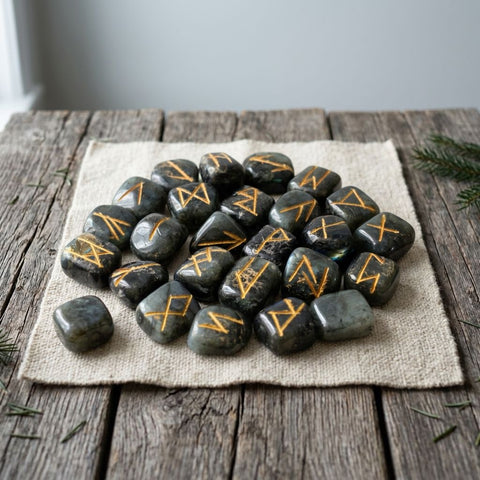 Labradorite runes: 25 dark grey stones with blue flash, engraved in gold
59,90 €
 Lapis lazuli runes: 25 royal blue stones engraved in gold
59,90 €
 Banded agate runes, 25 cream, amber and grey stones engraved in gold
29,90 €
 White agate runes: 25 porcelain white stones engraved in gold
29,90 €
 Moss agate runes: 25 grey-green stones engraved in gold
31,90 €