Jera (ᛃ): meaning of the rune of the year and the good harvest
Jera, ᛃ, the twelfth rune of the Elder Futhark, means the year and, by extension, a good harvest. Meaning of the name, runic poems and modern symbolic reading.
Key points
| Rune | ᛃ (Jera) |
|---|---|
| Phonetic value | j (like the “y” in “yes”) |
| Reconstructed name | *jēran (reconstructed) |
| Meaning of the name | year, good harvest |
| Family (aett) | Second, 4th rune of the family |
| Position in the futhark | 12 of 24 |
| Reversed reading | No: the rune is symmetrical |
Who is Jera?
Jera is written ᛃ: two hooks that interlock, one turned to the left and the other to the right, like two sickles locked together. It is the twelfth rune of the Elder Futhark and notes the sound j, pronounced like the “y” in “yes”.
Its reconstructed name *jēran means “year” and, more precisely, “year of good harvest”. It is the rune of agricultural cycles and of the passing of time.
The name of the rune and its meaning
The name *jēran is reconstructed from Old English gēr, Old Norse ár and Gothic jēr. It is related to English year and German Jahr. It is also a cousin of the Greek hōra (season, hour).
In the farming world, “the year” is above all the cycle of sowing and harvesting; a good year is a year of abundant harvest. Hence the double meaning: duration and fruit.
What the runic poems say
| Poem | What it says (summary) |
|---|---|
| Anglo-Saxon runic poem | The harvest is people’s hope, when God lets the earth give its bright fruits to rich and poor alike. |
| Norwegian runic poem | Abundance is a blessing for people; the poem cites the legendary king Frodi, renowned for his generosity. |
| Icelandic runic poem | Abundance is a blessing for people, a fine summer, well-stocked fields. |
The Anglo-Saxon poem, written in a Christian milieu, attributes the harvest to God; the Scandinavian poems speak rather of good fortune.
Inscriptions and ancient uses
The rune appears in the Kylver Stone series (around 400), in twelfth position. It was used to write the sound j, which is fairly rare in inscriptions.
In the Younger Futhark, this rune disappears in this form, but the name ár is taken up for another rune, of a different shape (ᛅ), which notes the sound a. It is an interesting case of a name kept while the form changed.
Jera in a modern reading: upright
A reminder: rune casting is a modern practice. Here is the most frequent reading in today’s books.
Upright, Jera is read as the rune of the cycle and of patience: what was sown is harvested in its own time. Authors often see in it the reward of steady effort, the maturing of a project, a natural rhythm that cannot be hurried.
In a spread, it can invite you to look at the long term: where are you in the cycle? It announces no result: it reminds you that some things require seasons.
A rune with no reversal
Jera is symmetrical by rotation: if you turn it half a turn, it keeps the same form. There is therefore no reversed reading.
Some authors draw an image from this: the cycle returns upon itself. One way to use this symmetry is to read it as a back-and-forth between sowing and harvesting.
A reflection exercise with Jera
Take a calendar and divide your year into four seasons. For each one, note what you have sown (a habit, an encounter, a learning) and what has begun to bear fruit.
Choose a single thing to sow for the coming season, and set a date on which you will look at it again.
Jera’s place in the futhark
Jera is rune no. 12 of 24. It occupies place 4 in the second family (aett), sometimes called the family of Hagal. It follows Isa and precedes Eihwaz.
Jera holds the twelfth place of 24: it therefore sits at the exact midpoint of the futhark. In a modern reading, after the cold of Hagalaz, Nauthiz and Isa, it is the season turning.
To see all the runes in relation to one another, consult the rune guide and the page the Elder Futhark: history and reading of the 24 runes.
Frequently asked questions
What does Jera mean?
The reconstructed name *jēran means “year” or “good harvest”. The rune notes the sound j.
What is the link with the English word year?
Year comes from the same Germanic root as the name of the rune.
Can Jera be reversed?
No: its form is symmetrical by rotation.
Why does the name ár reappear in the Younger Futhark?
Because the name was given to another rune, of a different shape, which notes the sound a.
Also read
The meanings mentioned belong to tradition and symbolism. They are neither promises of results nor medical advice. Back to Guide to the runes.
In the shop
Runes: our products
 Tiger's eye runes: 25 honey and bronze stones engraved in gold
59,90 €
 Amethyst runes: 25 purple stones engraved in gold
29,90 €
 Rainbow moonstone runes: 25 milky stones engraved in gold
59,90 €
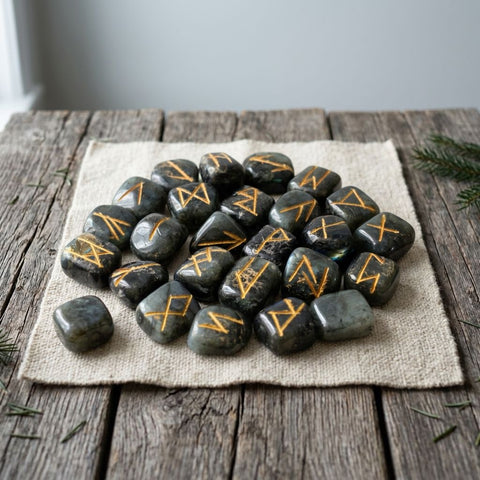 Labradorite runes: 25 dark grey stones with blue flash, engraved in gold
59,90 €
 Lapis lazuli runes: 25 royal blue stones engraved in gold
59,90 €
 Banded agate runes, 25 cream, amber and grey stones engraved in gold
29,90 €
 White agate runes: 25 porcelain white stones engraved in gold
29,90 €
 Moss agate runes: 25 grey-green stones engraved in gold
31,90 €