Eihwaz (ᛇ): meaning of the yew rune, endurance and connection
Eihwaz, ᛇ, the thirteenth rune of the Elder Futhark, is named after the yew. Its phonetic value remains debated. Runic poems, the yew in history and modern reading.
Key points
| Rune | ᛇ (Eihwaz) |
|---|---|
| Phonetic value | ï (value debated: vowel or consonant according to specialists) |
| Reconstructed name | *īhaz or *īwaz (reconstructed) |
| Meaning of the name | yew (tree) |
| Family (aett) | Second, 5th rune of the family |
| Position in the futhark | 13 of 24 |
| Reversed reading | No: the rune is symmetrical |
Who is Eihwaz?
Eihwaz is written ᛇ: a vertical stave with a hook pointing up to the right and a hook pointing down to the left, like a double fishhook. It is the thirteenth rune of the Elder Futhark.
Its reconstructed name *īhaz or *īwaz (the spelling “eihwaz” blends the two) refers to the yew, a conifer with dark foliage that can live for several centuries. Its phonetic value, however, is uncertain: it is conventionally noted ï, but this choice is arbitrary.
The name of the rune and its meaning
Specialists propose several possible pronunciations for this rune: a long vowel close to an open “e”, a central vowel, a consonant sound close to the German “ch” in ich, or even a group of two sounds. It is therefore honest to say that we do not know exactly how it was read.
The name, on the other hand, is better established: Old English ēoh designates the yew, and the Scandinavian rune ýr takes up this name. Among Germanic tree names, the yew holds a special place, because its wood is both hard and elastic.
What the runic poems say
| Poem | What it says (summary) |
|---|---|
| Anglo-Saxon runic poem | The yew is a tree rough on the outside, hard, firmly rooted in the earth, keeper of fire and joy of the estate. |
| Norwegian runic poem | The yew is the greenest of trees in winter; when it burns, it crackles (rune named ýr in the Younger Futhark). |
| Icelandic runic poem | The yew is a tensed bow, a fragile iron, the giant of the arrow. |
The images of fire, bow and evergreen green show that the yew was known for its practical uses as much as for its longevity.
Inscriptions and ancient uses
The yew played an important role in the history of weapons and tools: the bow of the Iceman (Ötzi, around 3300 BCE) was made of yew, and the medieval longbow was for a long time made of it too. This reputation is no doubt the source of the image in the Icelandic poem.
In inscriptions, the rune is rare and its exact function remains debated. It appears in complete series, such as the Kylver Stone (around 400), but we do not always know which sound it noted in texts.
A word of caution, outside the runes: the yew is a poisonous plant in almost all its parts (the needles and seeds especially). Do not use it for objects that go in the mouth, and keep it away from children and animals.
Eihwaz in a modern reading: upright
A reminder: rune casting is a modern practice. Here is how contemporary books read Eihwaz.
Eihwaz is associated with endurance, resistance over time, and persistence through the seasons. Some authors also see in it a link between what is below (the roots) and what is above, or between life and death, because the yew is a cemetery tree in many European cultures.
In the Nordic world, the cosmic tree Yggdrasil is an ash tree according to medieval texts; some modern authors nonetheless link it with the yew, which is a personal reading. In a spread, Eihwaz can simply ask the question: what holds in you, despite everything?
A rune with no reversal
Eihwaz is symmetrical by rotation: turned half a turn, it keeps the same form. It is therefore not read reversed.
Some authors retain the image of the tree that connects top and bottom: the reversal is already built into the form. You can use this as a way to ask yourself what is anchored and what rises.
A reflection exercise with Eihwaz
Look for an old tree near your home (a yew in a cemetery or a park, or any other tree). Observe its bark, its roots, its shape. Note what it must have gone through to still be standing: storms, pruning, seasons.
Then write down three things that helped you hold on during difficult periods. What is your own “root”?
Eihwaz’s place in the futhark
Eihwaz is rune no. 13 of 24. It occupies place 5 in the second family (aett), sometimes called the family of Hagal. It follows Jera and precedes Perthro.
Eihwaz sits just after the midpoint of the futhark (13th place of 24). It has a special status in the futhark: its pronunciation is uncertain and its form is closer to a symbol than to a letter. The sources do not allow us to say more.
To see all the runes in relation to one another, consult the rune guide and the page the Elder Futhark: history and reading of the 24 runes.
Frequently asked questions
What does Eihwaz mean?
The reconstructed name designates the yew, a tree with hard wood and evergreen foliage. The phonetic value of the rune is debated.
How is Eihwaz pronounced?
By convention, the name is read “EI-hwaz”. As for the sound the rune noted, several hypotheses coexist.
Is Eihwaz linked to Yggdrasil?
Medieval texts describe Yggdrasil as an ash tree. The link with the yew is a proposal by modern authors.
Is the yew dangerous?
Yes: almost all of its parts are toxic. It must be kept out of reach of children and animals.
Also read
The meanings mentioned belong to tradition and symbolism. They are neither promises of results nor medical advice. Back to Guide to the runes.
In the shop
Runes: our products
 Tiger's eye runes: 25 honey and bronze stones engraved in gold
59,90 €
 Amethyst runes: 25 purple stones engraved in gold
29,90 €
 Rainbow moonstone runes: 25 milky stones engraved in gold
59,90 €
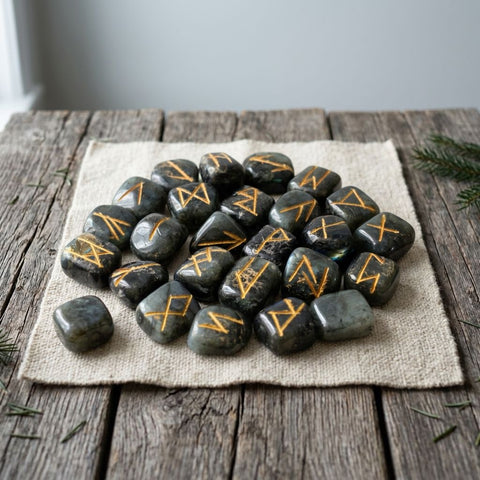 Labradorite runes: 25 dark grey stones with blue flash, engraved in gold
59,90 €
 Lapis lazuli runes: 25 royal blue stones engraved in gold
59,90 €
 Banded agate runes, 25 cream, amber and grey stones engraved in gold
29,90 €
 White agate runes: 25 porcelain white stones engraved in gold
29,90 €
 Moss agate runes: 25 grey-green stones engraved in gold
31,90 €