Perthro (ᛈ): meaning of the rune whose name remains a mystery
Perthro, ᛈ, the fourteenth rune of the Elder Futhark, is the most enigmatic: its original name is unknown. Hypotheses, the Anglo-Saxon poem and modern reading.
Key points
| Rune | ᛈ (Perthro) |
|---|---|
| Phonetic value | p |
| Reconstructed name | *perþō (reconstructed, meaning unknown) |
| Meaning of the name | unknown; hypotheses: pear tree, game |
| Family (aett) | Second, 6th rune of the family |
| Position in the futhark | 14 of 24 |
| Reversed reading | Yes, used in modern readings |
Who is Perthro?
Perthro is written ᛈ: a vertical stave to which two hooks are attached on the right, like an open cup or an overturned pot. It is the fourteenth rune of the Elder Futhark; it notes the sound p.
Its original name is unknown. The form *perþō is a phonetic reconstruction, with no certain meaning. It is the rune for which honesty calls for the most caution.
The name of the rune and its meaning
The only attested name is Old English peorð, known only from the runic poem, and its meaning is uncertain. Gothic has a letter name, pairþra, which linguists sometimes relate to *perþō. Hence the hypothesis of a name linked to a fruit tree (pear tree), because the Gothic word resembles the root of “pear”.
Other proposals exist: a dice cup, a board game, a musical instrument. None is proven. The sound p was rare in Proto-Germanic, which complicates the search for a name beginning with it.
What the runic poems say
| Poem | What it says (summary) |
|---|---|
| Anglo-Saxon runic poem | Peorð is a constant source of play and laughter for proud men, when they sit together in the mead hall. |
| Norwegian runic poem | No stanza: the rune p is absent from the Younger Futhark. |
| Icelandic runic poem | No stanza, for the same reason. |
The Anglo-Saxon poem is the only source, and its unique manuscript burned in 1731: we depend on a transcription from 1705, which may contain errors.
Inscriptions and ancient uses
The rune appears in the Kylver Stone series (around 400), in fourteenth position, but it is rare in texts. Its first clear use in actual written language is late: it is found on Anglo-Saxon coins of Kent, around 700.
This rarity is explained by the low frequency of the sound p in the original language. Some researchers think the rune is a variant of the rune for b.
Perthro in a modern reading: upright
A reminder: rune casting is a modern practice. Readings of Perthro are all the freer because its name is unknown: each author brings in their own hypothesis.
The most common one sees in the form a dice cup and reads the rune as that of chance, mystery, what is hidden or not yet known. Others, drawing on the Anglo-Saxon poem, read in it play and life in common. Still others see a secret that one keeps or shares.
In a spread, it can simply ask the question: what do I not yet know? It announces no surprise: it invites you to accept a part of the unknown.
Perthro reversed
Reversed, the cup empties: in modern readings, this is seen as a secret coming out, a risk taken without thinking, a chance slipping away, or a fear of the unforeseen. Others read it rather as the relief of letting go.
None of these readings is ancient. Keep above all the idea that the rune is open: it invites you to ask questions rather than to answer them.
A reflection exercise with Perthro
Choose a small game of chance with no stakes (a die, cards) and play it three times. Note what you feel at each draw: anticipation, impatience, indifference.
Then write down one thing you would like to know and cannot know right now. Ask yourself what you can do, starting today, with this uncertainty.
Perthro’s place in the futhark
Perthro is rune no. 14 of 24. It occupies place 6 in the second family (aett), sometimes called the family of Hagal. It follows Eihwaz and precedes Algiz.
Perthro is the rune whose name is the least certain in the whole series. In a modern reading, it is often its “mystery” place that is retained. It is followed by Algiz, whose name is also reconstructed, but in a different way.
To see all the runes in relation to one another, consult the rune guide and the page the Elder Futhark: history and reading of the 24 runes.
Frequently asked questions
What does Perthro mean?
We do not know. The only attested name is Old English peorð, of uncertain meaning. The hypotheses range from pear tree to dice cup.
Why is Perthro rare in inscriptions?
Because the sound p was infrequent in the early Germanic languages.
Is Perthro the rune of destiny?
It is one modern reading among others. Nothing in the ancient sources establishes it.
Can Perthro be reversed?
Yes: in its reversed form, the cup is empty, which gives rise to different readings depending on the author.
Also read
The meanings mentioned belong to tradition and symbolism. They are neither promises of results nor medical advice. Back to Guide to the runes.
In the shop
Runes: our products
 Tiger's eye runes: 25 honey and bronze stones engraved in gold
59,90 €
 Amethyst runes: 25 purple stones engraved in gold
29,90 €
 Rainbow moonstone runes: 25 milky stones engraved in gold
59,90 €
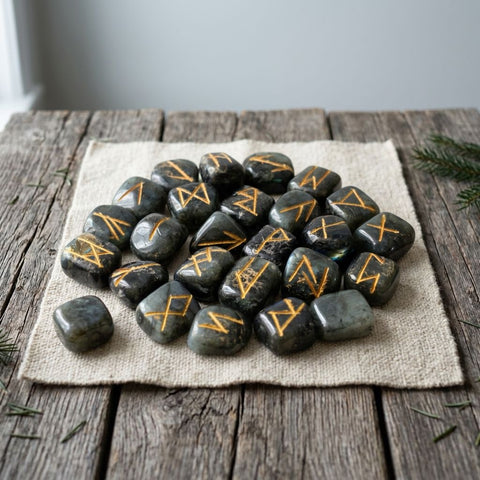 Labradorite runes: 25 dark grey stones with blue flash, engraved in gold
59,90 €
 Lapis lazuli runes: 25 royal blue stones engraved in gold
59,90 €
 Banded agate runes, 25 cream, amber and grey stones engraved in gold
29,90 €
 White agate runes: 25 porcelain white stones engraved in gold
29,90 €
 Moss agate runes: 25 grey-green stones engraved in gold
31,90 €