Algiz (ᛉ): meaning of the rune of the elk, sedge and protection
Algiz, ᛉ, the fifteenth rune of the Elder Futhark. Its name is a reconstruction from Old English eolh: elk, sedge or protection, depending on the theory.
Key points
| Rune | ᛉ (Algiz) |
|---|---|
| Phonetic value | z |
| Reconstructed name | *algiz (reconstructed, uncertain) |
| Meaning of the name | elk (probable); other theories: sedge, protection |
| Family (aett) | Second, 7th rune of the family |
| Position in the futhark | 15 of 24 |
| Reversed reading | Yes, used in modern readings |
Who is Algiz?
Algiz is written ᛉ: a vertical staff from which two branches rise in a V, like a hand with spread fingers or the antlers of a deer. It is the fifteenth rune of the Elder Futhark. It represents an early z sound, which no longer exists in the later Scandinavian languages.
Its name, *algiz, is a fragile reconstruction: no direct attestation survives, and scholars hesitate between several meanings. The rune is nonetheless one of the best known, so it helps to understand what the readings rest on.
The rune's name and its meaning
The name rests on Old English eolhx or eolh. In the Anglo-Saxon rune poem, the stanza speaks of the eolh-secg, traditionally translated as “sedge” (a marsh plant). Another reading links the word to the elk or the deer (the English word elk descends from it). A third, more recent hypothesis sees the root *alh-, “protection”.
The z sound was rare at the beginning of a word, which rules out the usual explanation (the name begins with the sound the rune stands for). Scholars conclude that the name may have been chosen in another way, or lost.
What the runic poems say
| Poem | What it says (summary) |
|---|---|
| Anglo-Saxon runic poem | Sedge grows in the marshes; it wounds cruelly and draws the blood of any warrior who grips it. |
| Norwegian runic poem | No stanza for this rune as z; the inverted form is used for the rune ýr (yew). |
| Icelandic runic poem | Same: the Younger Futhark reuses the form for other runes. |
The Scandinavian poems do not mention Algiz. However, its inverted form ᛦ designates the yew (ýr) in the Younger Futhark, and its upright form ᛘ serves, with another name (maðr), for the human being.
Inscriptions and ancient uses
The rune is attested in early inscriptions, such as on the scabbard from Thorsberg and the spearhead of Øvre Stabu, and at the end of some words. It also appears on the Gallehus golden horns (around 400).
It disappeared as a letter when the z sound turned into r at the end of words (around the 7th–8th century). Anglo-Saxon writing kept it with another use, sometimes to note the Latin letter X.
Algiz in a modern reading: upright
Reminder: rune casting is a modern practice. The reading below comes from contemporary books that rest mainly on the shape of the rune and on the hypothesis of “protection”.
The shape, with its arms raised toward the sky, has suggested the image of a gesture of defence or of welcome. In current books, upright Algiz is associated with protection (in a symbolic sense), vigilance, and the safeguarding of what one values. Some also see in it the link between earth and sky.
In a spread, it may invite you to ask what you want to protect and through which concrete actions. It protects nothing by itself: it is a symbol for reflection.
Reversed Algiz
Reversed, the shape evokes a gesture of lowering: vulnerability, a lack of defences, carelessness or, according to others, withdrawal. A few authors also read in it the need to let go of a guard that has become too heavy.
Do not take these as an omen: they are leads for questioning your own limits.
A reflection exercise with Algiz
List what you want to protect (a place, a relationship, a time of rest, a project). For each one, write a concrete, realistic action that contributes to it.
Then make the physical gesture of raising your arms in a V for a few seconds, then letting them fall, and observe what you feel: tension, relief, discomfort.
Algiz's place in the futhark
Algiz is rune no. 15 of 24. It occupies position 7 in the second family (aett), sometimes called the Hagal family. It follows Perthro and precedes Sowilo.
Algiz closes the runes of nature and the imagination before Sowilo, the sun, which ends the second family. The name Algiz is one of the most debated; if you cite it, it is better to say that it is reconstructed.
To see all the runes in relation to one another, see the rune guide and the page the Elder Futhark: history and reading of the 24 runes.
Frequently asked questions
What does Algiz mean?
The reconstructed name *algiz is uncertain: it is compared with Old English eolh, translated as elk or sedge. Another hypothesis sees in it a word meaning protection.
Is Algiz a rune of protection?
It is the most widespread modern reading, but it rests on a hypothesis. The ancient sources do not say so.
Why did the rune disappear from the Younger Futhark?
Because the z sound turned into r, and this letter was replaced by the rune r.
How is reversed Algiz read?
Authors tend to read it as vulnerability. It is a modern convention.
Also read
The meanings mentioned belong to tradition and symbolism. They are neither promises of results nor medical advice. Back to Guide to the runes.
In the shop
Runes: our products
 Tiger's eye runes: 25 honey and bronze stones engraved in gold
59,90 €
 Amethyst runes: 25 purple stones engraved in gold
29,90 €
 Rainbow moonstone runes: 25 milky stones engraved in gold
59,90 €
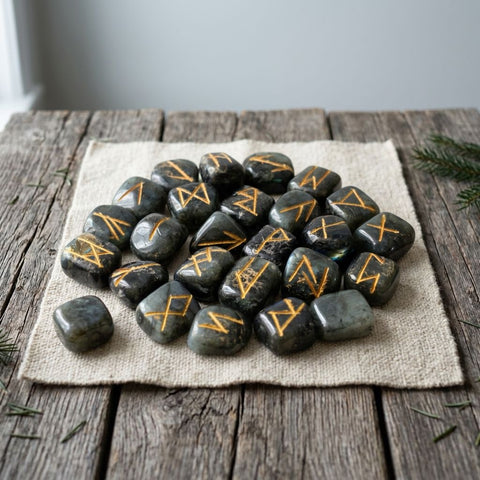 Labradorite runes: 25 dark grey stones with blue flash, engraved in gold
59,90 €
 Lapis lazuli runes: 25 royal blue stones engraved in gold
59,90 €
 Banded agate runes, 25 cream, amber and grey stones engraved in gold
29,90 €
 White agate runes: 25 porcelain white stones engraved in gold
29,90 €
 Moss agate runes: 25 grey-green stones engraved in gold
31,90 €