Hagalaz (ᚺ): meaning of the rune of hail and rupture
Hagalaz, ᚺ, opens the second family of the Elder Futhark. Its reconstructed name means hail. Runic poems, history and modern symbolic reading.
Key points
| Rune | ᚺ (Hagalaz) |
|---|---|
| Phonetic value | h |
| Reconstructed name | *hagalaz (reconstructed) |
| Meaning of the name | hail |
| Family (aett) | Second, 1st rune of the family |
| Position in the futhark | 9 of 24 |
| Reversed reading | No: the rune is symmetrical |
Who is Hagalaz?
Hagalaz is written ᚺ in the Elder Futhark: two vertical staves joined by a double diagonal bar, recalling a large H. It is the ninth rune of the Elder Futhark and the first of the second family, sometimes called the “family of Hagal”. It notes the sound h.
Its reconstructed name *hagalaz means “hail”, those small grains of ice that fall from the sky and damage crops. The rune therefore evokes a force of nature over which humans have no control.
The name of the rune and its meaning
The name *hagalaz is reconstructed from Old English hægl, Old Norse hagall and modern German Hagel. The word has remained very stable across all the Germanic languages, which makes it one of the most secure rune names. English hail is its direct descendant.
The rune exists in two forms: ᚺ with two bars (Elder Futhark) and ᚻ with a single bar (Anglo-Saxon writing; the Younger Futhark has both variants). Both forms note the sound h.
What the runic poems say
| Poem | What it says (summary) |
|---|---|
| Anglo-Saxon runic poem | Hail is the whitest of grains; it falls from the sky, is driven by the wind, then melts and becomes water. |
| Norwegian runic poem | Hail is the coldest of grains; the poem adds that Christ created the world, a sign of a Christian era. |
| Icelandic runic poem | Hail is a cold grain, a sleety shower, a scourge for serpents. |
The Anglo-Saxon poem neatly describes the cycle: a white grain becomes water. Modern readers have drawn from this detail the idea of a destruction that transforms itself.
Inscriptions and ancient uses
The rune h is attested in complete series, including the Kylver Stone (around 400), where it opens the second family, in ninth position. It was used to write words and names containing an h.
Hail is a real calamity for farming societies: a single storm can destroy a harvest. This is enough to explain why the poems give it a stanza, without any need to suppose an ancient magical use.
Hagalaz in a modern reading: upright
A reminder: rune casting is a modern practice. Here is how contemporary books read Hagalaz.
Hagalaz is most often interpreted as an external upheaval, an event beyond control: an unexpected delay, bad news, a situation that forces you to change your plans. Several authors stress the cycle of melting hail: after the storm, the water nourishes the earth.
In a spread, it can invite you to ask what is beyond your reach and what is not. It does not predict any misfortune: it suggests looking calmly at what has shaken, or could shake, your reference points.
A rune with no reversal
Hagalaz is symmetrical: turned upside down, it keeps the same form. In readings, it therefore has no reversed meaning.
As with all symmetrical runes, it is the question asked and the neighbouring runes that give the nuance. You can also ask yourself whether the event has already passed (the hail has fallen) or is still to come (the sky is darkening).
A reflection exercise with Hagalaz
Note down three recent events that did not depend on you (a breakdown, an unforeseen event, a decision made by someone else). Next to each one, write down what you were able to do once it had happened.
Then look at what you keep from it: a precaution, a habit, a request for help. The idea is to identify your margins for action, not to downplay what was difficult.
Hagalaz’s place in the futhark
Hagalaz is rune no. 9 of 24. It occupies place 1 in the second family (aett), sometimes called the family of Hagal. It follows Wunjo and precedes Nauthiz.
Hagalaz opens the second family, which includes among its runes necessity (Nauthiz), ice (Isa) and the sun (Sowilo). Many authors read it as a series of trials and passages, but this is a modern interpretation.
To see all the runes in relation to one another, consult the rune guide and the page the Elder Futhark: history and reading of the 24 runes.
Frequently asked questions
What does Hagalaz mean?
The reconstructed name *hagalaz means “hail”. The rune notes the sound h.
Is Hagalaz a rune of misfortune?
No, it is a modern symbolic reading centred on what escapes control. Medieval poems describe a natural phenomenon, not an ill omen.
Why are there two forms of the rune h?
The Elder Futhark uses a form with two bars, and Anglo-Saxon writing a form with one bar. Both note the same sound.
Can Hagalaz be reversed?
No, it is symmetrical. It is always read in the same direction.
Also read
The meanings mentioned belong to tradition and symbolism. They are neither promises of results nor medical advice. Back to Guide to the runes.
In the shop
Runes: our products
 Tiger's eye runes: 25 honey and bronze stones engraved in gold
59,90 €
 Amethyst runes: 25 purple stones engraved in gold
29,90 €
 Rainbow moonstone runes: 25 milky stones engraved in gold
59,90 €
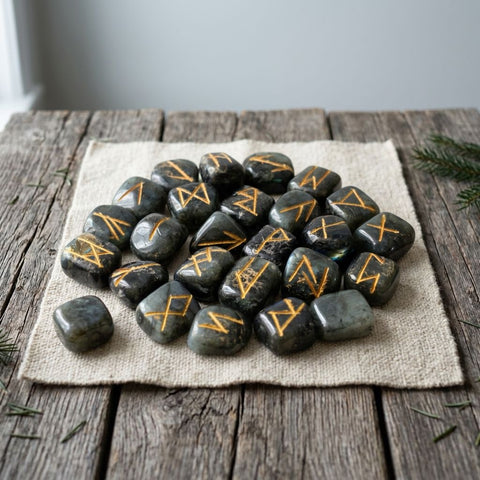 Labradorite runes: 25 dark grey stones with blue flash, engraved in gold
59,90 €
 Lapis lazuli runes: 25 royal blue stones engraved in gold
59,90 €
 Banded agate runes, 25 cream, amber and grey stones engraved in gold
29,90 €
 White agate runes: 25 porcelain white stones engraved in gold
29,90 €
 Moss agate runes: 25 grey-green stones engraved in gold
31,90 €