Wunjo (ᚹ): meaning of the rune of joy and harmony
Wunjo, ᚹ, the eighth and last rune of the first family, is named after joy. The meaning of its name, the wynn letter of Anglo-Saxon manuscripts and modern readings.
Key points
| Rune | ᚹ (Wunjo) |
|---|---|
| Phonetic value | w |
| Reconstructed name | *wunjō (reconstructed) |
| Meaning of the name | joy, pleasure |
| Family (aett) | First, 8th rune of the family |
| Position in the futhark | 8 of 24 |
| Reversed reading | Yes, used in modern readings |
Who is Wunjo?
Wunjo is written ᚹ: a vertical stave topped on the right by a small triangular loop, like a flag or a leaning letter P. It is the eighth rune of the Elder Futhark, and it notes the sound w (as in “way”).
Its reconstructed name *wunjō means “joy, pleasure”. It is the rune that closes the first family of eight signs, the one that begins with Fehu.
The name of the rune and its meaning
The name *wunjō is reconstructed from Old English wynn, “joy, happiness”. It is the only attested name of this rune in the poems: Old Norse keeps no form of it, because the rune disappeared from the Younger Futhark.
A historical curiosity: in Old English, the rune wynn (written ƿ) was used as a letter in manuscripts to note the sound w, until around the 13th century, when it was replaced by the double v (“w”) we know today. So the letter “w” on our keyboards replaced an ancient rune of joy.
What the runic poems say
| Poem | What it says (summary) |
|---|---|
| Anglo-Saxon runic poem | Joy belongs to the one who knows few sorrows and anxieties, and who possesses prosperity and happiness, with a good home. |
| Norwegian runic poem | No stanza: the rune has disappeared from the Younger Futhark. |
| Icelandic runic poem | No stanza, for the same reason. |
Note that the Anglo-Saxon poem does not define joy as an inner feeling, but through material and social conditions: being dry, fed and surrounded by others.
Inscriptions and ancient uses
The rune w appears in the Kylver Stone series (around 400), in eighth position. It then appears in inscriptions of names.
To our knowledge, there is no ancient inscription that uses it explicitly as a symbol of joy. The symbolic reading comes from the name preserved by medieval poems and from modern commentary.
Wunjo in a modern reading: upright
A reminder: rune casting is a modern practice. The readings that follow come from contemporary books.
Upright, Wunjo is associated with joy, harmony, conviviality and the feeling of belonging to a group. Many authors see in it the moment when the efforts of the previous series (wealth, strength, journey, gift) find their meaning.
In a spread, it can invite you to notice what does you good and to make yourself available to it. It does not promise that joy will come, nor that it will last: it suggests leaving room for it.
Wunjo reversed
Reversed, Wunjo is read as joy that is missing or fragile: a feeling of being out of step, isolation, disappointment, or on the contrary joy that one denies oneself. Other authors simply see in it a time to rest or to ask for help.
This is not a diagnosis. If you are going through a lasting period of sadness, talk to someone close to you or to a professional: a rune reading does not replace that conversation.
A reflection exercise with Wunjo
For one week, keep a small joy journal: each evening, write down one thing that gave you pleasure, however small (the smell of coffee, a message, a ray of sunshine).
At the end of the week, read back over your notes and look at what these moments have in common: place, people, season, activity. Choose one to repeat.
Wunjo’s place in the futhark
Wunjo is rune no. 8 of 24. It occupies place 8 in the first family (aett), sometimes called the family of Freyr. It follows Gebo and precedes Hagalaz.
Wunjo closes the first family. After it, everything changes: Hagalaz opens a darker series (hail, need, ice). Modern authors often read this passage as a deliberate contrast, but this order is that of recent centuries, not of antiquity.
To see all the runes in relation to one another, consult the rune guide and the page the Elder Futhark: history and reading of the 24 runes.
Frequently asked questions
What does Wunjo mean?
The reconstructed name *wunjō means “joy, pleasure”. The rune notes the sound w.
Where does the wynn letter come from?
From Anglo-Saxon scribes, who took up the rune Wunjo to write the sound w in their manuscripts until the 13th century.
Does Wunjo foretell future happiness?
No. Rune readings do not predict anything: Wunjo invites you to reflect on what does you good.
Why is Wunjo not in the Younger Futhark?
Because that alphabet, reduced to sixteen signs, dropped several runes, including the one for the sound w.
Also read
The meanings mentioned belong to tradition and symbolism. They are neither promises of results nor medical advice. Back to Guide to the runes.
In the shop
Runes: our products
 Tiger's eye runes: 25 honey and bronze stones engraved in gold
59,90 €
 Amethyst runes: 25 purple stones engraved in gold
29,90 €
 Rainbow moonstone runes: 25 milky stones engraved in gold
59,90 €
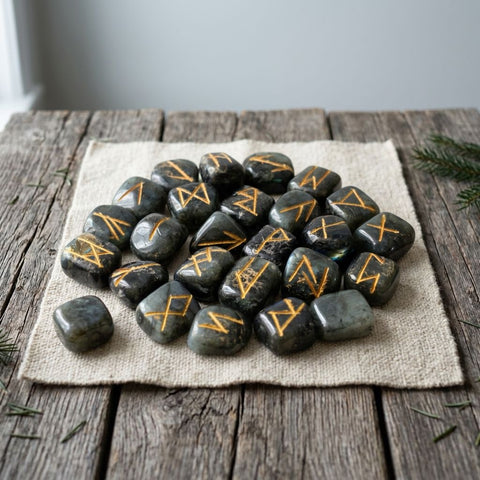 Labradorite runes: 25 dark grey stones with blue flash, engraved in gold
59,90 €
 Lapis lazuli runes: 25 royal blue stones engraved in gold
59,90 €
 Banded agate runes, 25 cream, amber and grey stones engraved in gold
29,90 €
 White agate runes: 25 porcelain white stones engraved in gold
29,90 €
 Moss agate runes: 25 grey-green stones engraved in gold
31,90 €