Nauthiz (ᚾ): meaning of the rune of need and constraint
Nauthiz, ᚾ, the tenth rune of the Elder Futhark, is named need or distress. Meaning of the name, medieval runic poems and modern symbolic reading.
Key points
| Rune | ᚾ (Nauthiz) |
|---|---|
| Phonetic value | n |
| Reconstructed name | *naudiz (reconstructed) |
| Meaning of the name | need, necessity, distress |
| Family (aett) | Second, 2nd rune of the family |
| Position in the futhark | 10 of 24 |
| Reversed reading | No: the rune is symmetrical |
Who is Nauthiz?
Nauthiz is written ᚾ: a vertical stave crossed diagonally by a short stroke, like a distorted N. It is the tenth rune of the Elder Futhark and notes the sound n.
Its reconstructed name *naudiz means “need, constraint, distress”. It is a rune whose name speaks of a lack, which makes it less welcoming than Fehu or Wunjo, but very telling for anyone interested in how one gets through difficulties.
The name of the rune and its meaning
The name *naudiz is reconstructed from Old English nȳd, Old Norse nauðr and Gothic nauþs. It is a cousin of German Not (distress, necessity): the word is found in the expression Notwendigkeit, necessity, and in English need.
The meaning is both material (what is lacking) and moral (what compels). In the poems, it is often associated with a specific social condition: that of a servant, of a poor person, of someone exposed to the cold.
What the runic poems say
| Poem | What it says (summary) |
|---|---|
| Anglo-Saxon runic poem | Necessity weighs on the heart, but it often becomes a help for those who know how to listen to it in time. |
| Norwegian runic poem | Necessity leaves little choice; the one who is naked is cold in the frost (depending on the translation). |
| Icelandic runic poem | Necessity is the sorrow of a servant, a painful condition, exhausting labour. |
Only the Anglo-Saxon poem adds a nuance: constraint can teach. Modern authors often draw their reading of the rune from this.
Inscriptions and ancient uses
Nauthiz is attested from the earliest complete series, such as the Kylver Stone (around 400). It notes the sound n in many names and formulas.
It remains in the Younger Futhark under the name nauðr, which shows continuous transmission. Researchers have no evidence that it was used for anything other than writing in antiquity; the divinatory use is modern.
Nauthiz in a modern reading: upright
A reminder: rune casting is a modern practice. What follows comes from contemporary books.
Upright, Nauthiz is read as a rune of limits: a real lack (of time, money, energy), a constraint one does not choose, a deadline. Most authors insist on an idea from the Anglo-Saxon poem: what is lacking can push one to act differently and to ask for help.
In a spread, it can invite you to distinguish real need from desire, and to look at what, in the situation, is truly a constraint. It does not say that the situation is difficult: it proposes naming it.
A rune with no reversal
Nauthiz is symmetrical: turned upside down, it keeps its form. It is therefore not read reversed.
Some authors instead play on the nuance of context: constraint endured or constraint chosen, yesterday’s need or today’s need. You can turn it into a personal question rather than a rule of reading.
A reflection exercise with Nauthiz
Write on the left what I need and, on the right, what I want. For each line, ask yourself honestly which column it belongs in.
Choose one real need from the left-hand column and imagine a first modest step to meet it this week: a phone call, an appointment, a request for help. A rune reading never replaces medical, legal or financial advice.
Nauthiz’s place in the futhark
Nauthiz is rune no. 10 of 24. It occupies place 2 in the second family (aett), sometimes called the family of Hagal. It follows Hagalaz and precedes Isa.
Nauthiz follows Hagalaz: in this sequence, hail (the event) comes before necessity (the effect). This pairing is modern, but it offers a way to remember their order.
To see all the runes in relation to one another, consult the rune guide and the page the Elder Futhark: history and reading of the 24 runes.
Frequently asked questions
What does Nauthiz mean?
The reconstructed name *naudiz means need, necessity or distress. The rune notes the sound n.
Is Nauthiz a negative rune?
It is not an ill omen. Modern authors read it rather as a reminder of what is lacking or what compels, sometimes with the idea that this moves things forward.
Can Nauthiz be read reversed?
No: its form is symmetrical, so there is no reversed reading.
What is the link with the German word Not?
Not (distress) comes from the same Germanic root as the name of the rune.
Also read
The meanings mentioned belong to tradition and symbolism. They are neither promises of results nor medical advice. Back to Guide to the runes.
In the shop
Runes: our products
 Tiger's eye runes: 25 honey and bronze stones engraved in gold
59,90 €
 Amethyst runes: 25 purple stones engraved in gold
29,90 €
 Rainbow moonstone runes: 25 milky stones engraved in gold
59,90 €
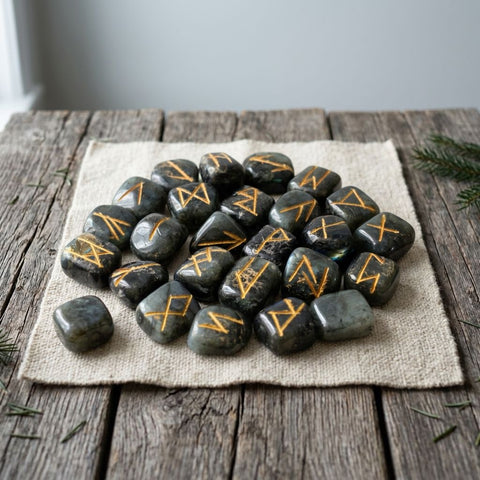 Labradorite runes: 25 dark grey stones with blue flash, engraved in gold
59,90 €
 Lapis lazuli runes: 25 royal blue stones engraved in gold
59,90 €
 Banded agate runes, 25 cream, amber and grey stones engraved in gold
29,90 €
 White agate runes: 25 porcelain white stones engraved in gold
29,90 €
 Moss agate runes: 25 grey-green stones engraved in gold
31,90 €