Ingwaz (ᛜ): meaning of the rune of the hero Ing and the lozenge
Ingwaz, ᛜ, the twenty-second rune of the Elder Futhark, takes its name from an ancestral hero, Ing. The meaning of the name, the Anglo-Saxon poem, links with Freyr and modern readings.
Key points
| Rune | ᛜ (Ingwaz) |
|---|---|
| Phonetic value | ŋ ("ng", as in English sing) |
| Reconstructed name | *ingwaz (reconstructed) |
| Meaning of the name | the hero or god Ing (Yngvi) |
| Family (aett) | Third, 6th rune of the family |
| Position in the futhark | 22 of 24 |
| Reversed reading | No: the rune is symmetrical |
Who is Ingwaz?
Ingwaz is written ᛜ: a lozenge, sometimes standing on its point, sometimes shaped like two opposing "v" letters. It is the twenty-second rune of the Elder Futhark. It stands for the sound ŋ, the "ng" of English sing.
Its reconstructed name *ingwaz belongs to a figure of Germanic tradition: an ancestor or a deity, depending on the sources, known as Ing in Old English and Yngvi in Old Norse.
The name of the rune and its meaning
The name *ingwaz is reconstructed from the Old English Ing and a group of personal and tribal names: the Ingaevones, a group of tribes on the North Sea coast mentioned by Tacitus and Pliny the Elder, are said to have taken their name from him. The word survives in the poem Beowulf, where the Danes are called "friends of Ing" (Ingwine).
In Norse mythology, Yngvi is also an epithet of the god Freyr, god of fertility and peace: the Ynglinga saga speaks of a king "Yngvi-Freyr". Scholars think that Ing and Freyr were partly the same figure, although the sources do not agree on the details.
What the rune poems say
| Poem | What it says (summary) |
|---|---|
| Anglo-Saxon rune poem | Ing was first seen among the East Danes, then he set off eastward over the waves, his chariot following him; this is how the Heardings named the hero. |
| Norwegian rune poem | No verse: the rune has disappeared from the Younger Futhark. |
| Icelandic rune poem | No verse, for the same reason. |
The image of a hero who leaves by sea with his chariot is one of the most enigmatic passages of the poem.
Inscriptions and early uses
The rune appears in the Kylver Stone series (around 400), in twenty-second position. It is used to write the sound ŋ, which never appears at the beginning of a word in Proto-Germanic: the rune cannot therefore have been named after a word beginning with that sound, which is why the name Ing matters.
It is not found in the Younger Futhark, which no longer writes this sound with a sign of its own. The inscriptions bearing it are rare and do not allow us to assign it an independent symbolic value.
Ingwaz in a modern reading: upright
A reminder: rune casting is a modern practice. Here are the readings found in contemporary literature.
Upright, Ingwaz is associated with completion, gestation, and a project that matures after a period of rest. The closed shape of the lozenge suggests a contained space, a seed. Its link with Freyr, god of fertility, has led some authors to read it as fruitfulness in the broad sense: creative, familial, agricultural.
In a casting, it may invite you to ask what is ripening and what needs calm before it comes out. It does not announce a birth or a result: it speaks of the time of maturation.
A rune without a reversal
Ingwaz is a symmetrical shape: a lozenge stays a lozenge when turned around. There is therefore no reversed reading.
Some authors note that the rune can be read as a phase: before opening, or after completion. You might take this as a question: am I in waiting or in completion?
A reflection exercise with Ingwaz
Choose a project in progress and note where it stands: idea, preparation, execution, or nearly finished. Circle the stage and ask yourself whether you are rushing it or respecting it.
If the project needs time, decide on a specific moment when you will return to it, and until then leave it alone.
Ingwaz's place in the futhark
Ingwaz is rune no. 22 of 24. It occupies place 6 in the third family (aett), sometimes called the Tyr family. It follows Laguz and precedes Dagaz.
Ingwaz comes before Dagaz and Othala, the last two runes. In a modern reading, the seed (Ingwaz) becomes the day (Dagaz), then the inherited estate (Othala). This is a way to remember them, with no ancient value attached.
To see how all the runes relate to one another, consult the rune guide and the page the Elder Futhark: history and reading of the 24 runes.
Frequently asked questions
What does Ingwaz mean?
The reconstructed name *ingwaz belongs to a hero or ancestor called Ing. The rune stands for the sound "ng".
What is the link between Ing and Freyr?
Yngvi, the Norse form of the name, is also an epithet of Freyr. Scholars think the two figures partly overlap.
Does Ingwaz have a reversed version?
No: a lozenge is symmetrical.
Why did the rune disappear in Scandinavia?
The Younger Futhark no longer has a sign of its own for the sound "ng": the writing system was simplified.
Also read
The meanings mentioned belong to tradition and symbolism. They are neither promises of results nor medical advice. Back to Guide to the runes.
In the shop
Runes: our products
 Tiger's eye runes: 25 honey and bronze stones engraved in gold
59,90 €
 Amethyst runes: 25 purple stones engraved in gold
29,90 €
 Rainbow moonstone runes: 25 milky stones engraved in gold
59,90 €
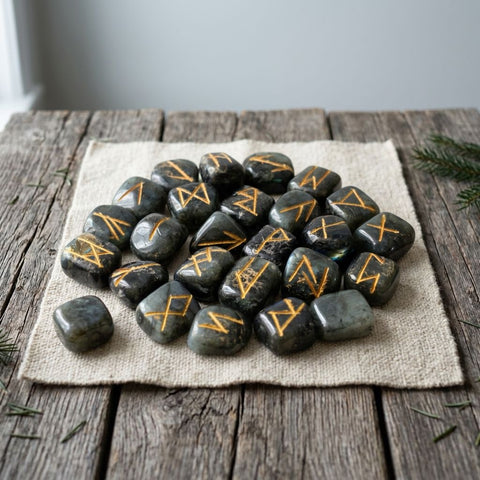 Labradorite runes: 25 dark grey stones with blue flash, engraved in gold
59,90 €
 Lapis lazuli runes: 25 royal blue stones engraved in gold
59,90 €
 Banded agate runes, 25 cream, amber and grey stones engraved in gold
29,90 €
 White agate runes: 25 porcelain white stones engraved in gold
29,90 €
 Moss agate runes: 25 grey-green stones engraved in gold
31,90 €