Laguz (ᛚ): meaning of the rune of water, sea and flow
Laguz, ᛚ, twenty-first rune of the Elder Futhark, named after water, the sea or a lake. One hypothesis sees the leek. Meaning of the name, poems and a modern reading.
Key points
| Rune | ᛚ (Laguz) |
|---|---|
| Phonetic value | l |
| Reconstructed name | *laguz (reconstructed) |
| Meaning of the name | water, lake, sea (hypothesis: leek, *laukaz) |
| Family (aett) | Third, 5th rune of the family |
| Position in the futhark | 21 of 24 |
| Reversed reading | Yes, used in modern readings |
Who is Laguz?
Laguz is written ᛚ: a vertical staff to which an oblique stroke rising upward is attached, like a leaning L or a curved stick. It is the twenty-first rune of the Elder Futhark and represents the sound l.
Its reconstructed name *laguz designates water, a lake or the sea. Another, rarer hypothesis proposes the name *laukaz, “leek”.
The rune's name and its meaning
The name *laguz is reconstructed from Old English lagu (the sea, water) and Old Norse lǫgr (liquid, sea).
The leek hypothesis rests on ancient inscriptions, such as the Bülach fibula (Switzerland), where the rune seems to abbreviate laukaz. According to some authors, the leek was associated with fertility; some late Scandinavian manuscripts also list laukr among the names of the rune. There is no consensus.
What the runic poems say
| Poem | What it says (summary) |
|---|---|
| Anglo-Saxon runic poem | Water seems endless to those who must venture onto a pitching ship; the waves frighten them, and the sea-horse refuses the bit. |
| Norwegian runic poem | Water falling from the mountain forms a waterfall, while ornaments of gold are precious. |
| Icelandic runic poem | Water is a gushing flood, a wide cauldron, the land of fish. |
The poems show water in three guises: the dangerous sea, the waterfall, and the calm expanse.
Inscriptions and ancient uses
The l rune appears in the row of runes on the Kylver stone (around 400), in twenty-first position. It serves to write the sound l, common in names. In the Younger Futhark, it keeps its form and takes the name lǫgr, which makes it one of the most stable runes in the series.
Its form is identical to that of a letter of the Raetic alphabet, one of the alphabets of northern Italy from which the runes may derive. This makes Laguz one of the runes whose graphic origin is easiest to trace.
Laguz in a modern reading: upright
Reminder: rune casting is a modern practice. Here are the readings of contemporary books.
Upright, Laguz is most often associated with intuition, emotions, and whatever flows and changes: water takes the shape of what contains it. Many authors also read in it the unconscious, dreams and the feeling of letting oneself be carried. They sometimes recall that, in Norse tales, water is also that of the well of Mímir, where Odin is said to have left an eye in exchange for wisdom: water as a source of knowledge.
In a spread, it may invite you to listen to what you feel before deciding. It does not say which emotion will pass through you: it suggests leaving room for it.
Reversed Laguz
Reversed, Laguz is read as a blocked flow: confusion, fear of letting go, emotions held back or overflowing. Other authors see in it a need for a shore, for clear limits.
These are modern conventions. If you are going through a period of intense anxiety or sadness, talk to someone close to you or to a professional: a rune reading does not replace real support.
A reflection exercise with Laguz
Take a sheet of paper and write without stopping for five minutes everything that passes through your mind, without correcting or judging. Then underline a word or phrase that recurs.
Then pause near water if you can (river, fountain, simply a glass of water) and observe it without looking for anything. Always stay at a safe distance from the edge.
Laguz's place in the futhark
Laguz is rune no. 21 of 24. It occupies position 5 in the third family (aett), sometimes called the Tyr family. It follows Mannaz and precedes Ingwaz.
Laguz follows Mannaz: the human being, then the water that surrounds it. The next rune, Ingwaz, introduces an ancient hero.
To see all the runes in relation to one another, see the rune guide and the page the Elder Futhark: history and reading of the 24 runes.
Frequently asked questions
What does Laguz mean?
The reconstructed name *laguz designates water, a lake or the sea. Some researchers propose *laukaz, “leek”.
Is Laguz a rune of intuition?
It is the most common modern reading, inspired by the image of water. The ancient poems speak mainly of sea and waterfalls.
Why are there two possible names?
The poems give names meaning water; older inscriptions suggest a name meaning leek.
What does reversed Laguz mean?
Modern books see it as a blocked or overflowing emotion. It is a reading convention.
Also read
The meanings mentioned belong to tradition and symbolism. They are neither promises of results nor medical advice. Back to Guide to the runes.
In the shop
Runes: our products
 Tiger's eye runes: 25 honey and bronze stones engraved in gold
59,90 €
 Amethyst runes: 25 purple stones engraved in gold
29,90 €
 Rainbow moonstone runes: 25 milky stones engraved in gold
59,90 €
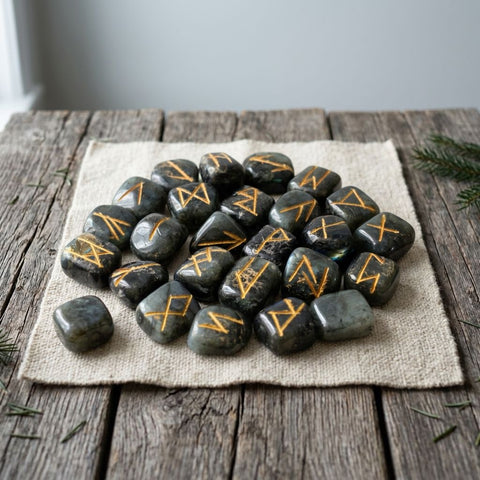 Labradorite runes: 25 dark grey stones with blue flash, engraved in gold
59,90 €
 Lapis lazuli runes: 25 royal blue stones engraved in gold
59,90 €
 Banded agate runes, 25 cream, amber and grey stones engraved in gold
29,90 €
 White agate runes: 25 porcelain white stones engraved in gold
29,90 €
 Moss agate runes: 25 grey-green stones engraved in gold
31,90 €