Tiwaz (ᛏ): meaning of the rune of the god Týr, courage and justice
Tiwaz, ᛏ, opens the third family of the Elder Futhark. Its name is that of the god Týr. The myth of Fenrir, runic poems and a modern symbolic reading.
Key points
| Rune | ᛏ (Tiwaz) |
|---|---|
| Phonetic value | t |
| Reconstructed name | *tīwaz (reconstructed) |
| Meaning of the name | the god Týr (Tiw) |
| Family (aett) | Third, 1st rune of the family |
| Position in the futhark | 17 of 24 |
| Reversed reading | Yes, used in modern readings |
Who is Tiwaz?
Tiwaz is written ᛏ: an arrow pointing upward, a vertical staff topped by two oblique strokes. It is the seventeenth rune of the Elder Futhark and represents the sound t. It opens the third family, sometimes called “the family of Týr”.
Its reconstructed name *tīwaz is that of a god: Týr in Old Norse, Tiw in Old English. The name is one of the oldest in all of Germanic mythology.
The rune's name and its meaning
The Germanic god *Tīwaz belongs to the same family as the Greek god Zeus and the Roman god Jupiter: the Indo-European word designating “the bright sky” or “a god”. Over the centuries, the god's role shifted toward war and justice.
His name survives in our calendar: Tuesday in English comes from Tīwesdæg, the day of Tiw. In German, Dienstag refers instead to a nickname of the same god, linked to the assembly (Thing).
What the runic poems say
| Poem | What it says (summary) |
|---|---|
| Anglo-Saxon runic poem | Tir is a guiding star: it remains faithful to the noble, crosses the dark nights and never misses its course. |
| Norwegian runic poem | Týr is the one-handed god (who has only one hand). |
| Icelandic runic poem | Týr is the one-handed god, what remains of the wolf, the chief of the temples. |
“One-handed” refers to a famous myth: that of the wolf Fenrir, whom the gods wanted to bind.
Inscriptions and ancient uses
According to the medieval account of the Gylfaginning, the gods wished to bind the wolf Fenrir. Only Týr agreed to put his hand in its mouth as a pledge of good faith. When the wolf realised it had been tricked, it tore off his hand. The figure is thus that of a god who sacrifices something out of commitment.
In the Sigrdrífumál, a medieval poem, one is told to carve victory runes on the hilt of a sword while invoking Týr twice. Earlier, the Lindholm amulet (2nd–4th century) bears several t runes in a row, sometimes read as an invocation, and the Kylver stone ends with a series of t runes. These readings should be treated with caution. Finally, a 3rd-century dedication on Hadrian's Wall, made by Frisian soldiers to “Mars Thincsus”, is often compared with the god of assemblies (þing).
Tiwaz in a modern reading: upright
Reminder: rune casting is a modern practice. Here is what contemporary books say.
Upright, Tiwaz is associated with courage, justice, loyalty to a cause and discipline. The image of the arrow adds that of direction: aiming straight. Many authors also read in it the idea of a sacrifice made for a principle.
In a spread, it may invite you to ask what you care about enough to commit to, and at what price. It does not say that you will win: it speaks of uprightness and commitment.
Reversed Tiwaz
Reversed, the arrow points downward: authors read in it a lack of courage, a misplaced commitment, an injustice, a useless sacrifice, or a discipline that has turned into rigidity.
As always, these are modern conventions, not verdicts. You may also read it as a reminder: a principle defended without flexibility can hurt.
A reflection exercise with Tiwaz
Write down the three values you hold most dear, then, opposite each one, a recent situation in which you lived it and one in which you departed from it.
Then choose a concrete commitment, small but precise, that you could keep for a month (writing to a loved one, finishing a piece of work). Note the date and hold yourself to account.
Tiwaz's place in the futhark
Tiwaz is rune no. 17 of 24. It occupies position 1 in the third family (aett), sometimes called the Tyr family. It follows Sowilo and precedes Berkano.
Tiwaz opens the last family. In the modern order, the eight runes of this family speak of growth (birch), relationships (horse, human being), water, the hero Ing, day and inheritance: a series centred on collective life.
To see all the runes in relation to one another, see the rune guide and the page the Elder Futhark: history and reading of the 24 runes.
Frequently asked questions
What does Tiwaz mean?
It is the reconstructed name of the god Týr (Tiw). The rune stands for the sound t.
What is the link with Tuesday?
In English, Tuesday comes from Tīwesdæg, the day of Tiw. In French, “mardi” refers to the Roman god Mars.
Why does Týr have only one hand?
According to medieval texts, he lost his hand after placing it in the mouth of the wolf Fenrir as a pledge.
What does reversed Tiwaz mean?
Modern books read in it a lack of courage or a misplaced commitment. These are reading conventions.
Also read
The meanings mentioned belong to tradition and symbolism. They are neither promises of results nor medical advice. Back to Guide to the runes.
In the shop
Runes: our products
 Tiger's eye runes: 25 honey and bronze stones engraved in gold
59,90 €
 Amethyst runes: 25 purple stones engraved in gold
29,90 €
 Rainbow moonstone runes: 25 milky stones engraved in gold
59,90 €
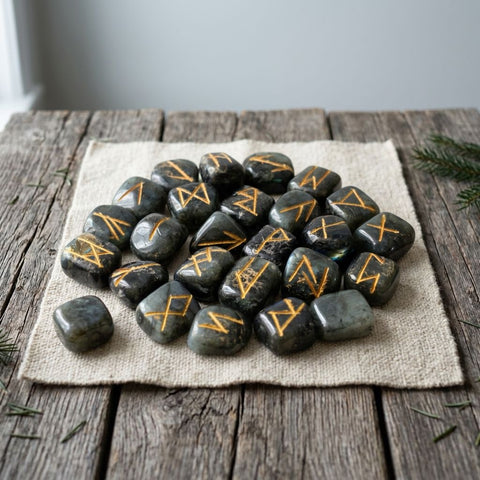 Labradorite runes: 25 dark grey stones with blue flash, engraved in gold
59,90 €
 Lapis lazuli runes: 25 royal blue stones engraved in gold
59,90 €
 Banded agate runes, 25 cream, amber and grey stones engraved in gold
29,90 €
 White agate runes: 25 porcelain white stones engraved in gold
29,90 €
 Moss agate runes: 25 grey-green stones engraved in gold
31,90 €