Kenaz (ᚲ): meaning of the rune of the torch, or of the ulcer
Kenaz, ᚲ, sixth rune of the Elder Futhark, has two names depending on the tradition: the torch in Old English, the ulcer in Old Norse. History and readings.
Key points
| Rune | ᚲ (Kenaz) |
|---|---|
| Phonetic value | k |
| Reconstructed name | *kenaz (torch) or *kauną (ulcer), both reconstructed |
| Meaning of the name | torch (Old English); ulcer (Old Norse) |
| Family (aett) | First, 6th rune of the family |
| Position in the futhark | 6 of 24 |
| Reversed reading | Yes, practised in modern readings |
Who is Kenaz?
Kenaz is written ᚲ: a simple open chevron pointing right, like the "less than" sign in mathematics. It is the sixth rune of the Elder Futhark, and it notes the sound k.
It is one of the runes whose name gives rise to the most discussion. Specialists have reconstructed two different names, *kenaz "torch" and *kauną "ulcer, abscess". The sources do not settle the question, which is why the pages and books you read do not always give the same meaning.
The meaning of the rune's name
The "torch" version rests on Old English cēn, which designates a torch of resinous wood. This word is related to German Kien (resinous pine wood used for light). It is the best known in modern books, because it gives a brighter image of the rune.
The "ulcer" version rests on Old Norse kaun and on the Scandinavian poems. It is reconstructed as *kauną. There is no consensus on which of the two is older. Gothic, for its part, calls the corresponding letter kusma, a word of uncertain meaning.
In practice, it is best to keep both versions in mind: many modern authors retain only the torch, without mentioning the other lead.
What the rune poems say
| Poem | What it says (summary) |
|---|---|
| Anglo-Saxon rune poem | The torch is known to every living being for its clear and lively flame; it shines where the nobles sit in the hall. |
| Norwegian rune poem | The ulcer is baneful to children (according to the common translation). |
| Icelandic rune poem | The ulcer is a scourge for children, a painful wound, a dwelling of rotting flesh. |
This page draws no health conclusion from these lines: they describe the misfortunes of the time, not recommendations.
Inscriptions and ancient uses
The rune appears in the first inscriptions to note the sound k, for example in names or formulas carved on objects. It is found in the series of the Kylver stone (around 400) in sixth place.
In the Younger Futhark, the rune takes the form ᚴ and the name kaun: it is therefore the "ulcer" version that is preserved in Scandinavia. In England, the Anglo-Saxon alphabet keeps the name cēn. This split between traditions explains the two names.
Kenaz in a modern reading: upright
Reminder: rune reading is a modern practice. The meanings below are those of contemporary books, almost all of which retain the torch.
Upright, Kenaz is read as a light that illuminates: an idea, a knowledge that is passed on, a skill, a know-how, a creative impulse. The torch is also the tool that allows one to forge, to work in the dark. Some authors see in it an invitation to learn, or to light up a shadowy area of a situation.
In a reading, it may suggest inspiration, something one finally understands, or a way of working. It promises no success: it draws attention to what gives light.
Reversed Kenaz
Reversed, Kenaz is read as a flickering light: lack of inspiration, loss of momentum, knowledge that stays closed. Authors who rely on the meaning "ulcer" sometimes add the idea of something smouldering in silence that is better faced. This is a symbolic reading, unrelated to real health.
As always, these are conventions: take them as questions, not verdicts.
A reflection exercise with Kenaz
Choose something you want to learn or understand better. Write: what I already know, what I would like to know, who could help me, and a first small step for this week.
If you light a candle for this moment of reflection, place it on a stable surface, away from anything flammable, and never leave it unattended.
Kenaz's place in the futhark
Kenaz is rune no. 6 of 24. It occupies place 6 in the first family (aett), sometimes called the family of Freyr. It follows Raidho and precedes Gebo.
Kenaz is the last rune of the part "livestock, strength, giant, god, journey" before the gift (Gebo) and joy (Wunjo). In this modern reading, after the journey comes the light that makes it possible to move forward.
To place all the runes relative to one another, see the rune guide and the page The Elder Futhark: history and reading of the 24 runes.
Frequently asked questions
What does Kenaz mean?
According to the traditions, the name means torch (Old English cēn) or ulcer (Old Norse kaun). Both names are reconstructed.
Why does Kenaz have two opposite meanings?
Because the sources come from two regions: England for the torch, Scandinavia for the ulcer. Specialists do not settle the question.
Is Kenaz a fire rune?
In modern use it is readily associated with light and creativity. It is a symbolic reading.
Can Kenaz be used for a creative project?
You can take it as a theme for reflection on your ideas. It guarantees nothing.
Also read
The meanings mentioned belong to tradition and symbolism. They are neither promises of results nor medical advice. Back to Guide to the runes.
In the shop
Runes: our products
 Tiger's eye runes: 25 honey and bronze stones engraved in gold
59,90 €
 Amethyst runes: 25 purple stones engraved in gold
29,90 €
 Rainbow moonstone runes: 25 milky stones engraved in gold
59,90 €
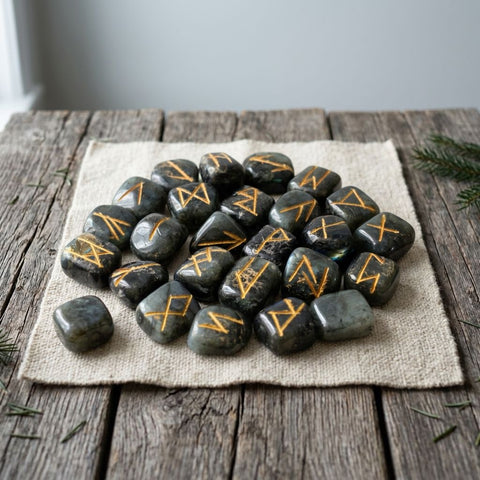 Labradorite runes: 25 dark grey stones with blue flash, engraved in gold
59,90 €
 Lapis lazuli runes: 25 royal blue stones engraved in gold
59,90 €
 Banded agate runes, 25 cream, amber and grey stones engraved in gold
29,90 €
 White agate runes: 25 porcelain white stones engraved in gold
29,90 €
 Moss agate runes: 25 grey-green stones engraved in gold
31,90 €