Othala (ᛟ): meaning of the rune of inheritance, home and estate
Othala, ᛟ, the last rune of the Elder Futhark, is named for inheritance, the family estate. The meaning of the name, the word odel, the Anglo-Saxon poem and modern symbolic reading.
Key points
| Rune | ᛟ (Othala) |
|---|---|
| Phonetic value | o |
| Reconstructed name | *ōþala (reconstructed) |
| Meaning of the name | inheritance, ancestral property, estate |
| Family (aett) | Third, 8th rune of the family |
| Position in the futhark | 24 of 24 |
| Reversed reading | Yes, practised in modern castings |
Who is Othala?
Othala is written ᛟ: a lozenge set on two slanting legs, like a small figure or a stylised house. It is the twenty-fourth and last rune of the Elder Futhark, in the order of the Kylver Stone. It stands for the sound o.
Its reconstructed name *ōþala refers to property inherited from one's family: land, a house, a patrimony. As the rune that closes the series, it leads many authors to see in it a return home.
The name of the rune and its meaning
The name *ōþala is reconstructed from Old English ēðel or ōðel (homeland, estate, hereditary property), Old Norse óðal, and related words in Old Saxon and Old High German. It is the source of the Norwegian term odel, which still today designates a special family right over an agricultural property.
The idea is that of a possession that is passed on and creates obligations: one must look after it in order to hand it down to those who follow. The meaning is therefore economic, emotional and legal at once.
What the rune poems say
| Poem | What it says (summary) |
|---|---|
| Anglo-Saxon rune poem | The estate is dear to every man who may enjoy his rights and his property in his home, most often in prosperity. |
| Norwegian rune poem | No verse: the rune has disappeared from the Younger Futhark. |
| Icelandic rune poem | No verse, for the same reason. |
The Anglo-Saxon poem does not speak of genealogy, but of a concrete happiness: enjoying what one owns at home.
Inscriptions and early uses
Othala appears in early inscriptions, notably on the Kylver Stone (around 400), which closes the series with it, and on the Rök Runestone (around 800), where its use seems deliberate. It disappears from Scandinavian inscriptions around the 8th century, but survives in England until the 11th century, where manuscripts use it as an abbreviation of the word ēðel, for example in Beowulf.
In the Anglo-Saxon script the rune changes value: it writes a different sound, and another sign takes the sound o. It is a good example of how an alphabet evolves over time.
Othala in a modern reading: upright
A reminder: rune casting is a modern practice. Here is how contemporary books read it.
Upright, Othala is associated with home, roots, and what one receives from one's family or history: material goods, know-how, values, memories. Authors read in it the question of what we keep and what we pass on, but also that of the security of a place called home.
In a casting, it may invite you to ask what supports you in your roots and what you would like to pass on. It does not announce an inheritance or a move: it concerns memory and place.
Othala reversed
Reversed, Othala is read as a difficulty linked to inheritance: a family conflict, an excessive attachment to the old, fear of losing a place, or, on the contrary, a wish to let go of it. Some authors see in it the freedom to choose what one keeps.
These are modern conventions. One way to use them is to ask yourself what you keep by choice and what you keep out of habit.
A reflection exercise with Othala
Look over an object or a place that came to you from someone: a piece of furniture, a book, a recipe. Note its story as you know it and what it passes on to you.
Then ask yourself which object, which story or which know-how you would like to pass on in turn, and to whom. You may begin by writing a few lines about it.
Othala's place in the futhark
Othala is rune no. 24 of 24. It occupies place 8 in the third family (aett), sometimes called the Tyr family. It closes the series; it follows Dagaz.
Othala closes the Elder Futhark, which explains why some authors like to read it as a return: to home, to family, to roots. In the order of the Vadstena bracteates, it is Dagaz that closes the series, a reminder that the order is not fixed.
To see how all the runes relate to one another, consult the rune guide and the page the Elder Futhark: history and reading of the 24 runes.
Frequently asked questions
What does Othala mean?
The reconstructed name *ōþala means inheritance, ancestral property, estate. The rune stands for the sound o.
Is Othala the last rune?
In the order of the Kylver Stone, yes. Other early supports place Dagaz last.
What is the link with the Norwegian word odel?
Odel comes from the same root as the name of the rune and designates a family right over a property.
What does a reversed Othala mean?
Modern books read it as a difficulty linked to inheritance or to home. It is a reading convention.
Also read
The meanings mentioned belong to tradition and symbolism. They are neither promises of results nor medical advice. Back to Guide to the runes.
In the shop
Runes: our products
 Tiger's eye runes: 25 honey and bronze stones engraved in gold
59,90 €
 Amethyst runes: 25 purple stones engraved in gold
29,90 €
 Rainbow moonstone runes: 25 milky stones engraved in gold
59,90 €
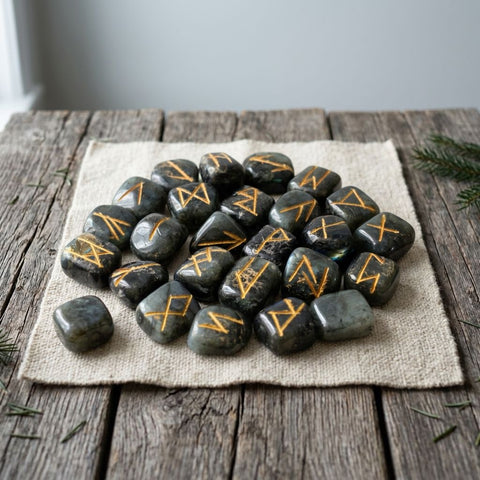 Labradorite runes: 25 dark grey stones with blue flash, engraved in gold
59,90 €
 Lapis lazuli runes: 25 royal blue stones engraved in gold
59,90 €
 Banded agate runes, 25 cream, amber and grey stones engraved in gold
29,90 €
 White agate runes: 25 porcelain white stones engraved in gold
29,90 €
 Moss agate runes: 25 grey-green stones engraved in gold
31,90 €