Ogham: ancient Irish alphabet, history, trees and modern uses
Ogham, an Irish alphabet cut into stone from the 4th to the 6th century: its 20 letters, its inscriptions, its legend of the trees, and modern divination, which dates from the 20th century.
Key points
| Nature | Alphabet of 20 main letters, plus five additional letters (forfeda) |
|---|---|
| Period of the inscriptions | 4th to 6th century for the so-called orthodox inscriptions |
| Number of inscriptions | About 380 to 400, mostly in southern Ireland |
| Language | Primitive Irish, sometimes Latin; Pictish in Scotland |
| Direction of reading | From bottom to top, along the edge of the stone |
| Links with trees | Medieval glosses (14th century for the surviving copies) |
| Divination | Modern practice, popularised after 1948 |
What is ogham?
Ogham is an alphabet used to write the earliest forms of Irish, cut mainly on standing stones. It is recognised by its appearance: a baseline, called the drach (often the edge of the stone), on either side of which small strokes, notches or nicks are cut. Each letter is defined by the number of these strokes (from one to five) and by their position relative to the line.
The main alphabet has twenty letters, to which the manuscripts add five further signs, the forfeda (Ébad, Ór, Uilleann, Pín, Emancholl). The twenty letters are divided into four groups of five, the aicmí (singular aicme), each named after its first letter. Our ogham guide devotes a page to each letter.
Inscriptions on stone
Some 380 to 400 so-called “orthodox” ogham inscriptions are known, cut on the edge of standing stones between the 4th and 6th centuries AD. A large majority are in the Irish province of Munster, especially in the counties of Cork and Kerry. Outside Ireland they are found in Wales (Pembrokeshire has the most), south-west England, the Isle of Man and Scotland. Some stones are bilingual, with a Latin text alongside.
The texts are short. They almost always contain a name in the genitive, followed by a formula of descent: maqi (“son of”) or mucoi (“of the lineage of”), then the name of the father or ancestor. These stones probably marked graves or territorial boundaries. They are read from bottom to top along the edge, then continued on the other side if the text is long. After the 6th century, the “scholastic” inscriptions become rarer and reproduce manuscript practices.
The twenty letters in a table
| Group | Letter | Sound | Tree or plant in the manuscripts |
|---|---|---|---|
| B | Beith | b | birch |
| B | Luis | l | rowan |
| B | Fearn | f / v | alder |
| B | Sail | s | willow |
| B | Nion | n | ash |
| H | Uath | h / j | hawthorn |
| H | Dair | d | oak |
| H | Tinne | t | holly |
| H | Coll | c / k | hazel |
| H | Ceirt | q | apple tree |
| M | Muin | m | vine |
| M | Gort | g | ivy |
| M | Ngetal | ng | fern or broom (reed in modern lists) |
| M | Straif | st / z | blackthorn |
| M | Ruis | r | elder |
| A | Ailm | a | fir or pine |
| A | Onn | o | gorse |
| A | Úr | u | heather |
| A | Edad | e | aspen |
| A | Idad | i | yew |
The B group (aicme Beithe) is cut to the right of the line or beneath it, the H group (aicme hÚatha) to the left or above it, the M group (aicme Muine) by oblique strokes crossing the line, and the A group (aicme Ailme) by notches for the vowels. The sound values of a few letters (Ngetal, Straif) are uncertain, as their pages explain.
Where did ogham come from?
No one knows for certain. Most specialists think the alphabet was created in Ireland, perhaps as early as the 4th century, by Irish speakers familiar with Latin writing, which would explain the alphabetic structure of ogham, probably inspired by Latin. Others have proposed a runic or Greek model, or an older system of counting on notched sticks; one 20th-century researcher argued for a far older origin, without archaeological evidence to support it. None of these hypotheses commands consensus.
Medieval Irish texts tell their own story: the Auraicept na n-Éces and the “Book of Conquests” attribute the invention to Fenius Farsaid, a sage linked to the Tower of Babel, while the Treatise on Ogham credits Ogma, a figure of Irish mythology. These are scholars' accounts, valuable for understanding how medieval Irish people saw their writing, but they are not historical sources on its origin.
Medieval manuscripts and the trees
It is in later manuscripts, including the Book of Ballymote copied around 1390, that we find the lists of letter names, the commentaries and the kennings (the bríatharogaim, short imagery-laden phrases attached to each letter). The Auraicept na n-Éces, “scholars' primer”, whose core is generally dated to the early 8th century, was enriched with many additions.
The association with trees comes from these commentaries: in the Middle Ages, scholars drew up lists of trees and plants, one for each letter. Modern study, notably that of Damian McManus, shows that only a few letter names plausibly designate a tree (about eight). Many mean something else: “field” for Gort, “sulphur” for Straif, “red” for Ruis, “earth” for Úr, “ash” for Onn, whereas the glossator proposes gorse. The “tree alphabet” is therefore a tradition of commentators, not the key to the original alphabet.
From ogham to divination: a modern use
No ancient source describes ogham as an instrument of divination. Irish sagas mention sticks inscribed with ogham for sending messages or marking property, perhaps for magical purposes; this is not the same thing as a reading.
Divination by ogham is a 20th-century phenomenon. The British poet and mythographer Robert Graves, in The White Goddess (1948), argued that the alphabet concealed a calendar of thirteen months of trees linked to a cult of the moon goddess. Specialists have rejected this thesis, which is now judged to have no historical foundation; it nevertheless inspired the “Celtic tree calendar” that has spread since, as well as oracle games from the 1980s onward. These games give each letter a divinatory meaning, often based on its associated tree.
Practising today with honesty
If ogham attracts you, you can make it a support for reflection, on condition that you know the meanings are modern. A reading with a single letter, for example:
- Make or buy twenty small sticks or tokens bearing the letters (gather dead wood rather than cutting branches, and avoid yew and other toxic woods if children or animals are around).
- Formulate an open question about what you are living through, not about the future.
- Draw a letter and read its page in this guide: name, meaning, tree, kennings.
- Write in three sentences what the letter suggests to you, then decide on one small, concrete gesture.
Ogham trees should not be used in preparations: several are toxic. Always present these readings as modern traditions, without attributing them to druids or ancient sages.
How to read this guide
Each letter page distinguishes what the inscriptions say, what the medieval manuscripts say and what modern readings propose. Start with Beith, the first letter, and continue to Idad. To compare with another ancient alphabet, see the introduction to the Elder Futhark, and for a wider view, the history of divination.
Frequently asked questions
What is ogham?
An ancient Irish alphabet of twenty main letters, cut on the edge of standing stones from the 4th to the 6th century, plus five letters added in the manuscripts.
Is ogham a tree alphabet?
Medieval manuscripts associate trees with the letters, but only a few letter names plausibly designate a tree. The “tree alphabet” is mainly a tradition of commentators.
Did the druids use ogham for divination?
No ancient source shows this. Divinatory use is modern and owes much to Robert Graves (1948).
Is the Celtic tree calendar authentic?
No: it was built in the 20th century from Graves's ideas, which specialists have rejected.
How is an ogham inscription read?
From bottom to top along the edge of the stone, then on the other side if the text is long. Most inscriptions are short personal names.
Where can you see ogham stones?
Mainly in southern Ireland (Kerry, Cork), in Wales and in Scotland, where museums and local sites display them.
Also read
The meanings mentioned belong to tradition and symbolism. They are neither promises of results nor medical advice. Back to Guide to Ogham.
In the shop
Runes: our products
 Tiger's eye runes: 25 honey and bronze stones engraved in gold
59,90 €
 Amethyst runes: 25 purple stones engraved in gold
29,90 €
 Rainbow moonstone runes: 25 milky stones engraved in gold
59,90 €
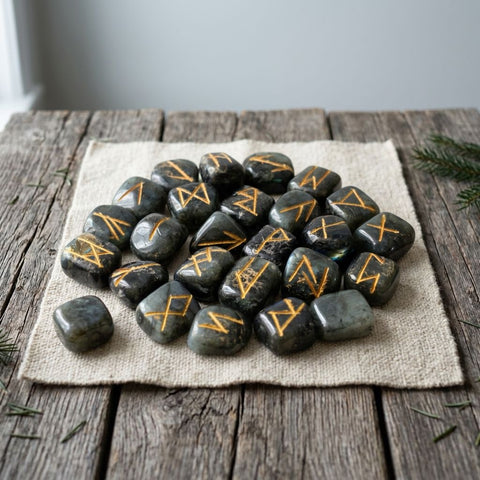 Labradorite runes: 25 dark grey stones with blue flash, engraved in gold
59,90 €
 Lapis lazuli runes: 25 royal blue stones engraved in gold
59,90 €
 Banded agate runes, 25 cream, amber and grey stones engraved in gold
29,90 €
 White agate runes: 25 porcelain white stones engraved in gold
29,90 €
 Moss agate runes: 25 grey-green stones engraved in gold
31,90 €