Ogham Úr: the heather letter, a name meaning earth or clay
Úr, the eighteenth letter of ogham: a name meaning “earth, clay”, the heather of the manuscripts, and kennings of cold and seed. Sources and modern reading.
Key points
| Letter | Úr (ᚒ) |
|---|---|
| Rank | 18th letter, Aicme Ailme (A group) |
| Sound value | u |
| Tree in the manuscripts | Heather (fraech) |
| Meaning of the name | “earth, clay, soil” |
| Modern keywords | Rootedness, matter, life cycle |
The letter Úr in the alphabet
Úr (also written Ur) is the eighteenth letter of ogham, the third vowel: three notches on the baseline, for the sound [u]. It belongs to the aicme Ailme, between Onn and Edad.
This is one of the rare letters of the alphabet whose name is not that of a tree, even in the manuscripts: the word evokes the very substance of the soil. Here are the key facts:
| Reference | Detail |
|---|---|
| Rank | 18th of the 20 main letters |
| Group (aicme) | Aicme Ailme (A group): 3 strokes, notches or short strokes perpendicular to the baseline, used to write vowels |
| Sound value | u |
| Tree or plant in the manuscripts | Heather (fraech) |
The name and its meaning: what the sources say
The name úr means “earth”, “clay”, “soil”. The word survives in modern Irish úir, which can mean the earth of a grave, and in úr, “fresh, damp, new”. The meaning of the letter is secure, largely thanks to the kennings, which speak of cold dwellings, seed and shroud.
For the plant, the Auraicept na n-Éces gives heather (fraech). This is not a tree, and the link with the sense of “earth” may lie in the fact that heather covers poor, acid soils. It must be repeated: this is a medieval gloss, not a datum from ancient writing.
The associated tree or plant
Ling, or common heather (Calluna vulgaris), is a small shrub of heaths and acid peat bogs. It flowers at the end of summer, from August to September, in pinkish-violet clusters much visited by bees; heather honey is one of its traditional products. It is found in Ireland, Scotland, Brittany and on the poor soils of Europe.
In Graves's tree calendar (1948), the vowels do not form months but markers, and this usage remains modern. To learn more, see the introduction to ogham.
The three portraits of the name (bríatharogam)
The three medieval lists give the letter an image of cold soil, seed and the grave:| List | Old Irish expression | Approximate meaning |
|---|---|---|
| Morann mac Moín | úaraib adbaib | in cold dwellings |
| Mac ind Óc | sílad cland | seed (propagation) of plants |
| Cú Chulainn | forbbaid ambí | shroud of one who is no longer alive |
These expressions are hard to translate: some may be corrupt, and the proposed translations are approximate. They are not reading instructions, only medieval images.
Modern divinatory reading
Current readings make Úr the letter of rootedness, matter, humility and the cycle of life: the earth is both what nourishes and what receives. It is associated with fertility, with returning to essentials, and with what happens beneath the surface.
The kennings suggest a back-and-forth between two images: seed and shroud. Many authors draw a sober reading from this: accepting that everything that grows returns to the soil. This is only one way of reading, never a prediction.
These meanings are modern: they come from ogham games and books published from the late twentieth century onward, and their authors do not always agree. Nothing proves that ogham was used for divination in ancient Ireland.
A reflective exercise
Go and touch the earth: a garden pot or a patch of lawn. Note three things that grow thanks to you, and one thing you could let rest. Draw Úr and ask yourself what in you needs deeper roots. The exercise is a moment of calm, not a forecast.Frequently asked questions
What does Úr mean in ogham?
The name means “earth” or “clay”. It is the eighteenth letter, which represents the sound [u].
Which tree corresponds to Úr?
None: the manuscript tradition associates it with heather, which is not a tree.
Why do Úr's kennings speak of a shroud?
Because the word evokes the earth that covers. The same word can denote the earth of a grave and seed.
Is Úr linked to death?
Some kennings suggest it, others speak of seed. Modern readings focus mainly on the cycle of life.
Also read
The meanings mentioned belong to tradition and symbolism. They are neither promises of results nor medical advice. Back to Guide to Ogham.
In the shop
Runes: our products
 Tiger's eye runes: 25 honey and bronze stones engraved in gold
59,90 €
 Amethyst runes: 25 purple stones engraved in gold
29,90 €
 Rainbow moonstone runes: 25 milky stones engraved in gold
59,90 €
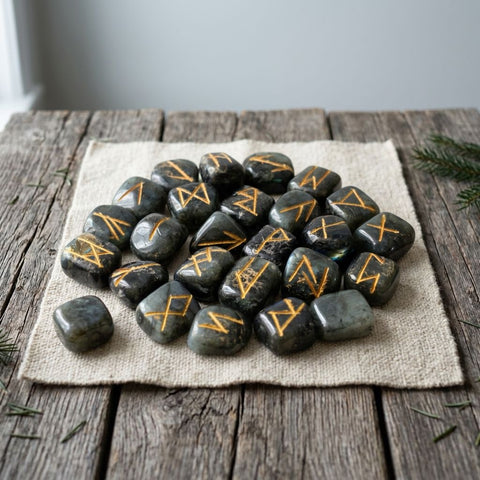 Labradorite runes: 25 dark grey stones with blue flash, engraved in gold
59,90 €
 Lapis lazuli runes: 25 royal blue stones engraved in gold
59,90 €
 Banded agate runes, 25 cream, amber and grey stones engraved in gold
29,90 €
 White agate runes: 25 porcelain white stones engraved in gold
29,90 €
 Moss agate runes: 25 grey-green stones engraved in gold
31,90 €