Ogham Ruis: the elder letter, meaning, sources and modern reading
Ruis, the fifteenth letter of ogham: a name meaning “red” or “redness”, the elder of the manuscripts and of modern end-of-cycle readings. Sources and nuances.
Key points
| Letter | Ruis (ᚏ) |
|---|---|
| Rank | 15th letter, Aicme Muine (M group) |
| Sound value | r |
| Tree in the manuscripts | Elder (trom) |
| Meaning of the name | “red, redness” |
| Modern keywords | End of a cycle, passage, renewal |
The letter Ruis in the alphabet
Ruis is the fifteenth letter of ogham, the fifth and last of the M group: five oblique strokes cross the baseline. It represents the sound [r]. With it closes the series of consonants in this group; the vowels follow, opening with Ailm.
This letter appears in stone inscriptions from the 4th to the 6th century, where it is used to write personal names like any other consonant. The associations with the elder come from another world: that of the medieval manuscripts. Here are the key facts:
| Reference | Detail |
|---|---|
| Rank | 15th of the 20 main letters |
| Group (aicme) | Aicme Muine (M group): 5 strokes, oblique strokes crossing the baseline |
| Sound value | r |
| Tree or plant in the manuscripts | Elder (trom) |
The name and its meaning: what the sources say
The meaning of the name is one of the most secure in the alphabet: ruis is connected with the Indo-European root meaning “red”, and survives in Latin ruber and Irish ruad. The kennings confirm it, all of them speaking of blushing, the redness of the face and anger.
For the plant, the Auraicept na n-Éces and the “tree” tradition give the elder (trom in Old Irish). The link with red is not direct, since the black elder bears dark berries: the glossators may have thought of the colour of skin that flushes, or of other associations that can no longer be reconstructed. The scholar Damian McManus, whose work underpins the modern study of letter names, takes the meaning “red” for granted, but is much less sure about the identification of the tree.
The associated tree or plant
The black elder (Sambucus nigra) is a small tree with soft pith, found in hedgerows and woodland edges. It flowers in June in large, highly fragrant cream-white umbels, and in late summer produces dark violet-black berries. The flowers are traditionally used for syrup or drinks; the berries must be cooked, as raw they are poorly tolerated, and the leaves, bark and twigs should not be eaten. Do not pick anything unless you are certain of its identification.
British and Irish folklore surrounds the elder with varied and sometimes contradictory beliefs: protective for some, not to be cut for others. In Graves's tree calendar (1948), Ruis is the last of the thirteen months, from late November to late December in the common version: this modern construction has no basis in the Irish sources.
The three portraits of the name (bríatharogam)
The three medieval lists speak of redness and anger, without mentioning a tree:| List | Old Irish expression | Approximate meaning |
|---|---|---|
| Morann mac Moín | tindem rucci | the most vivid of reddenings |
| Mac ind Óc | rúamnae drech | reddening of faces |
| Cú Chulainn | bruth fergae | heat of anger |
These expressions are hard to translate: some may be corrupt, and the proposed translations are approximate. They are not reading instructions, only medieval images.
Modern divinatory reading
In modern readings, Ruis is the letter of the end of a cycle, passage and renewal, partly because Graves made it the last month of the year. It is also associated with the candour of emotions (the blush that gives you away), with confession, and with the threshold one crosses.
Authors differ on whether they stress the letter's shadow or its light: a painful ending for some, liberation for others. None of these readings is attested before the twentieth century.
These meanings are modern: they come from ogham games and books published from the late twentieth century onward, and their authors do not always agree. Nothing proves that ogham was used for divination in ancient Ireland.
A reflective exercise
Think of a period of your life that is coming to an end: a job, a place, a habit. Note what you keep, what you thank, and what you leave behind. Draw Ruis and ask yourself what reddens in you when you speak of this ending. The exercise is a review, not a forecast.Frequently asked questions
What does Ruis mean in ogham?
The name means “red” or “redness”. It is the fifteenth letter, which represents the sound [r].
Is Ruis the letter of the elder?
Medieval manuscripts associate it with the elder. The identification is a tradition of the glossators, less certain than the meaning of the name.
Why is Ruis linked to the end of a cycle?
Because, in Graves's tree calendar, Ruis is the last month. This reading is modern.
Can you eat elder?
The flowers are used in syrup, the berries after cooking. The other parts are not eaten. Identify the tree with certainty before picking.
Also read
The meanings mentioned belong to tradition and symbolism. They are neither promises of results nor medical advice. Back to Guide to Ogham.
In the shop
Runes: our products
 Tiger's eye runes: 25 honey and bronze stones engraved in gold
59,90 €
 Amethyst runes: 25 purple stones engraved in gold
29,90 €
 Rainbow moonstone runes: 25 milky stones engraved in gold
59,90 €
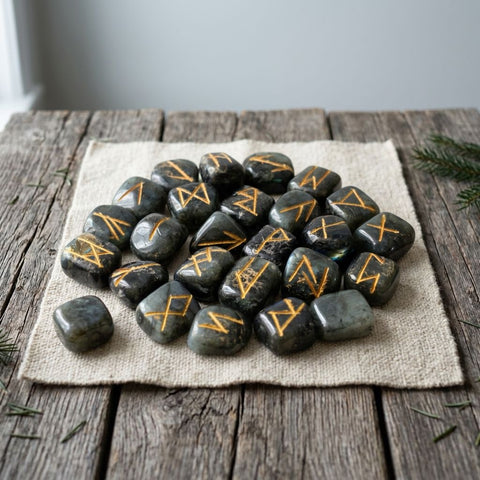 Labradorite runes: 25 dark grey stones with blue flash, engraved in gold
59,90 €
 Lapis lazuli runes: 25 royal blue stones engraved in gold
59,90 €
 Banded agate runes, 25 cream, amber and grey stones engraved in gold
29,90 €
 White agate runes: 25 porcelain white stones engraved in gold
29,90 €
 Moss agate runes: 25 grey-green stones engraved in gold
31,90 €