Ogham Straif: the blackthorn letter, meaning, history and reading
Straif, the fourteenth letter of ogham: a name probably meaning “sulphur”, an uncertain sound value and the blackthorn of the manuscripts. Sources and readings.
Key points
| Letter | Straif (ᚎ) |
|---|---|
| Rank | 14th letter, Aicme Muine (M group) |
| Sound value | uncertain: possibly [st], [ts], or a sibilant distinct from s |
| Tree in the manuscripts | Blackthorn (draighean) |
| Meaning of the name | probably “sulphur” |
| Modern keywords | Trial, necessity, protection, tenacity |
The letter Straif in the alphabet
Straif is the fourteenth letter of the ogham alphabet and the fourth of the M group: four oblique strokes cross the baseline. It is one of the most enigmatic letters of the alphabet, because its sound value has not been established.
The manuscripts transcribe it with a Latin Z. Linguists put forward several hypotheses: an [st] sound, an affricate [ts], a sibilant distinct from s, or even [sw]. It is rare on stones and does not change the reading of proper names. Here are the key facts:
| Reference | Detail |
|---|---|
| Rank | 14th of the 20 main letters |
| Group (aicme) | Aicme Muine (M group): 4 strokes, oblique strokes crossing the baseline |
| Sound value | uncertain: possibly [st], [ts], or a sibilant distinct from s |
| Tree or plant in the manuscripts | Blackthorn (draighean) |
The name and its meaning: what the sources say
The name is written in several ways in the manuscripts (straif, straiph, sraif, sraib…). The most likely meaning is “sulphur”, which specialists connect with the biblical brimstone (sulphur) (Isaiah 30:33 is cited). This meaning has nothing to do with a tree.
The blackthorn (draighean in Irish) is the plant the glossators attribute to the letter, according to the Auraicept na n-Éces. The reasoning that leads there passes through an additional kenning, “chief of the streams” (aire srábae), whose logic is hard to reconstruct. Two things should therefore be kept in mind: the name probably means “sulphur”, and the link with the blackthorn is a tradition of the glossators.
The associated tree or plant
The blackthorn or sloe (Prunus spinosa) is a thorny shrub of hedgerows and woodland edges. It flowers in March and April, usually before the leaves appear, in a cloud of small white flowers. Its fruit, the sloes, are sour and are eaten after the first frosts, as a liqueur or jam. Its hard wood has long been used for walking sticks, including the Irish shillelagh. The leaves and kernels should not be eaten.
In Graves's tree calendar (1948), which has only thirteen months, Straif has no month: the letter is left out. This says enough about the constructed nature of that calendar.
The three portraits of the name (bríatharogam)
The three medieval lists evoke colour, secrecy and the sky, with an obscurity that invites discussion:| List | Old Irish expression | Approximate meaning |
|---|---|---|
| Morann mac Moín | tressam rúamnai | the strongest of glows |
| Mac ind Óc | mórad rún | increase of secrets |
| Cú Chulainn | saigid nél | pursuit of the clouds (perhaps “arrow of the clouds”, lightning; doubtful text) |
These expressions are hard to translate: some may be corrupt, and the proposed translations are approximate. They are not reading instructions, only medieval images.
Modern divinatory reading
Modern readings make Straif the letter of trial, necessity, tenacity and protection: the blackthorn is prickly and hard to approach, yet its flowers announce spring. It is associated with an obstacle to be crossed, and with a strength that reveals itself under constraint.
Other authors prefer caution: an obscure letter onto which everyone projects what they wish. Keep this reservation in mind: an alphabet this incomplete cannot support a single fixed reading.
These meanings are modern: they come from ogham games and books published from the late twentieth century onward, and their authors do not always agree. Nothing proves that ogham was used for divination in ancient Ireland.
A reflective exercise
Think of a difficulty you have been through. Note what it asked of you, then what it taught you. Draw Straif and ask yourself which defence in your life is useful and which has become a barrier. The exercise is meant to help you understand a past trial, not to announce a future one.Frequently asked questions
What does Straif mean in ogham?
Probably “sulphur”. The manuscripts associate it with the blackthorn, through a later tradition of glossators.
How is Straif pronounced?
The sound value is uncertain: [st], [ts], or a particular sibilant. The manuscripts write it Z.
Is Straif a rare letter?
Yes, it is rarely found on inscriptions. It nevertheless belongs to the 20 main letters, at rank 14.
Does Straif have a place in the tree calendar?
No: Graves's calendar has thirteen months and leaves Straif out.
Can you pick sloes?
Yes, but with care: be sure you recognise the shrub, do not eat the kernels, and respect hedgerows and private property.
Also read
The meanings mentioned belong to tradition and symbolism. They are neither promises of results nor medical advice. Back to Guide to Ogham.
In the shop
Runes: our products
 Tiger's eye runes: 25 honey and bronze stones engraved in gold
59,90 €
 Amethyst runes: 25 purple stones engraved in gold
29,90 €
 Rainbow moonstone runes: 25 milky stones engraved in gold
59,90 €
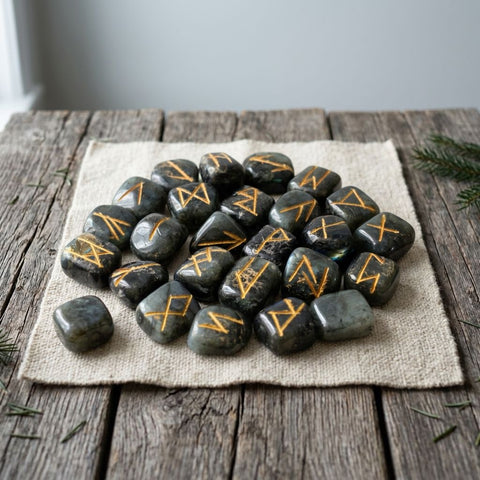 Labradorite runes: 25 dark grey stones with blue flash, engraved in gold
59,90 €
 Lapis lazuli runes: 25 royal blue stones engraved in gold
59,90 €
 Banded agate runes, 25 cream, amber and grey stones engraved in gold
29,90 €
 White agate runes: 25 porcelain white stones engraved in gold
29,90 €
 Moss agate runes: 25 grey-green stones engraved in gold
31,90 €