Ogham Ngetal (Gétal): the reed letter, meaning, history and reading
Ngetal or Gétal, thirteenth letter of ogham: a name that may mean “act of wounding”, an uncertain plant (reed, broom or fern) and modern readings.
Key points
| Letter | Ngetal (ᚍ) |
|---|---|
| Rank | 13th letter, Aicme Muine (M group) |
| Sound value | probably [gʷ] originally; read “ng” in the manuscripts |
| Tree in the manuscripts | Cilcach: broom or fern; reed in modern lists |
| Meaning of the name | probably “act of wounding, killing” |
| Modern keywords | Efficiency, order, direct action |
The letter Ngetal in the alphabet
Ngetal, also written Gétal, Ngéadal or nGéadal, is the thirteenth letter of ogham and the third of the M group. It is carved with three oblique strokes crossing the baseline. Its spelling wavers because the letter itself posed problems for the scribes.
On ancient stones, this letter notes a sound that linguists reconstruct as a rounded [g], a voiced labio-velar consonant, [gʷ]. It later merged with the plain g in Old Irish, which made the letter almost redundant. The manuscripts read it “ng”, but the initial n of the name probably has no etymological origin. Here are the reference points:
| Reference | Detail |
|---|---|
| Rank | 13th of the 20 main letters |
| Group (aicme) | Aicme Muine (M group): 3 strokes, oblique strokes crossing the baseline |
| Sound value | probably [gʷ] originally; read “ng” in the manuscripts |
| Tree or plant in the manuscripts | Cilcach: broom or fern; reed in modern lists |
The name and its meaning: what the sources say
The name itself is uncertain. The most cited proposal links it to a verb meaning “to wound, to kill” (gonid), which would give the letter the sense of “act of wounding” or “putting to death”. Yet the first two kennings (see below) evoke medicine, which may surprise; some scholars see in this a play on the idea of the wound and of healing.
For the plant, the glossators give cilcach, a word translated sometimes as fern, sometimes as broom. Modern lists, following Graves, mainly retain reed, which is not what the oldest texts say. When you read “Ngetal: reed” in a book, know that this is only one of the possible readings.
The associated tree or plant
Common reed (Phragmites australis) forms reed beds along the edges of fresh and brackish waters; its hollow stems have long been used for basketry and thatching. Broom (Cytisus scoparius) bears yellow flowers in spring, but its seeds and other parts are toxic. Bracken is a large fern of the heaths. None of these plants should be taken in a herbal tea or “elixir” without qualified advice.
In Graves’s tree calendar (1948), Ngetal is the twelfth month, which in the most widespread version runs from late October to late November. This modern construction has no basis in the Irish sources.
The three portraits of the name (bríatharogam)
The three medieval lists associate Ngetal with images of a physician and of combat, unrelated to the plant:| List | Old Irish expression | Approximate sense |
|---|---|---|
| Morann mac Moín | lúth lego | the physician’s strength (or food) |
| Mac ind Óc | étiud midach | the physicians’ garment |
| Cú Chulainn | tosach n-échto | the beginning of slaying |
These expressions are hard to translate: some may be corrupted, and the proposed translations are approximate. They are not reading instructions, only medieval images.
Modern divinatory reading
In recent divination books, Ngetal is read as the letter of efficiency, order, direct action and clear communication, linked to the reed (pen, arrow, pipe). Other authors, closer to the name, see in it an invitation to decide, to close a matter with precision.
As is often the case, these readings depend on the book you open. There is no “official meaning” of Ngetal, which is one more reason to read it as a support for reflection.
These meanings are modern: they come from ogham sets and books published from the late twentieth century onwards, and authors do not always agree. Nothing proves that ogham was used for divination in ancient Ireland.
A reflection exercise
Choose a task that is waiting for you. Note what keeps you from finishing it and what would make it clear and sharp. Draw Ngetal and ask yourself which simple, precise action you could take today. The exercise does not foretell the outcome; it helps you decide.Frequently asked questions
What does Ngetal or Gétal mean in ogham?
The meaning of the name is uncertain; it is linked to a verb meaning “to wound, to kill”. It is the thirteenth letter of the alphabet.
Which tree corresponds to Ngetal?
No tree: the manuscripts speak of fern or broom (cilcach), and modern lists of reed.
Is Ngetal read “ng” or “g”?
The manuscripts read it “ng”. On ancient stones it probably notes a rounded g, [gʷ], which later merged with g.
Why are there several spellings?
Because the letter was misunderstood by the scribes: Ngetal, Gétal, Ngéadal and nGéadal all designate the same letter.
Also read
The meanings mentioned belong to tradition and symbolism. They are neither promises of results nor medical advice. Back to Guide to Ogham.
In the shop
Runes: our products
 Tiger's eye runes: 25 honey and bronze stones engraved in gold
59,90 €
 Amethyst runes: 25 purple stones engraved in gold
29,90 €
 Rainbow moonstone runes: 25 milky stones engraved in gold
59,90 €
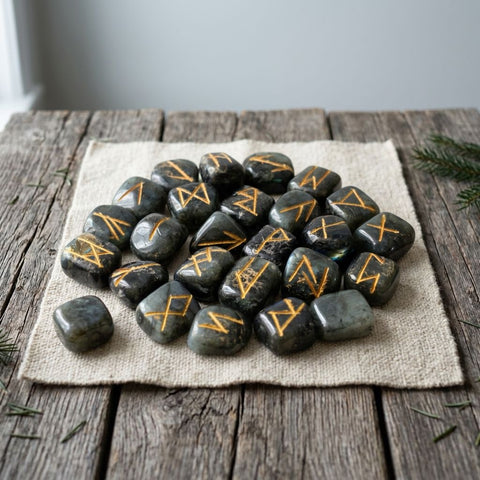 Labradorite runes: 25 dark grey stones with blue flash, engraved in gold
59,90 €
 Lapis lazuli runes: 25 royal blue stones engraved in gold
59,90 €
 Banded agate runes, 25 cream, amber and grey stones engraved in gold
29,90 €
 White agate runes: 25 porcelain white stones engraved in gold
29,90 €
 Moss agate runes: 25 grey-green stones engraved in gold
31,90 €