Ogham Muin: the vine, the nape or the voice, eleventh letter
Muin, the eleventh letter of the ogham, opens the family of oblique strokes. Its name probably means “nape”; tradition assigns it the vine. Sources, folklore and modern reading.
Key points
| Letter | ᚋ Muin (M) |
|---|---|
| Phonetic value | /m/ |
| Family (aicme) | Aicme Muine, third family |
| Form | One oblique stroke crossing the baseline |
| Tree (medieval gloss) | Vine (according to tradition), sometimes bramble |
| Modern divinatory meaning | Voice, harvest, expression |
The letter and its form
Muin is the eleventh letter of the ogham and the first of the third family, the aicme Muine, whose strokes are oblique and cross the baseline instead of staying on one side. Muin is written with a single oblique stroke. Its value is that of an /m/, well attested on stones.
This family comprises five letters, from Muin to Ruis. On stones, these oblique strokes cross the edge itself; a single oblique stroke is only just distinguishable from a simple scratch, hence the attention it requires of the reader.
The tree or plant
The Old Irish word muin covers three homonyms: “nape, upper back”, “cunning, stratagem” and “love, esteem”. Linguists regard “nape” as the most plausible origin of the letter’s name, but without certainty. The word is related to Welsh and Latin terms designating the neck or a collar.
Medieval tradition nevertheless associates the letter with the vine, and modern lists sometimes add the bramble. But the vine is not a native plant of Ireland: wine was imported there. The gloss should therefore be taken as a learned construction, not as a memory of the landscape.
What the medieval sources say
The three series of kennings are enigmatic: “the strongest in effort” (Morann series), “proverb of the massacre” (Mac ind Óc series) and “path of the voice” (Cú Chulainn series). The last formula fits well with the sense of “nape”: the neck is what carries the voice.
As with several other letters, the formulas do not confirm the botanical gloss. Specialists hold that at most eight of the twenty letter names are genuine names of trees.
| Element | Status |
|---|---|
| Letter form and its value | Attested on carved stones (around the 4th-6th centuries) |
| Name of the letter | Transmitted by medieval manuscripts |
| Associated tree | Gloss from medieval treatises, sometimes uncertain |
| Divinatory meaning | Modern (20th century), disputed by specialists |
Culture and folklore
If one takes the bramble (Rubus fruticosus) rather than the vine, one meets a popular belief widespread in the British Isles and Ireland: blackberries should no longer be picked after Michaelmas (29 September), because the devil is said to have spat on them. It is a folk custom, useful above all as a reminder that the blackberry season has an end.
The vine, for its part, belongs to a quite different story, that of wine and its rites, much more tied to the Mediterranean world and to Gaul than to ancient Ireland.
Modern divinatory reading
In modern divinatory ogham, Muin is the letter of the voice, of expression and of the harvest: saying what must be said, gathering the fruit of one’s work. Handbooks often add a nuance of frankness, even the giddiness of speaking out. This reading comes from twentieth-century authors and from Robert Graves’s calendar (1948), whose historical foundation is disputed.
It can serve as a mirror: what have I not yet said, and what have I already gathered without noticing? Nothing is promised in it.
A reflection exercise
Choose something you take for granted in your life (a skill, a relationship, a place). Write down how it came to be, then one sentence of thanks you could say to someone who contributed to it. Draw or choose the letter Muin and send or say that sentence within the week. The exercise is one of gratitude.
Frequently asked questions
What does Muin mean in ogham?
The name probably means “nape”; tradition places the vine there, without certainty. The letter has the value /m/.
Is Muin the vine?
It is the traditional gloss, but the vine is not a native plant of Ireland and the kennings speak rather of the voice or the nape.
Why is the bramble sometimes cited?
Some modern lists prefer it to the vine, because it grows in the British Isles. This choice is modern.
Do specialists consider the trees of the ogham reliable?
Only in part. At most eight of the twenty letter names are genuine names of trees.
What is the modern divinatory meaning of Muin?
The voice, expression, harvest. It is a modern symbolic reading, not a prediction.
Also read
The meanings mentioned belong to tradition and symbolism. They are neither promises of results nor medical advice. Back to Guide to Ogham.
In the shop
Runes: our products
 Tiger's eye runes: 25 honey and bronze stones engraved in gold
59,90 €
 Amethyst runes: 25 purple stones engraved in gold
29,90 €
 Rainbow moonstone runes: 25 milky stones engraved in gold
59,90 €
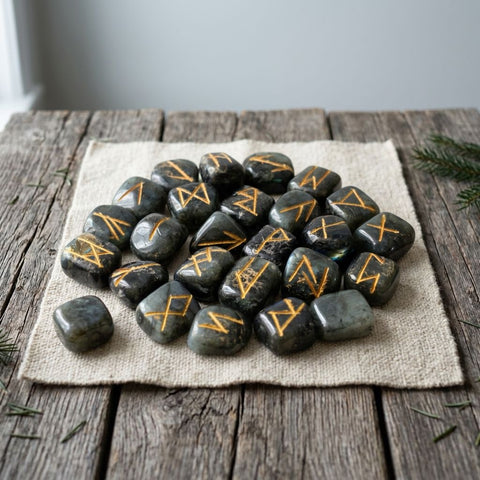 Labradorite runes: 25 dark grey stones with blue flash, engraved in gold
59,90 €
 Lapis lazuli runes: 25 royal blue stones engraved in gold
59,90 €
 Banded agate runes, 25 cream, amber and grey stones engraved in gold
29,90 €
 White agate runes: 25 porcelain white stones engraved in gold
29,90 €
 Moss agate runes: 25 grey-green stones engraved in gold
31,90 €