Ogham Ceirt: the apple or the bush, tenth letter (the Q)
Ceirt, the tenth letter of the ogham, notes a rounded /k/ (Q). Medieval treatises see the apple tree in it. Form, uncertainties, the Otherworld of apples and modern reading.
Key points
| Letter | ᚊ Ceirt, or Cert (Q) |
|---|---|
| Phonetic value | /kʷ/ (rounded k) |
| Family (aicme) | Aicme hÚatha, last letter of the family |
| Form | Five short strokes to the left of the baseline |
| Tree (medieval gloss) | Apple tree (according to the treatise), or bush |
| Modern divinatory meaning | Choice, abundance, beauty |
The letter and its form
Ceirt is the tenth letter of the ogham and the last of the Huath family: five short strokes placed on the left side of the baseline. Its value is that of a /kʷ/, a /k/ pronounced with rounded lips, as in “quick”. It is transcribed Q.
It is a very frequent letter on stones: it appears in the word maqi, “of the son”, which opens or links a large number of funerary formulas of the type “[name] son of [name]”. Over time, the /kʷ/ of primitive Irish merged into /k/, hence the modern word “mac”.
The tree or plant
The Auraicept na n-Éces glosses the letter as aball, the apple tree. The identification is more fragile than it seems. The primitive name *cert has been compared with the Welsh perth, “thorny bush”, and with the Latin quercus, “oak”. It has also been confused with the Irish word ceirt, “rag”, which appears in the kennings.
The wild apple (Malus sylvestris) is a small thorny tree, native to Ireland and Great Britain, with sour fruit. The cultivated apple tree came later, with grafting. The treatise’s gloss may well rest on a word whose meaning is uncertain.
What the medieval sources say
The three series of kennings are in a wretched register, which fits the apple poorly: “shelter of a [fool]” (Morann series), “substance of a worthless man” (Mac ind Óc series), “dregs of clothing” (Cú Chulainn series). They are partly explained by the confusion with the word for “rag”.
This is an interesting case for judging the method of the treatises: the formulas do not always support the gloss that accompanies them. Specialists have also noted the resemblance to the Anglo-Saxon rune peorð, often understood as “pear”, which could indicate an ancient kinship, but the hypothesis remains debated.
| Element | Status |
|---|---|
| Letter form and its value | Attested on carved stones (around the 4th-6th centuries) |
| Name of the letter | Transmitted by medieval manuscripts |
| Associated tree | Gloss from medieval treatises, sometimes uncertain |
| Divinatory meaning | Modern (20th century), disputed by specialists |
Culture and folklore
The apple tree is one of the great trees of Celtic wonder. The account of the Voyage of Bran, an Irish text of around the 7th-8th centuries, opens with a woman who comes from an island of the Otherworld (Emain Ablach, “Emain of the apples”) and offers the hero a silver branch with apple blossoms. Wales knows the island of Avalon, “island of apples”. These stories are literary, composed by clerics.
For the record, they have no demonstrated connection with the letter itself: it is the gloss of the apple tree that builds the bridge.
Modern divinatory reading
In modern divinatory ogham, Ceirt is the letter of choice, beauty and shared abundance: the fruit that may be picked or left, the threshold between two possibilities. This reading comes from twentieth-century handbooks, which retain the apple-tree gloss, and from Robert Graves’s calendar (1948), whose historical foundation is disputed.
It can serve as a mirror when facing a decision: what am I choosing, what am I leaving, and at what cost? No abundance or encounter is promised.
A reflection exercise
Choose a decision to make. Write down two options, and for each, what it would bring you and what it would cost you. Draw or choose the letter Ceirt and ask yourself: what information do I still need before deciding? Set a date by which to decide. The exercise is one of clarity.
Frequently asked questions
Why is Ceirt transcribed as Q?
Because the letter notes a rounded /k/ (/kʷ/), written Q in Latin alphabets.
Is Ceirt really the apple tree?
It is the gloss of the medieval treatise, but the name could mean “bush” and the kennings speak rather of a rag. The identification is uncertain.
What does maqi mean on the stones?
The word means “of the son” and is used in funerary formulas such as “[name] son of [name]”.
Why is the apple linked to the Otherworld?
Irish and Welsh accounts, such as the Voyage of Bran or Avalon, associate apple trees with marvellous islands. They are literary texts.
What is the modern divinatory meaning of Ceirt?
Choice, beauty, shared abundance. It is a modern reading, not a prediction.
Also read
The meanings mentioned belong to tradition and symbolism. They are neither promises of results nor medical advice. Back to Guide to Ogham.
In the shop
Runes: our products
 Tiger's eye runes: 25 honey and bronze stones engraved in gold
59,90 €
 Amethyst runes: 25 purple stones engraved in gold
29,90 €
 Rainbow moonstone runes: 25 milky stones engraved in gold
59,90 €
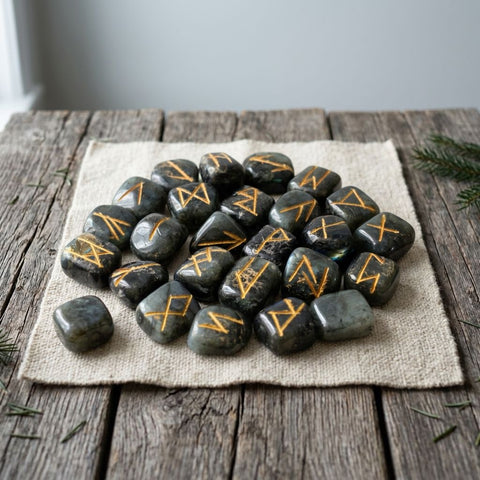 Labradorite runes: 25 dark grey stones with blue flash, engraved in gold
59,90 €
 Lapis lazuli runes: 25 royal blue stones engraved in gold
59,90 €
 Banded agate runes, 25 cream, amber and grey stones engraved in gold
29,90 €
 White agate runes: 25 porcelain white stones engraved in gold
29,90 €
 Moss agate runes: 25 grey-green stones engraved in gold
31,90 €