Ogham Gort: the ivy letter, meaning, history and modern reading
Gort, twelfth letter of the ogham: its name means “field” and the manuscripts link it to ivy. What the sources say, and what is made of it today.
Key points
| Letter | Gort (ᚌ) |
|---|---|
| Rank | 12th letter, Aicme Muine (M group) |
| Sound value | g |
| Tree in the manuscripts | Ivy (according to the Auraicept) |
| Meaning of the name | “field, garden” |
| Modern keywords | Perseverance, attachment, spiral growth |
The letter Gort in the alphabet
Gort is the twelfth letter of the ogham alphabet and the second of the M group, the aicme Muine. It is written with two oblique strokes crossing the baseline, the drach, along which inscriptions were carved on the edge of standing stones. It writes the sound [g], as in “game”.
The roughly four hundred “orthodox” inscriptions that survive date mostly from the 4th to the 6th century CE and are found largely in southern Ireland. Gort is used there only to note personal names, nothing more. The links between letters and trees come from much later medieval manuscripts. Here are the reference points for the letter:
| Reference | Detail |
|---|---|
| Rank | 12th of the 20 main letters |
| Group (aicme) | Aicme Muine (M group): 2 strokes, oblique strokes crossing the baseline |
| Sound value | g |
| Tree or plant in the manuscripts | Ivy (according to the Auraicept) |
The name and its meaning: what the sources say
In Old Irish, gort means “field” or “cultivated land”, a word that linguists compare with Celtic and Latin forms (hortus) and with the English garden, from an Indo-European root that evokes an enclosure. The name of the letter is therefore, very probably, that of an enclosed and cultivated space.
Medieval glossators, notably in the Auraicept na n-Éces (“the scholars’ primer”, a text whose core is often dated to the 8th century and which was copied into the Book of Ballymote around 1390), match Gort with ivy (edind). The text does not explain this choice: nothing in the sense of “field” naturally calls for ivy. It is an example of how the “tree” tradition was added after the fact to older letter names. The scholar Damian McManus, moreover, considers that only a small number of letter names plausibly designate trees.
The associated tree or plant
Common ivy (Hedera helix) is an evergreen climber that clings with small holdfasts without drawing sap from its support. It flowers late, from September to November, providing nectar to insects at a season when little remains; its black berries ripen in late winter. Leaves and berries are toxic if swallowed: do not use them in herbal teas or preparations.
For enthusiasts of Robert Graves’s “tree calendar” (1948), the month of Gort corresponds, in the most widespread version, to a period from late September to late October. This calendar is a modern construction, disputed by specialists.
The three portraits of the name (bríatharogam)
Three medieval lists, the bríatharogaim, associate each letter with a short, imagery-rich expression, sometimes called a “kenning”. For Gort, they evoke pasture and abundance, not ivy:| List | Old Irish expression | Approximate sense |
|---|---|---|
| Morann mac Moín | milsiu féraib | the sweetest of herbs |
| Mac ind Óc | ined erc | a place good for cows |
| Cú Chulainn | sásad ile | the satisfying of multitudes |
These expressions are hard to translate: some may be corrupted, and the proposed translations are approximate. They are not reading instructions, only medieval images.
Modern divinatory reading
Modern ogham sets give Gort ivy as its emblem and read the letter as a figure of perseverance, attachment and spiral growth: what clings, what takes hold, slow progress. Other authors, starting from the sense of “field”, see in it rather a piece of land to cultivate, a project to tend.
The two readings are not mutually exclusive, but neither is ancient. They were born from the idea that the letters form a “tree alphabet”, popularised by Graves in The White Goddess (1948) and taken up in divination books from the 1980s onwards.
These meanings are modern: they come from ogham sets and books published from the late twentieth century onwards, and authors do not always agree. Nothing proves that ogham was used for divination in ancient Ireland.
A reflection exercise
Think of a project you have been tending for a long time. Note what supports it, then what may be stifling it. Draw Gort and ask yourself what in your life needs to be cultivated rather than pushed. The exercise invites you to look at how you sustain things; it says nothing about what will happen.Frequently asked questions
What does Gort mean in the ogham alphabet?
The name means “field” or “garden” in Old Irish. The letter writes the sound [g] and is the twelfth of the alphabet.
Which tree corresponds to Gort?
Medieval manuscripts associate it with ivy. The link with the sense of “field” is not explained in the texts.
Is ivy really Gort’s tree?
It is a tradition of medieval glossators, not a fact demonstrated on the oldest inscriptions. Ivy, moreover, is not a tree.
Was Gort used for divination in ancient Ireland?
No evidence shows it. The divinatory use of the letters is modern.
Which month corresponds to Gort in the Celtic tree calendar?
In the most widespread version, the month of Gort runs from late September to late October. This calendar is a modern invention of Graves’s.
Also read
The meanings mentioned belong to tradition and symbolism. They are neither promises of results nor medical advice. Back to Guide to Ogham.
In the shop
Runes: our products
 Tiger's eye runes: 25 honey and bronze stones engraved in gold
59,90 €
 Amethyst runes: 25 purple stones engraved in gold
29,90 €
 Rainbow moonstone runes: 25 milky stones engraved in gold
59,90 €
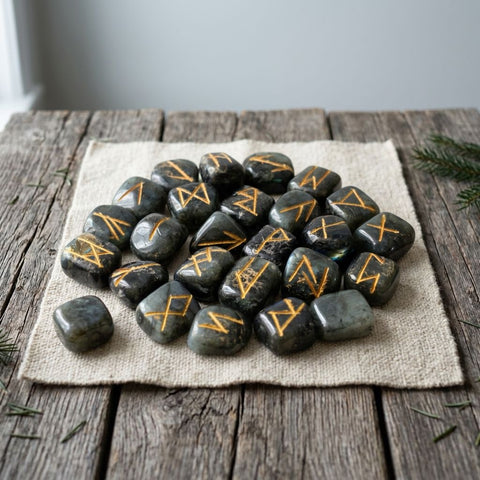 Labradorite runes: 25 dark grey stones with blue flash, engraved in gold
59,90 €
 Lapis lazuli runes: 25 royal blue stones engraved in gold
59,90 €
 Banded agate runes, 25 cream, amber and grey stones engraved in gold
29,90 €
 White agate runes: 25 porcelain white stones engraved in gold
29,90 €
 Moss agate runes: 25 grey-green stones engraved in gold
31,90 €