Ogham Idad (Iodhadh): the yew letter, meaning, sources and reading
Idad or Iodhadh, the twentieth and last letter of ogham: an uncertain name, the yew of the manuscripts, and kennings about antiquity. Sources, caution and modern reading.
Key points
| Letter | Idad (ᚔ) |
|---|---|
| Rank | 20th letter, Aicme Ailme (A group) |
| Sound value | i |
| Tree in the manuscripts | Yew (ibar, eo) |
| Meaning of the name | uncertain, possibly linked to “yew” |
| Modern keywords | Longevity, memory, ending and rebirth |
The letter Idad in the alphabet
Idad, also found in the form Iodhadh, is the twentieth and last main letter of ogham: five notches on the baseline, for the sound [i]. It closes the aicme Ailme after Edad.
After it, the manuscripts add five further signs, the forfeda, only one of which regularly appears on inscriptions. Here are the key facts about the last letter:
| Reference | Detail |
|---|---|
| Rank | 20th of the 20 main letters |
| Group (aicme) | Aicme Ailme (A group): 5 strokes, notches or short strokes perpendicular to the baseline, used to write vowels |
| Sound value | i |
| Tree or plant in the manuscripts | Yew (ibar, eo) |
The name and its meaning: what the sources say
The name is of uncertain origin. The glossators recognised the yew in it, but this derivation is hardly plausible; an ancient Celtic form related to Welsh ywen, “yew”, is a more credible lead, as is a connection with ibar, the Irish name for yew. McManus also suggests that idad may have been coined to pair with Edad.
The result is paradoxical: the last letter carries a very well-known tree, yet its name is nearly as obscure as that of Edad. It is a useful reminder that the “trees of ogham” are a tradition of medieval commentary rather than a key to the original alphabet.
The associated tree or plant
The common yew (Taxus baccata) is a conifer with very slow growth and extreme longevity. Old yews, often hollow, are hard to date; many stand in churchyards in Ireland and Britain. Every part of the tree is toxic to humans and animals, except the red flesh of the aril, whose seed is itself very poisonous. Do not burn it, do not chew it, and keep it away from children and animals, especially horses.
Yew wood, elastic, was used for bows. In Graves's calendar (1948), the vowels are not months; their role varies between modern versions.
The three portraits of the name (bríatharogam)
For this letter, the first two lists stress antiquity; the third is uncertain:| List | Old Irish expression | Approximate meaning |
|---|---|---|
| Morann mac Moín | sinem fedo | the most ancient of trees |
| Mac ind Óc | caínem sen | the most beautiful of the ancients |
| Cú Chulainn | lúth lobair (?) | strength of one who is weakened (doubtful reading) |
These expressions are hard to translate: some may be corrupt, and the proposed translations are approximate. They are not reading instructions, only medieval images.
Modern divinatory reading
Modern readings, strongly shaped by the image of the churchyard yew, make Idad the letter of longevity, memory, ending and rebirth: the ancient tree, the lineage, what passes through time. They read in it a reminder that every ending prepares a new beginning.
This image is appealing, but it owes much to Graves and to the books that followed him. On stones from the 4th to the 6th century, the letter served only to write names, like the [i] in any other word.
These meanings are modern: they come from ogham games and books published from the late twentieth century onward, and their authors do not always agree. Nothing proves that ogham was used for divination in ancient Ireland.
A reflective exercise
Search your memories for what has come to you from further back than yourself: a recipe, an object, a family story. Note what you want to keep. Draw Idad and ask yourself which story you want to pass on. The exercise is about memory, not the future.Frequently asked questions
What does Idad mean in ogham?
The meaning of the name is uncertain; it is linked to the yew. It is the twentieth letter, which represents the sound [i].
Is the yew really Idad's tree?
The glossators say so, though the etymology of the name does not prove it. It is a convention of the tradition.
What are the forfeda after Idad?
Five additional signs added in the manuscripts; only one, Ébad, regularly appears on stones.
Is the yew dangerous?
Yes: all its parts, except the flesh of the aril, are toxic. Do not chew them or use them in an infusion.
Also read
The meanings mentioned belong to tradition and symbolism. They are neither promises of results nor medical advice. Back to Guide to Ogham.
In the shop
Runes: our products
 Tiger's eye runes: 25 honey and bronze stones engraved in gold
59,90 €
 Amethyst runes: 25 purple stones engraved in gold
29,90 €
 Rainbow moonstone runes: 25 milky stones engraved in gold
59,90 €
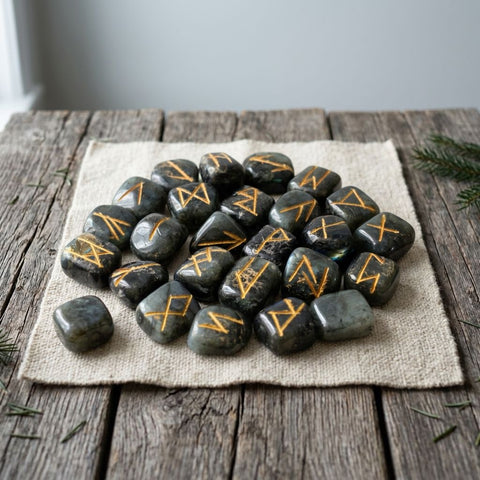 Labradorite runes: 25 dark grey stones with blue flash, engraved in gold
59,90 €
 Lapis lazuli runes: 25 royal blue stones engraved in gold
59,90 €
 Banded agate runes, 25 cream, amber and grey stones engraved in gold
29,90 €
 White agate runes: 25 porcelain white stones engraved in gold
29,90 €
 Moss agate runes: 25 grey-green stones engraved in gold
31,90 €