Ogham Edad (Eadhadh): the aspen letter, a mysterious name
Edad or Eadhadh, the nineteenth letter of ogham: a name of unknown origin, the aspen of the manuscripts and obscure kennings. What is known, and what is assumed.
Key points
| Letter | Edad (ᚓ) |
|---|---|
| Rank | 19th letter, Aicme Ailme (A group) |
| Sound value | e |
| Tree in the manuscripts | Aspen (crann crithach) |
| Meaning of the name | unknown |
| Modern keywords | Listening, sensitivity, courage |
The letter Edad in the alphabet
Edad, also written Eadhadh, is the nineteenth letter of ogham, the fourth vowel: four notches on the baseline, for the sound [e]. It belongs to the aicme Ailme, between Úr and Idad.
It is one of the letters whose history is least clear: even its name has no known meaning. Here are the key facts:
| Reference | Detail |
|---|---|
| Rank | 19th of the 20 main letters |
| Group (aicme) | Aicme Ailme (A group): 4 strokes, notches or short strokes perpendicular to the baseline, used to write vowels |
| Sound value | e |
| Tree or plant in the manuscripts | Aspen (crann crithach) |
The name and its meaning: what the sources say
The meaning of edad is unknown. Specialists think the name may have been coined to form a pair with Idad, like some words of ancient alphabets that answer each other by their sounds. This reading is a hypothesis by McManus, not an established fact.
The glossators' tradition, in the Auraicept na n-Éces, gives “true tree or trembling tree” (crann fir no crithach), hence the identification with the aspen. This link has little support in etymology or in the kennings. It is better to regard the aspen here as a convention.
The associated tree or plant
The aspen (Populus tremula) is a poplar whose leaves, carried on flattened stalks, tremble at the slightest breath of air, which explains its name. It suckers: a single colony can form a grove of many trunks connected by their roots. Its wood is soft and light. It is a pioneer tree of hedgerows and clearings, found in the British Isles.
In Graves's tree calendar (1948), the vowels are not months; they serve as markers, with different versions depending on the book. This modern construction should be distinguished from the Irish sources.
The three portraits of the name (bríatharogam)
The kennings of this letter are among the most obscure in the alphabet, and that of Cú Chulainn is not established:| List | Old Irish expression | Approximate meaning |
|---|---|---|
| Morann mac Moín | érgnaid fid | tree that discerns |
| Mac ind Óc | commaín carat | exchange of friends |
| Cú Chulainn | doubtful text | not established (the Cú Chulainn list is poorly preserved) |
These expressions are hard to translate: some may be corrupt, and the proposed translations are approximate. They are not reading instructions, only medieval images.
Modern divinatory reading
Modern readings, based on the aspen, make Edad the letter of sensitivity, listening and courage in the face of fear: a leaf trembles, but the tree holds. Another reading, closer to the first kenning, sees discernment in it. The idea of an “exchange of friends” inspires some authors, who connect the letter with trust and reciprocity.
When the meaning of a letter is this uncertain, the most honest course is to leave your reading open: it is for you to decide what enlightens you, and to say so.
These meanings are modern: they come from ogham games and books published from the late twentieth century onward, and their authors do not always agree. Nothing proves that ogham was used for divination in ancient Ireland.
A reflective exercise
Think of a fear that makes you tremble without stopping you from moving forward. Note what supports you when it rises. Draw Edad and ask yourself what it asks you to listen to rather than silence. The exercise invites you to look at an emotion, not to predict an event.Frequently asked questions
What does Edad mean in ogham?
The meaning of the name is unknown. It is the nineteenth letter, which represents the sound [e].
Is Edad the letter of the aspen?
The manuscripts gloss it as “true tree or trembling tree”, hence the aspen. This identification has little support and remains a convention.
Why are there two forms, Edad and Eadhadh?
They are two spellings of the same letter: one in Old Irish, the other in modern Irish.
Why do Edad and Idad form a pair?
Their names answer each other in form; some researchers think one was coined to go with the other.
Also read
The meanings mentioned belong to tradition and symbolism. They are neither promises of results nor medical advice. Back to Guide to Ogham.
In the shop
Runes: our products
 Tiger's eye runes: 25 honey and bronze stones engraved in gold
59,90 €
 Amethyst runes: 25 purple stones engraved in gold
29,90 €
 Rainbow moonstone runes: 25 milky stones engraved in gold
59,90 €
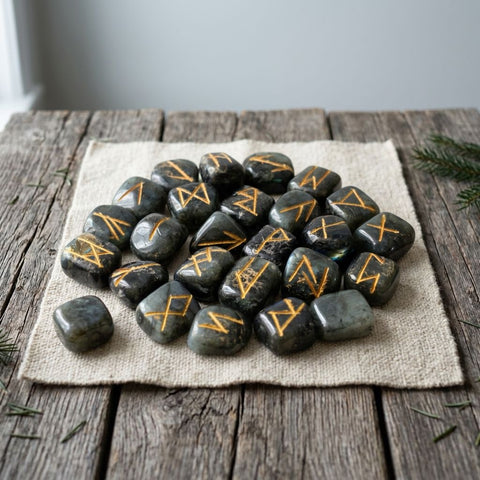 Labradorite runes: 25 dark grey stones with blue flash, engraved in gold
59,90 €
 Lapis lazuli runes: 25 royal blue stones engraved in gold
59,90 €
 Banded agate runes, 25 cream, amber and grey stones engraved in gold
29,90 €
 White agate runes: 25 porcelain white stones engraved in gold
29,90 €
 Moss agate runes: 25 grey-green stones engraved in gold
31,90 €