Ogham Beith: The Birch, First Letter of the Tree Alphabet
Beith, the first letter of Irish ogham, is traditionally associated with the birch. Its form, medieval sources, folklore and modern divinatory reading, kept distinct from the history.
Key points
| Letter | ᚁ Beith (B) |
|---|---|
| Phonetic value | /b/ |
| Family (aicme) | Aicme Beithe, the first of the four families |
| Form | A short stroke to the right of the baseline |
| Tree (medieval gloss) | Birch |
| Modern divinatory meaning | Beginnings, renewal, simplicity |
The letter and its form
Beith is the first letter of ogham, the ancient Irish script carved on the edges of standing stones. Some 400 inscriptions are known, dating mostly from the 4th to the 6th century, chiefly in south-west Ireland (Cork and Kerry), as well as in Wales, Scotland, the Isle of Man and Cornwall. The text is generally read from bottom to top, along the stone's edge that serves as the baseline.
Beith is written as a single short stroke, perpendicular to the line, on the right-hand side. It opens the family (aicme) known as “of Beith”, which comprises five letters: B, L, F, S, N. The alphabet is in fact sometimes called “Beith-Luis-Nin”, after its first three letters.
The tree or the plant
The name “beith” is the Old Irish word for the birch. It has relatives in the Welsh bedw, the Breton bezv and the Latin betula. The birch (especially the silver birch and the downy birch) is a pioneer tree: it quickly colonises cleared ground, thriving in the light, with its white bark peeling into thin strips.
Pliny the Elder notes it as a tree of Gaulish origin, remarkable for its whiteness, whose rods were used by magistrates. Its bark yields tar, which prehistoric communities used as glue: the ancient Indo-European name of the tree is thought to refer to resin. It is no doubt to these practical uses that the images medieval texts associate with it are linked.
What the medieval sources say
The Auraicept na n-Éces (“the scholars' primer”), a grammatical treatise in Middle Irish, is the chief source of the idea that the letters of ogham bear the names of trees. The core of the text may go back to the 8th century, but the oldest surviving manuscripts date from the late 14th century. The treatise relates that, according to a mythological account, beith was the first letter ever written in ogham.
Another tradition, the “kennings” (bríatharogaim, or the ogham of words), links each letter with a short formula. For Beith, the series attributed to Morann says “withered foot with fine hair”, an image compared with the fine drooping branches of the birch. An important caveat: according to the work of linguists such as Damian McManus, at most eight of the twenty letter names are really names of trees; the idea of a “tree alphabet” is therefore partly a medieval construction.
| Element | Status |
|---|---|
| Form of the letter and its value | Attested on carved stones (roughly 4th–6th centuries) |
| Name of the letter | Transmitted by medieval manuscripts |
| Associated tree | Gloss from medieval treatises, sometimes uncertain |
| Divinatory meaning | Modern (20th century), disputed by specialists |
Culture and folklore
In the Nordic countries and in Russia, the birch is often associated with midsummer festivities: branches raised in front of houses, and small bundles of twigs (vihta in Finland) used in the sauna. In Western Europe, it is among the trees planted or cut for May festivities. These customs are documented by folklorists; they prove nothing about ogham.
The Old Futhark, the runic alphabet, also has a letter named after the birch: Berkano (“birch twig”, in reconstructed Proto-Germanic). These are two distinct alphabets, born in different cultures; do not confuse them.
Modern divinatory reading
The divinatory reading of ogham is a modern practice. It owes much to Robert Graves, who published The White Goddess in 1948 and proposed in it a thirteen-month “tree calendar”. Ogham specialists reject this construction, yet it has become very popular. In this calendar, Beith opens the year shortly after the winter solstice.
In current games and manuals, Beith is read as the card of beginning: a first step, a renewal, a clearing out, the choice of simplicity. It invites the question: what am I ready to let go of in order to begin? There is no prediction here, only a line of reflection drawn from the image of the pioneer birch.
A reflection exercise
Take a sheet of paper. Write down one thing you would like to begin and one thing you would need to let go of to make room for it. Draw or choose the letter Beith and ask yourself: what would be the first move, as simple as possible? Make that move during the day. The exercise is about moving from intention to action, nothing more.
Frequently asked questions
What does Beith mean in ogham?
It is the old Irish name of the birch and the first letter of the alphabet, with the value /b/.
Is ogham really a tree alphabet?
Only in part. Medieval treatises linked trees with the letters, but according to specialists at most eight of the twenty letter names are genuine tree names.
Is the Celtic tree calendar authentic?
No. It dates from Robert Graves (1948). It is popular but is not attested in ancient sources.
Was ogham used for divination?
No source proves such a use in antiquity. The divinatory reading is modern.
What is the modern divinatory meaning of Beith?
Beginnings, renewal, simplicity. It is a line of reflection, not a prediction.
Also read
The meanings mentioned belong to tradition and symbolism. They are neither promises of results nor medical advice. Back to Guide to Ogham.
In the shop
Runes: our products
 Tiger's eye runes: 25 honey and bronze stones engraved in gold
59,90 €
 Amethyst runes: 25 purple stones engraved in gold
29,90 €
 Rainbow moonstone runes: 25 milky stones engraved in gold
59,90 €
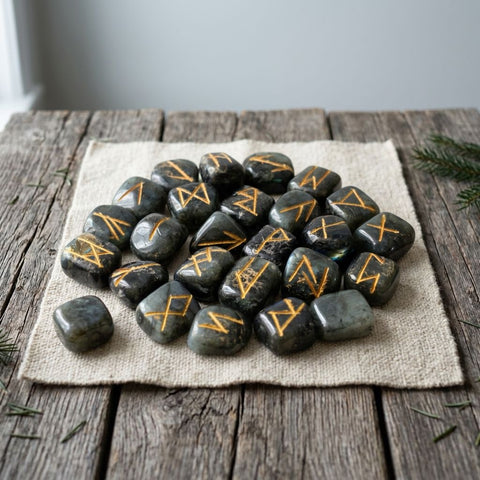 Labradorite runes: 25 dark grey stones with blue flash, engraved in gold
59,90 €
 Lapis lazuli runes: 25 royal blue stones engraved in gold
59,90 €
 Banded agate runes, 25 cream, amber and grey stones engraved in gold
29,90 €
 White agate runes: 25 porcelain white stones engraved in gold
29,90 €
 Moss agate runes: 25 grey-green stones engraved in gold
31,90 €