Ogham Dair: the oak, seventh letter of the ancient Irish alphabet
Dair, the seventh letter of the ogham, is the oak in ancient Ireland. Form, etymology, places named after it, druids and modern divinatory reading.
Key points
| Letter | ᚇ Dair (D) |
|---|---|
| Phonetic value | /d/ |
| Family (aicme) | Aicme hÚatha |
| Form | Two short strokes to the left of the baseline |
| Tree (medieval gloss) | Oak |
| Modern divinatory meaning | Quiet strength, stability, threshold |
The letter and its form
Dair is the seventh letter of the ogham and the second of the Huath family: two short strokes placed on the left side of the baseline. Its value, a /d/, is beyond doubt, and the letter is well attested on the stones of south-western Ireland.
It is one of the five letters whose name is immediately understandable, with Beith, Fearn, Sail and Coll. It can therefore be taken as one of the anchor points of the tradition of the tree alphabet.
The tree or plant
The word “dair” (daur in an earlier form) means the oak, and is related to the Welsh derwen and the Breton derv. It derives from an Indo-European root meaning “tree”, perhaps from an adjective meaning “hard, firm”. In Ireland and Great Britain, the two common species are the pedunculate oak and the sessile oak.
The oak is a massive tree of slow growth, which can live for several centuries. Its hard and durable wood has been used for roof frames, ships, barrels and furniture. Many Irish place names still preserve its trace.
What the medieval sources say
The three series of kennings show remarkable unanimity about the oak and craftsmanship: “the highest of trees” (Morann series), “work of a craftsman” (Mac ind Óc series) and “the most carved of craftsmen’s work” (Cú Chulainn series). They point to the tree’s grandeur and the quality of its wood.
This letter is therefore less problematic than others: name, kennings and use agree. That is precisely why it is often cited as an example in presentations of the ogham.
| Element | Status |
|---|---|
| Letter form and its value | Attested on carved stones (around the 4th-6th centuries) |
| Name of the letter | Transmitted by medieval manuscripts |
| Associated tree | Gloss from medieval treatises, sometimes uncertain |
| Divinatory meaning | Modern (20th century), disputed by specialists |
Culture and folklore
In Irish, the root dair gives doire, “oak grove”, which is found in Derry/Londonderry, or in Kildare (Cill Dara, “the church of the oak”), a place associated with Saint Brigid. Personal names such as Daire, Dara or Darragh derive from it.
The oak also has the reputation of being “the tree of the druids”. Pliny the Elder reports, in the first century, that the Gaulish druids revered the oak and the mistletoe growing on it. Some linguists connect the word “druid” with a root meaning “oak” or “solid”, but the etymology remains debated. The link between the ogham, the writing of Ireland from the 4th to 6th centuries, and the Gaulish druids is not established.
Modern divinatory reading
In modern divinatory ogham, Dair is the letter of quiet strength, of stability and of the threshold: holding firm, taking root, having authority without fanfare. This reading comes from twentieth-century handbooks and from the calendar of Robert Graves (1948), whose foundation specialists of the ogham dispute.
It can serve as a mirror: where do I need endurance? Where am I stubbornly insisting for no good reason? The oak that resists is also the one that breaks when the wind is too strong.
A reflection exercise
Choose a project that spans several months. Write down three things that give it solidity (a habit, a support, a budget) and one that calls for flexibility. Draw or choose the letter Dair and note one tiny, repeatable action of patience. The exercise is one of consistency, with no forecasting.
Frequently asked questions
What does Dair mean in ogham?
It is the oak in Old Irish and the seventh letter of the alphabet, with the value /d/.
Is the oak a safe identification for this letter?
Yes, it is one of the most solid identifications: the name, the kennings and the uses agree.
Was the ogham the writing of the druids?
Nothing proves it. The ogham dates from the 4th to 6th centuries in Ireland, whereas the Gaulish druids are described several centuries earlier.
Where does the name Kildare come from?
From Cill Dara, “the church of the oak”, where dair means oak.
What is the modern divinatory meaning of Dair?
Quiet strength, stability, endurance. It is a modern reading, not a prediction.
Also read
The meanings mentioned belong to tradition and symbolism. They are neither promises of results nor medical advice. Back to Guide to Ogham.
In the shop
Runes: our products
 Tiger's eye runes: 25 honey and bronze stones engraved in gold
59,90 €
 Amethyst runes: 25 purple stones engraved in gold
29,90 €
 Rainbow moonstone runes: 25 milky stones engraved in gold
59,90 €
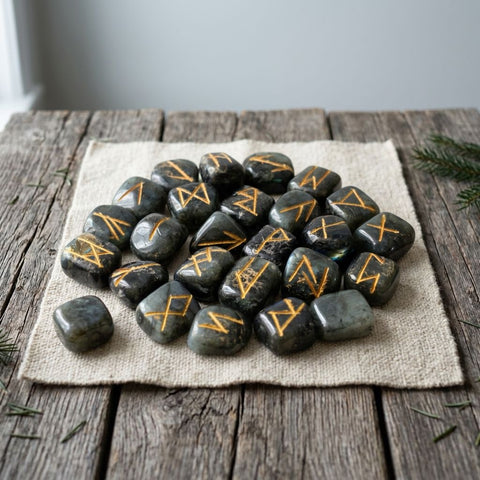 Labradorite runes: 25 dark grey stones with blue flash, engraved in gold
59,90 €
 Lapis lazuli runes: 25 royal blue stones engraved in gold
59,90 €
 Banded agate runes, 25 cream, amber and grey stones engraved in gold
29,90 €
 White agate runes: 25 porcelain white stones engraved in gold
29,90 €
 Moss agate runes: 25 grey-green stones engraved in gold
31,90 €