Ogham Uath: the hawthorn, sixth letter and the name of dread
Uath, the sixth letter of the ogham and the first of the Huath family, is associated with the hawthorn, but its name means rather “dread”. Sources, folklore and modern reading.
Key points
| Letter | ᚆ Uath (H) |
|---|---|
| Phonetic value | /h/ in conventional transcription, ancient value debated |
| Family (aicme) | Aicme hÚatha, second family |
| Form | One short stroke to the left of the baseline |
| Tree (medieval gloss) | Hawthorn (white thorn) |
| Modern divinatory meaning | Obstacle, patience, measured trial |
The letter and its form
Uath is the sixth letter of the ogham and the first of the second family, named after it: aicme hÚatha. Its strokes are placed on the left side of the baseline (or above it, when the alphabet is written horizontally), unlike the Beith family. It is written with a single short stroke.
It is a hard letter to place. The manuscripts give it the value /h/, but linguists see it rather as a late readjustment: /h/ did not exist as such in Old Irish. Damian McManus has proposed a /j/ (as in “yes”), which raises other problems. Above all, the letter does not appear in any known stone inscriptions, which makes certainty impossible.
The tree or plant
The gloss in the Auraicept na n-Éces gives the hawthorn, or white thorn (Crataegus monogyna), a thorny shrub of hedges and woodland edges, which flowers in May with a profusion of small white blossoms. The gloss adds that the letter is “dreaded” because of its thorns.
The Irish word úath means “horror, dread”. The link between this word and the plant is therefore a metaphor: the hawthorn is the tree that scratches. The original etymology remains obscure, and a hypothesis connecting úath with the Latin pavere (“to fear”) is not accepted by all linguists.
What the medieval sources say
The three series of kennings illustrate fear and the night: “gathering of packs of hounds” (Morann series), “paling of faces” (Mac ind Óc series), “the hardest thing at night” (Cú Chulainn series). None describes a specific plant. It is the gloss of the treatise that, after the fact, placed the hawthorn on this letter.
This shows how the tradition works: the name is a word of emotion, the kenning an image, the gloss a tree. Specialists also consider that at most eight of the twenty letter names are really names of trees.
| Element | Status |
|---|---|
| Letter form and its value | Attested on carved stones (around the 4th-6th centuries) |
| Name of the letter | Transmitted by medieval manuscripts |
| Associated tree | Gloss from medieval treatises, sometimes uncertain |
| Divinatory meaning | Modern (20th century), disputed by specialists |
Culture and folklore
In Irish folklore, the lone hawthorn, called the “fairy thorn” (sceach), is believed to belong to the beings of the Otherworld. Many accounts report that building works were diverted so as not to cut it. This is a documented popular belief, and it can be presented as such. In the British Isles, it was also considered bad luck to bring hawthorn blossom into the house.
May is the time of its flowering, hence the English name may for the hawthorn. The “May trees” of village festivals were often branches of flowering thorn.
Modern divinatory reading
In modern divinatory ogham, Uath is the letter of the obstacle and of the measured trial: what stings, what holds back, what calls for patience. It is also read as the need to set limits and to protect oneself, as thorns protect the flowers. This reading comes from twentieth-century handbooks and from the calendar of Robert Graves (1948), which has no basis in ancient sources.
A responsible reading announces no misfortune. It invites the question: what limit do I need to set, and which thorn am I ready to go around with patience?
A reflection exercise
Think of a situation that currently “stings” you. Write down precisely what hurts you (a word, a habit, an expectation), then a way of setting a clear limit without closing yourself off. Draw or choose the letter Uath and note the first gesture that would seem right to you. The exercise is for naming, not predicting.
Frequently asked questions
What does Uath mean in ogham?
The word means “dread, horror” in Old Irish; the medieval gloss sees the hawthorn in it.
Is Uath pronounced /h/?
That is the value given by the manuscripts, but it is debated. The letter is not attested on any known stones.
Is the hawthorn the tree of this letter?
It is the gloss of the medieval treatise; the kennings, for their part, evoke fear and night without naming the plant.
Why is it said that hawthorn brings misfortune?
It is a popular belief of the British Isles, tied to fairy lore and to May flowering. It has no proven basis.
What is the modern divinatory meaning of Uath?
The obstacle, patience, the limit to be set. It is a modern reading, not a prediction.
Also read
The meanings mentioned belong to tradition and symbolism. They are neither promises of results nor medical advice. Back to Guide to Ogham.
In the shop
Runes: our products
 Tiger's eye runes: 25 honey and bronze stones engraved in gold
59,90 €
 Amethyst runes: 25 purple stones engraved in gold
29,90 €
 Rainbow moonstone runes: 25 milky stones engraved in gold
59,90 €
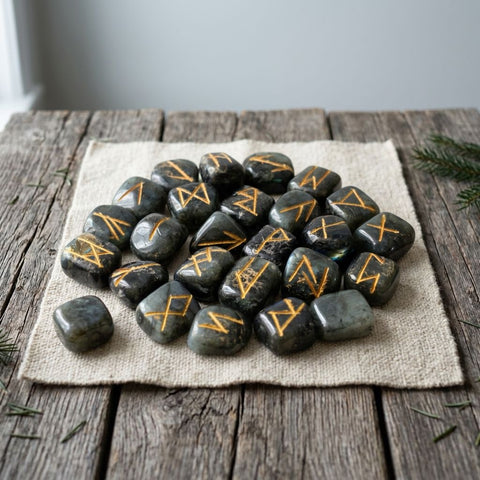 Labradorite runes: 25 dark grey stones with blue flash, engraved in gold
59,90 €
 Lapis lazuli runes: 25 royal blue stones engraved in gold
59,90 €
 Banded agate runes, 25 cream, amber and grey stones engraved in gold
29,90 €
 White agate runes: 25 porcelain white stones engraved in gold
29,90 €
 Moss agate runes: 25 grey-green stones engraved in gold
31,90 €