Ogham Fearn: The Alder, Third Letter of the Ancient Irish Alphabet
Fearn, the third letter of ogham, is associated with the alder, a tree of riverbanks. Form, early value /w/, medieval kennings, Welsh folklore and modern reading.
Key points
| Letter | ᚃ Fearn (F, V) |
|---|---|
| Phonetic value | /w/ in Primitive Irish, /f/ later |
| Family (aicme) | Aicme Beithe |
| Form | Three short strokes to the right of the baseline |
| Tree (medieval gloss) | Alder |
| Modern divinatory meaning | Courage, foundations, protection |
The letter and its form
Fearn is the third letter of the Beith family: three short strokes placed on the same side of the baseline. Its original value is not the one attributed to it in later Irish. In inscriptions in Primitive Irish it recorded a /w/; in Old Irish it became an /f/. This is why transcriptions render it sometimes as V, sometimes as F.
It appears in a few proper names carved on stone. The Old Irish word “fern” is related to the Welsh gwernen, “alder”, and to the reconstructed Primitive Irish *wernā.
The tree or the plant
The common alder (Alnus glutinosa) grows with its feet in the water: riverbanks, marshes, damp valley floors. Its roots host bacteria that enrich the soil with nitrogen, and its wood, which resists immersion very well, was used to build stakes and pilings, and later clogs and cooperage. A feature often noted: freshly cut wood takes on an orange to reddish hue.
Here the identification is among the best founded in the series: the name and the kennings converge. Specialists consider it fairly certain, which is not the case for all the letters.
What the medieval sources say
The three series of kennings describe real uses of the wood. “Vanguard of warriors” (Morann series) would refer to the wood of shields, and the red tint of freshly cut wood would evoke blood; “milk vessel” (Mac ind Óc) refers to the use of the wood for making containers; “protection of the heart” (Cú Chulainn) echoes the image of the shield. The Auraicept na n-Éces follows this same logic, and archaeological digs confirm the use of alder for this kind of object.
This is a good example of how medieval scholars built their glosses: a name, a formula, a craftsman's know-how. Specialists stress, however, that many other letters cannot be tied to a tree.
| Element | Status |
|---|---|
| Form of the letter and its value | Attested on carved stones (roughly 4th–6th centuries) |
| Name of the letter | Transmitted by medieval manuscripts |
| Associated tree | Gloss from medieval treatises, sometimes uncertain |
| Divinatory meaning | Modern (20th century), disputed by specialists |
Culture and folklore
The Brittonic world also knows the warrior alder: a Welsh poem attributed to the Taliesin tradition, Cad Goddeu (“the battle of the trees”), places the alder in the front line. This poem, preserved in a 14th-century manuscript, was widely quoted by Robert Graves; its interpretation remains debated.
In Ireland, the name of the tree survives in place names: Ferns, in County Wexford, comes from a word meaning alders. For other letters, fewer traces remain: the alder has more than most.
Modern divinatory reading
In modern divinatory ogham, Fearn is the letter of courage and foundations: holding one's place, laying solid bases, protecting oneself without closing oneself off. The image comes from the alder that keeps its feet in the water and does not rot there. This reading derives from twentieth-century manuals and from Robert Graves's calendar (1948), which is not attested in ancient sources.
A responsible reading finds in it no promise of success or magical shield. It serves to ask: what am I relying on, and what keeps me standing?
A reflection exercise
Draw two columns. On one side, what serves as your foundation (a habit, a person, a place, a value). On the other, what requires your vigilance. Draw or choose the letter Fearn and note one thing you could strengthen this week. The exercise aims at clarity, not protection.
Frequently asked questions
Why does Fearn have two values, V and F?
In Primitive Irish the letter recorded a /w/; in Old Irish it became /f/. Transcriptions therefore vary.
Is Fearn really the alder?
Yes, it is one of the best-founded identifications: the name, the kennings and the uses of the wood agree.
Why is the alder linked with warriors?
Medieval kennings evoke shields made of alderwood and the red tint of freshly cut wood.
Does the poem Cad Goddeu speak of ogham?
Not directly: it belongs to the Welsh tradition and names the alder among the fighting trees.
What is the modern divinatory meaning of Fearn?
Courage, foundations, protection in the figurative sense. It is a modern reading, not a prediction.
Also read
The meanings mentioned belong to tradition and symbolism. They are neither promises of results nor medical advice. Back to Guide to Ogham.
In the shop
Runes: our products
 Tiger's eye runes: 25 honey and bronze stones engraved in gold
59,90 €
 Amethyst runes: 25 purple stones engraved in gold
29,90 €
 Rainbow moonstone runes: 25 milky stones engraved in gold
59,90 €
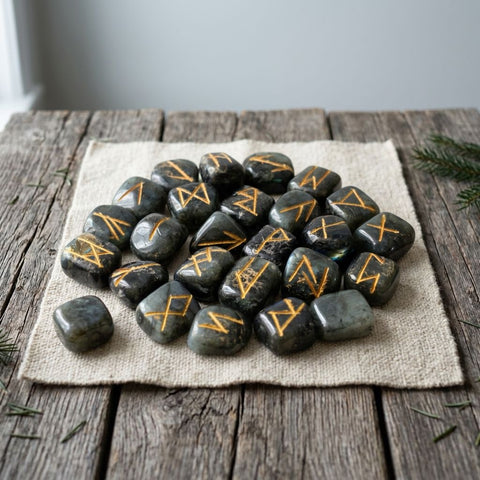 Labradorite runes: 25 dark grey stones with blue flash, engraved in gold
59,90 €
 Lapis lazuli runes: 25 royal blue stones engraved in gold
59,90 €
 Banded agate runes, 25 cream, amber and grey stones engraved in gold
29,90 €
 White agate runes: 25 porcelain white stones engraved in gold
29,90 €
 Moss agate runes: 25 grey-green stones engraved in gold
31,90 €