Ogham Sail: the willow, fourth letter of the tree alphabet
Sail, the fourth letter of the ogham, is associated with the willow. Its form, etymology (Latin salix), honey and bee kennings, modern divinatory reading and limits.
Key points
| Letter | ᚄ Sail (S) |
|---|---|
| Phonetic value | /s/ |
| Family (aicme) | Aicme Beithe |
| Form | Four short strokes to the right of the baseline |
| Tree (medieval gloss) | Willow |
| Modern divinatory meaning | Intuition, flexibility, cycles |
The letter and its form
Sail is the fourth letter of the Beith family: four short strokes aligned on the same side of the baseline. Its value is that of an /s/. Its four aligned strokes form a small comb, easy to pick out along the edge of a stone.
The name is transparent: “sail” (or “saille”) meant willow in Old Irish. It is related to the Welsh helyg and to the Latin salix, from an ancient Indo-European root meaning “dirty, greyish”, evoking the colour of the bark and foliage.
The tree or plant
The willow (genus Salix) includes hundreds of species. The most common in Europe are the white willow, the crack willow and the goat willow (or “pussy willow”). They like damp soils, line streams and ditches, and root very easily from cuttings: a twig planted in moist ground often takes root.
Its catkins, which open very early in spring, provide bees with one of their first sources of pollen. Its supple shoots were long used to weave baskets, fences and traps. The bark played a role in the history of chemistry: salicin, isolated in the early nineteenth century, is one of the molecules from which aspirin is derived. This is a fact of the history of science, and it implies no health advice.
What the medieval sources say
For Sail, the three series of kennings fit the willow remarkably well. The Morann series speaks of “the pallor of a lifeless being”, which is linked to the grey colour of the bark and foliage. The other two series speak of “food of the bees” and “beginning of honey”, phrases that recall the role of the catkins in the first flowering.
The ogham word lists also give other equivalents for this letter, such as “hawk” (seg) or “pack-saddle” (srathar), which show that the system links each letter to words of all kinds, not only trees. The willow is therefore not the only possible reading of this place in the alphabet.
| Element | Status |
|---|---|
| Letter form and its value | Attested on carved stones (around the 4th-6th centuries) |
| Name of the letter | Transmitted by medieval manuscripts |
| Associated tree | Gloss from medieval treatises, sometimes uncertain |
| Divinatory meaning | Modern (20th century), disputed by specialists |
Culture and folklore
The willow is ubiquitous in European traditions: the weeping willow of cemeteries, a symbol of lovesickness in English folk song, and willow branches carried on Palm Sunday in several regions of Northern Europe. These customs are documented, but they belong to cultures other than that of the ogham inscriptions.
In Ireland and Great Britain, willow basketry (osier weaving) is a craft still practised today. Woven baskets, fish traps and fences in the rural landscape are its most tangible legacy.
Modern divinatory reading
The divinatory reading of the ogham is a modern practice. In the calendar published by Robert Graves (1948), which has no foundation in ancient sources, the willow is linked to the Moon and to water. Current handbooks make it the letter of intuition, flexibility and cycles: bending without breaking, following rhythms, welcoming emotion.
These are symbols, which each person may keep or leave. None of these readings predicts anything; they serve as a starting point for talking about one’s emotions.
A reflection exercise
For one week, observe your “tides”: moments in the day when your energy drops or rises, periods when you are more open or more closed. Note them down in a few words each evening. Draw or choose the letter Sail and ask yourself: where do I need flexibility rather than force? The exercise is meant to help you know yourself, with no medical claim.
Frequently asked questions
What does Sail mean in ogham?
It is the Old Irish name of the willow, the fourth letter of the alphabet, with the value /s/.
Is the willow really the tree of this letter?
Yes, the etymology and the kennings (pallor, bees, honey) agree well with the willow.
Is Sail linked to the Moon?
In modern handbooks, yes, following Graves. The ancient sources say nothing of the kind.
Does aspirin come from willow?
Salicin, extracted from willow bark in the nineteenth century, paved the way for its synthesis. This is a fact of the history of chemistry, not health advice.
What is the modern divinatory meaning of Sail?
Intuition, flexibility, cycles. It is a symbolic reading, not a prediction.
Also read
The meanings mentioned belong to tradition and symbolism. They are neither promises of results nor medical advice. Back to Guide to Ogham.
In the shop
Runes: our products
 Tiger's eye runes: 25 honey and bronze stones engraved in gold
59,90 €
 Amethyst runes: 25 purple stones engraved in gold
29,90 €
 Rainbow moonstone runes: 25 milky stones engraved in gold
59,90 €
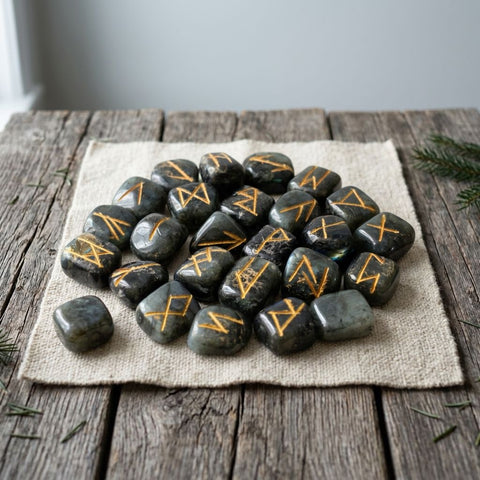 Labradorite runes: 25 dark grey stones with blue flash, engraved in gold
59,90 €
 Lapis lazuli runes: 25 royal blue stones engraved in gold
59,90 €
 Banded agate runes, 25 cream, amber and grey stones engraved in gold
29,90 €
 White agate runes: 25 porcelain white stones engraved in gold
29,90 €
 Moss agate runes: 25 grey-green stones engraved in gold
31,90 €