Personalised Gift with a Birthstone: A Practical Guide
How to choose the birthstone of the month, find a sturdier or more affordable alternative, and present it with a card and a personal touch, without promising any effect.
Key points
| Principle | Link a gift to the date of birth through a traditional stone |
|---|---|
| Modern origin | Monthly stone lists circulated from the early 20th century (1912, United States) |
| Variants | Several months have two or three stones depending on the list |
| Tip | Choose a stone of a similar colour that is sturdier when the official stone is fragile or expensive |
| Personalisation | A card, a date, a small booklet: the gesture matters as much as the stone |
| Honesty | It is a symbol and a keepsake, not a guaranteed lucky charm |
Why link a gift to a date of birth?
The birthstone of the month is a simple way to personalise a gift: it ties the object to the person's birth date without asking for any private information. It appeals because it offers both a theme (the colour, the name, the story of the stone) and an opportunity to tell a story. It works for a birthday, a birth or a family event.
Note, however, that this tradition is recent. It spread in the early 20th century from a list drawn up in 1912 by American jewellers, and it varies by country and era. Our birthstone guide explains its history. Present it as a game and a keepsake, never as a truth about the person.
Choosing the stone: the 12 months
| Month | Traditional stone(s) | Sturdier or more affordable idea (similar colour) |
|---|---|---|
| January | Garnet | Carnelian or small-sized garnet |
| February | Amethyst | Amethyst itself, already affordable |
| March | Aquamarine; bloodstone (older list) | Amazonite or heliotrope |
| April | Diamond | Clear quartz, transparent, as an honest substitute |
| May | Emerald; chrysoprase (British list) | Green aventurine or chrysoprase |
| June | Pearl, moonstone, alexandrite | Moonstone or labradorite |
| July | Ruby; carnelian (British list) | Carnelian |
| August | Peridot, spinel, sardonyx | Peridot, often affordable in small sizes |
| September | Sapphire; lapis lazuli (British list) | Lapis lazuli or sodalite |
| October | Opal, tourmaline | Pink tourmaline or rose quartz |
| November | Topaz, citrine | Citrine |
| December | Turquoise, zircon, tanzanite | Genuine turquoise, or sodalite for the colour |
When you give a “replacement” stone, simply say so: “this is a carnelian, the same colour as July's ruby.” It is not the same stone and should not be presented as such.
Check before you buy
Several birthstones are frequently treated or imitated. Commercial citrine is often heated amethyst; cheap turquoise is sometimes dyed howlite (see turquoise or dyed howlite); opal is fragile (knocks, heat). Read the product page, ask for the exact nature of the stone and any treatments, and consult real or fake stone. For a valuable gift, a certificate from a gemmological laboratory is an additional guarantee.
The form of the gift
- a pendant or a ring: for a stone that is worn, choose sufficient hardness;
- a bracelet: suited to hard stones; see measuring your wrist;
- a tumbled stone: the simplest gift, which slips into a pouch;
- a gift box: stone, card and a short note.
For durability, remember that stones of hardness 7 and above (quartz, topaz, sapphire, ruby) resist everyday scratches well, whereas soft stones (turquoise, opal, pearl) need more care.
Personalising without engraving
An object does not need to be engraved to feel personal. A few simple ideas:
- a card that tells the story of the stone and why it made you think of this person;
- the date and place of birth written by hand on the card or on the label;
- a small booklet with the stone's information sheet (hardness, colour, a little history);
- a wrapping in the colours of the stone.
If you would like a particular personalisation (engraving, custom setting), check with the shop before buying: we do not promise this service here.
A complete example: a September stone
Let us imagine a gift for someone born in September. Tradition names the sapphire, which, given its price, is rare as an everyday gift. You might choose a lapis lazuli (British list) or a sodalite for its blue colour. Slip the stone into a midnight-blue pouch with a card: “Sapphire is the stone of your month; I chose this blue stone because it suits you.” Write the date and place of birth inside, along with a sentence about the stone (colour, hardness, a little history). The gift is simple, honest and personal.
For siblings or a family
For a family, you can combine several birthstones in one object: a frame with four small stones, a pouch for each person, or a bracelet for the mother with each of her children's birthstones. Check that the stones are hard enough to be worn together, since soft stones can be damaged by harder ones. For a large family, mind readability: too many stones weigh the gift down, so it is better to choose three or four meaningful ones.
What to say, and what not to say
A few honest phrases:
- “Here is the stone of your birth month: a tradition, and above all a lovely excuse.”
- “It is the same colour as the traditional stone of your month.”
- “I chose it because it is sturdy and you will wear it.”
Avoid: “this stone matches your personality”, “it will protect you” or “it will bring you luck”. The birthstone of the month is a commercial and cultural convention, not a portrait of the person.
Frequently asked questions
How do you find out someone's birthstone?
It depends on their birth month and the list used. Several months have two or three stones; see our birthstone guide to choose.
Is the birthstone the same in every country?
No. The lists vary by country and era, notably between France, the United States and the United Kingdom.
Can you give a stone other than the official one?
Yes, as long as you say so honestly. A stone of a similar colour that is sturdier or more affordable is a perfectly valid choice.
Which birthstone is the sturdiest?
Stones of high hardness, such as sapphire, ruby, topaz or amethyst, hold up well. Pearls, opal and turquoise are more fragile.
How can you personalise a gift without engraving?
With a card, the birth date, a small booklet about the stone and careful wrapping. For engraving, check with the shop.
Does a birthstone bring good luck?
It is a popular belief and a tradition, not a verified fact. Give it as a keepsake and a symbol.
Also read
The meanings mentioned belong to tradition and symbolism. They are neither promises of results nor medical advice. Back to Buying guides and gift ideas.
In the shop
Gift ideas: our products
 Stone garden in a mango wood ring: tree of 60 chips
29,90 €
 Faceted stone necklace with butterfly in real silver-tone leaf, 42 cm
23,90 €
 Stone garden and yoga figurine on mango wood: 100 chips
39,90 €
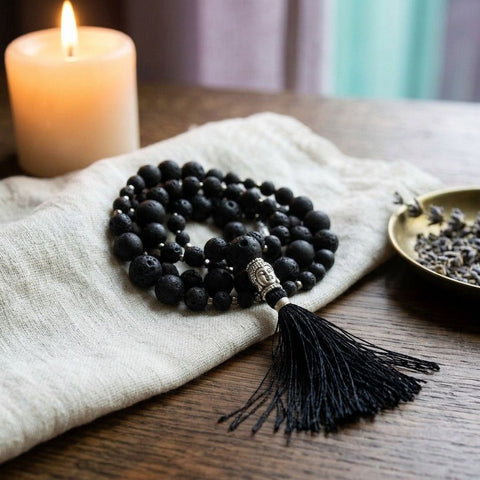 Long lava stone necklace, 42 cm, comes in a gift box with its card
22,90 €
 Oracle of the Sacred Horse: boxed deck and guidebook, text by Kathy Pike (English)
30,90 €
 Soul's Journey Oracle: 44 gold-foil cards and 120-page guidebook (English)
33,90 €
 The Divine Feminine Oracle: 53 cards and guidebook by Meggan Watterson (English)
23,90 €
 The Witch's Way Home Oracle: 44 cards, 4 Power Cards and 136-page book (English)
27,90 €