Measuring Your Wrist and Choosing a Gemstone Bracelet Size
How to measure your wrist with a tape or string, how much allowance to add depending on the bracelet, and how many beads to plan for an elastic bracelet.
Key points
| Duration | 5 minutes |
|---|---|
| Materials | Soft tape measure, or string and a ruler |
| Level | Beginner |
| Where to measure | Just above the wrist bone, against bare skin |
| Allowance to add | About 0.5 to 3 cm, depending on the fit you want |
| Good to know | Sizes vary from one brand to another |
Why measure carefully?
A gemstone bead bracelet is heavy, often stiff and not very stretchy. Too tight, it pinches and leaves marks on the skin. Too loose, it slides, knocks against tables, and the stones clash together, which can chip them. An accurate measurement takes five minutes and saves you a return. The average figures found online vary widely between sources: do not rely on an average, measure your own wrist.
Equipment
- A soft flexible tape measure, like a sewing tape, preferably fabric or flexible plastic.
- Or a non-elastic string (thick sewing thread, thin ribbon), a pen and a rigid ruler.
- A mirror or someone else’s help to read the figure.
Avoid elastic thread: it stretches and gives a measurement that is too short.
Measuring step by step
- Choose the right moment. Wrists are slightly wider at the end of the day or in warm weather. It is best to measure in the afternoon.
- Bare your wrist. Measure against bare skin, without a watch or bracelet.
- Place the tape just above the protruding wrist bone, where the bracelet will rest.
- Hold it snug without compressing. The tape should touch the skin without leaving a mark.
- Read the measurement at the point where the end meets the tape, in centimetres.
- With string: mark the meeting point with the pen, lay the string flat along a rigid ruler and read the length.
- Repeat twice and keep the average.
How much allowance to add?
A wrist measurement is the circumference of the wrist, not the length of the bracelet. You need to add an allowance, which depends on the fit you want. Jewellers’ guides give slightly different ranges; here are some benchmarks.
| Fit wanted | Allowance to add | Effect |
|---|---|---|
| Snug | 0.5 to 1 cm | Holds well, moves very little |
| Comfortable | 1.5 to 2.5 cm | Slides slightly, can be worn all day |
| Loose | about 3 cm | Hangs visibly, a “bangle” effect |
For a bead bracelet on elastic, which stretches, add 1 to 2 cm. For a rigid or clasp bracelet, allow 1.5 to 2.5 cm. If you are torn between two sizes, choose the larger one.
Worked example
You measure 16.5 cm. You like a comfortable fit: 16.5 + 2 = 18.5 cm of bracelet length. With 8 mm beads, you need about 185 / 8 = 23 beads. With 6 mm beads, about 31 beads. With 10 mm beads, about 19 beads.
This is an estimate: beads are not always perfectly round, and the hole in each bead slightly changes the length. Check the length stated on the product page rather than relying on the bead count alone.
Some tips for choosing
- Larger beads, bulkier bracelet. For a small wrist or everyday wear, favour beads of 6 to 8 mm.
- Heavy beads (lapis lazuli, malachite): plan for a sturdy elastic and a slightly more generous allowance.
- Children’s sizes. A child’s wrist grows quickly. Choose an adjustable model and always supervise wear, as small beads can be swallowed.
- Several bracelets worn together. Add 0.5 cm per bracelet so they do not catch on each other.
- Fragile stones. See caring for gemstone jewellery for precautions.
Common mistakes and exercise
- Measuring over clothing, or with a tape pulled too tight.
- Confusing the wrist measurement with the length of the finished bracelet.
- Forgetting that some watches or clasps add length.
- Relying on a “standard size” without checking the length in centimetres.
Exercise: measure both wrists, then compare. Your dominant wrist is often slightly larger. Choose the size based on the wrist that will wear the bracelet.
Frequently asked questions
What is the average wrist size?
It varies a great deal between sources and people. Measure your own rather than relying on an average.
Does an elastic bracelet loosen over time?
Yes: the elastic relaxes with use. Keep this in mind if you are between two sizes.
How can I measure my own wrist?
With non-elastic string: wrap it around your wrist, mark the point, then lay the string along a ruler.
What size is right for a men’s bracelet?
The method is the same. Men’s wrists are generally wider: measure and add the allowance you want.
Can a bead bracelet be made smaller?
A jeweller or craftsperson can restring it by removing beads. It is better to measure carefully from the start.
Also read
The meanings mentioned belong to tradition and symbolism. They are neither promises of results nor medical advice. Back to Step-by-step tutorials.
In the shop
Bracelets: our products
 Engraved brass or copper cuff bracelet: Nepalese designs, adjustable
23,90 €
 Hand-knotted Balinese temple thread bracelet with beads
27,90 €
 Set of three semi-precious stone bracelets with butterfly: 7 gift boxes
31,90 €
 Wooden bead bracelet with Buddha head
10,90 €
 Wooden bead bracelet with lucky coin: 6 tie-on colours
13,90 €
 Tri Hita Karana wood, glass and stone bracelet from Bali
24,90 €
 Hematite Shamballa bracelet on knotted cord
12,90 €
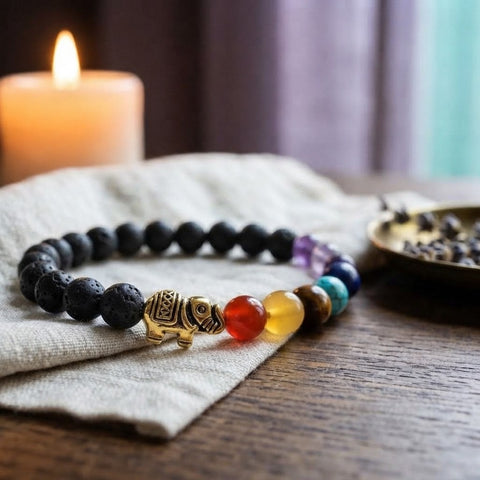 Lava stone bracelet with metal charm
13,90 €