Cultured Pearls and Stone Beads: The Differences to Know
Natural pearl, cultured pearl, stone bead, nacre-coated glass bead: what each term means, how to tell them apart, and how to wear and care for them.
Key points
| Cultured pearl | Formed inside a mollusk with human intervention, in nacre |
|---|---|
| Composition | Calcium carbonate (aragonite) and conchiolin |
| Hardness | 2.5 to 4.5 on the Mohs scale |
| Stone bead | Ball cut from a stone (quartz, agate, etc.) |
| Main types | Akoya, South Sea, Tahitian, freshwater |
| Enemies | Acids (vinegar), perfume, friction |
Two Meanings of “Pearl”
In everyday speech, “pearl” refers to two very different things. On the one hand, the pearl produced by a mollusk (oyster or mussel); on the other, the stone bead, a small ball cut from a mineral such as quartz or agate and drilled so it can be strung. Both are worn in necklaces or bracelets, but they differ in origin, hardness and care needs. This page is part of the guide to stone and metal jewellery.
Pearls: Made of Nacre
A pearl is made of calcium carbonate, mainly aragonite, deposited in concentric layers and bound by an organic material, conchiolin. Together they form nacre, the same material as the inside of many shells. Its hardness lies between 2.5 and 4.5 on the Mohs scale: a pearl is soft.
- Natural pearl: forms without human intervention, when a foreign body enters the mollusk. It is very rare.
- Cultured pearl: a small piece of tissue is implanted in the mollusk, sometimes with a nucleus (a bead). The mollusk then deposits nacre around it. Most pearls sold today are cultured pearls.
X-rays can distinguish natural pearls from nucleated cultured pearls, because their internal structure is not the same. A cultured pearl is not an imitation: it is a real pearl, formed by a mollusk with human help.
The Main Families of Cultured Pearls
| Type | Mollusc | Size and appearance |
|---|---|---|
| Akoya | Oysters from Japan and China | Often round, 2 to 10 mm, white or cream |
| South Sea | Pinctada maxima | The largest, highly prized |
| Tahitian (“black pearls”) | Pinctada margaritifera | Naturally dark tones, from grey to deep green |
| Freshwater | Freshwater mussels, mainly in China | Varied shapes, most often without a nucleus, more affordable |
Brightly coloured pearls sold at low prices are frequently dyed: the dye only penetrates the first layer or layers of nacre.
Stone Beads
A stone bead is a ball cut and polished from a mineral, then drilled. They come in rose quartz, amethyst, tiger’s eye, agate, jasper, labradorite, howlite and many others. Their hardness ranges from 2 to 7 depending on the stone. These are the ones found in most of our bracelets and necklaces. They may be smooth, faceted, drop-shaped or chip-shaped (small fragments). A stone bead has neither the luster nor the nature of nacre: its appeal lies in the colour and pattern of the mineral.
Telling a Real Pearl from an Imitation
- Imitations: you will find glass beads coated with a pearly substance (called “essence d’Orient”), plastic beads, or reconstituted shell beads. They are more regular and smoother.
- Rubbing test: when two pearls are gently rubbed together, real ones (natural or cultured) give a very slight gritty feel; imitations are completely smooth. A rough test that does not replace the opinion of a gemologist.
- Drilled hole: a layer of paint flaking around the hole is a sign of an imitation.
- Weight and temperature: a real pearl is heavier and feels cooler in the hand than a plastic one.
- Label: in France, a 2002 decree governs the information given on gemstones and pearls (including their imitations); an honest sale states whether the pearls are natural, cultured or imitation.
Care
- Pearls dislike acids: vinegar dissolves calcium carbonate. Also avoid lemon juice, acidic sweat, perfume and lacquer.
- Put your pearls on last, after makeup and perfume, and take them off first.
- Wipe them with a soft, slightly damp cloth after each wear.
- Store them separately, in a soft fabric, as they scratch easily.
- Have a pearl necklace restrung about every one to two years if it is worn often: the silk thread stretches.
See also caring for your stone jewellery.
How to Choose
If you are looking for a real pearl, ask for the type (Akoya, freshwater, Tahitian), the diameter, the thickness of the nacre if known, the natural or dyed colour, and the type of thread. If you prefer stone beads, choose the stone according to its use and hardness. The two can look well together in the same piece. Find jewellery with stone beads in our necklaces and bracelets sections.
Frequently asked questions
Is a cultured pearl a real pearl?
Yes. It is produced by a mollusk, with human help to start the process. It is not an imitation.
Why does a pearl dislike vinegar?
Because it is made of calcium carbonate, which the acetic acid in vinegar dissolves. Avoid any contact with acids.
What is the difference between a cultured pearl and a stone bead?
A cultured pearl is produced by a mollusk and made of nacre. A stone bead is a ball cut from a mineral such as quartz or agate.
How can I test a pearl at home?
By gently rubbing two pearls together: a real one feels slightly gritty, an imitation is smooth. This test is approximate; a gemologist can confirm.
Are coloured pearls natural?
Pale tones (white, cream, pink) can be. Bright, very uniform colours sold at low prices are most often dyed.
Also read
The meanings mentioned belong to tradition and symbolism. They are neither promises of results nor medical advice. Back to Guide to stone jewellery.
In the shop
Stone jewellery: our products
 Faceted stone necklace with butterfly in real silver-tone leaf, 42 cm
23,90 €
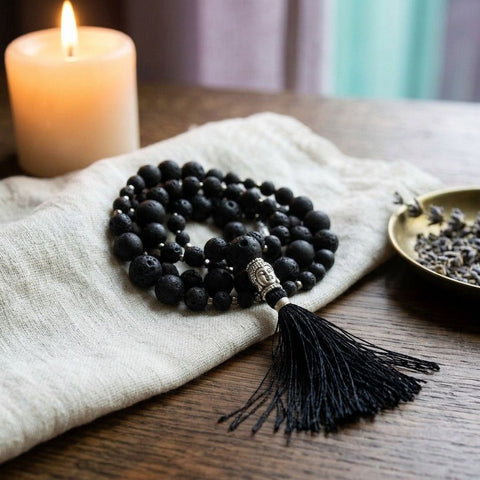 Long lava stone necklace, 42 cm, comes in a gift box with its card
22,90 €
 Engraved brass or copper cuff bracelet: Nepalese designs, adjustable
23,90 €
 Hand-knotted Balinese temple thread bracelet with beads
27,90 €
 Set of three semi-precious stone bracelets with butterfly: 7 gift boxes
31,90 €
 Wooden bead bracelet with Buddha head
10,90 €
 Wooden bead bracelet with lucky coin: 6 tie-on colours
13,90 €
 Tri Hita Karana wood, glass and stone bracelet from Bali
24,90 €