Stone Bracelets: Choosing the Right Size, Material and Clasp
How to measure your wrist, choose between elastic and clasp, count the beads and care for a stone bracelet, with simple reference points.
Key points
| Measurement to take | Wrist circumference, just above the bone, using a soft tape measure or a strip of paper |
|---|---|
| Bracelet length | Wrist + 1 cm (elastic) or wrist + 1.5 to 2 cm (clasp) |
| Bead size | 6, 8 or 10 mm |
| Types | Elastic, braided thread, lobster clasp, rigid bangle, leather |
| Weak point | The elastic thread, which wears over time |
| Remove it for | Showering, sport, housework, swimming |
Stone bracelets: what are we talking about?
A stone bracelet is a piece of jewellery made of stone beads threaded on a cord, or of stones mounted on a chain or leather. It is worn on the wrist and is chosen both for its look and for its size. It is one of the most widely worn stone jewellery pieces, as it is simple, easy to adjust and makes a good gift.
This page is part of the stone and metal jewellery guide. It complements the tutorial measuring your wrist and choosing the size of a bracelet.
Measuring your wrist
- Take a soft dressmaker's tape measure, or a strip of paper and a ruler.
- Wrap it around your wrist just above the prominent bone, where you will wear the bracelet. The tape should fit snugly without tightening.
- Note the measurement in centimetres, to the nearest 0.5 cm.
- Repeat the measurement twice: the wrist varies slightly with the time of day and the heat.
Adult wrists commonly measure from about 14 to 19 cm, with the most frequent values between 15 and 18 cm. A strip of paper avoids errors: mark the overlap point with a pen, then measure it flat.
Which bracelet length to choose?
| Type of bracelet | Recommended length | Effect |
|---|---|---|
| Elastic, close to the wrist | Wrist + 0.5 to 1 cm | Snug, stays in place |
| Comfortable elastic | Wrist + 1 to 1.5 cm | A little give, easier to slip on |
| Clasp (lobster, spring ring) | Wrist + 1.5 to 2 cm | Freedom of movement |
| Rigid bangle | Based on hand circumference, not wrist | Must pass over the hand, then stay in place |
These are indicative guidelines: some people prefer a bracelet that moves, others a snugger one. If you are torn between two sizes, choose the larger one for an elastic and the smaller one for a clasp.
To work out how many beads you need, divide the length (in millimetres) by the diameter of one bead: a 17 cm (170 mm) bracelet with 8 mm beads has about 21 beads.
Elastic, braided thread, clasp or leather: comparing the fastenings
- Elastic: practical and clasp-free. The thread wears, stretches and eventually breaks, especially with heat, sweat and perfume. A good elastic is thick and knotted with care (glued knot).
- Braided thread or coated cable: sturdier, often closed with a lobster clasp. More durable, but a little less comfortable to put on.
- Clasp: lets you adjust the length by one or two links. Check that the clasp does not catch and that the safety ring is properly soldered.
- Leather or waxed cotton: natural look; sensitive to water.
- Bangle or hinged bracelet: rigid metal setting with set stones; measure the hand circumference (the widest point of the closed hand).
Bead materials: how long they last on the wrist
A bracelet is exposed to knocks, to sleeves rubbing and to everyday surfaces. The hardness of the stone matters: on the Mohs scale, the higher the number, the better the stone resists scratches.
- Hard (6.5 to 7): quartz, jasper, agate, tiger's eye, aventurine. These hold up well.
- Medium (5 to 6.5): labradorite, moonstone, amazonite, obsidian. Suitable, with care against knocks.
- Soft (under 5): howlite, malachite, selenite, amber. They wear quickly; wear them occasionally.
Care and lifespan
- Take the bracelet off for showering, swimming, sport, washing up and housework: water, products and sweat damage the thread.
- Do not pull on an elastic to slip it on: roll it onto your hand, holding it in folds.
- Store the bracelet flat, not hanging, so the thread does not stretch.
- Clean hard beads with a soft, slightly damp cloth; soft beads with a dry cloth.
- Have the thread replaced every one to two years if you wear it daily. A new thread extends the life of the beads.
See also caring for your stone jewellery.
Avoiding surprises
- Dyed stones: blue howlite or coloured agate can rub off onto the skin or when in contact with water.
- Glass beads: some “stone” beads are glass. See real or fake stone.
- Metal: clasps are made of brass, steel or silver; read the page on jewellery metals if you are sensitive to nickel.
How to choose
Choose the size first, then the fastening (elastic for simplicity, clasp for durability), then the stone according to use: a hard stone for everyday wear, a more delicate stone for special occasions. For a gift, an elastic of 17 to 18 cm with 8 mm beads suits many people. Find our designs in the bracelets section.
Frequently asked questions
How do I choose the size of a stone bracelet?
Measure your wrist and add about 1 cm for an elastic, or 1.5 to 2 cm for a clasp bracelet. Torn between two sizes? Choose the larger one for an elastic.
How many beads does a 17 cm bracelet have?
With 8 mm beads, about 21. Divide the length in millimetres by the diameter of one bead.
Why did my elastic break?
The thread wears over time, with heat, sweat and perfume. Have it replaced with new thread, thicker if possible.
Can I wear a stone bracelet in the shower?
Better not. Water and soap damage the thread and can dull some stones.
Which stone should I choose for an everyday bracelet?
A stone with a hardness of 6.5 or more, such as quartz, jasper, agate or tiger's eye, which resists friction.
Also read
The meanings mentioned belong to tradition and symbolism. They are neither promises of results nor medical advice. Back to Guide to stone jewelry.
In the shop
Bracelets: our products
 Engraved brass or copper cuff bracelet: Nepalese designs, adjustable
23,90 €
 Hand-knotted Balinese temple thread bracelet with beads
27,90 €
 Set of three semi-precious stone bracelets with butterfly: 7 gift boxes
31,90 €
 Wooden bead bracelet with Buddha head
10,90 €
 Wooden bead bracelet with lucky coin: 6 tie-on colours
13,90 €
 Tri Hita Karana wood, glass and stone bracelet from Bali
24,90 €
 Hematite Shamballa bracelet on knotted cord
12,90 €
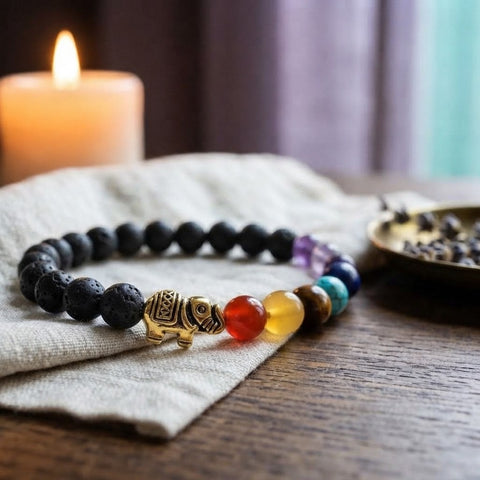 Lava stone bracelet with metal charm
13,90 €