Malas and Prayer Beads: 108 Beads, Origins and Uses
The mala is a string of 108 beads used in India and Buddhism to count mantras. Its origins, materials, respectful use and care.
Key points
| Number of beads | 108 usually, or 54 and 27 (divisors of 108) |
|---|---|
| Extra bead | Often a 109th “guru bead”, which is not counted |
| Traditions | Hinduism, Buddhism; other prayer beads: rosary, misbaha, juzu |
| Materials | Rudraksha, sandalwood, wood, seeds, bone, stone |
| Earliest known use | Chinese Buddhist depiction, 4th to 6th century |
| Use | Counting recitations or breaths |
What is a mala?
A mala (a Sanskrit word meaning “garland”) is a string of beads threaded on a cord. In Hindu and Buddhist traditions, it is used to count the recitations of a mantra, a divine name or a prayer. It is also called japamala: japa means “murmur” or “repetition”. The standard form has 108 beads of similar size and material, often completed by a larger 109th bead, called the “guru bead” or sumeru, which marks the start and end of a round and is not counted. Shorter malas of 54 or 27 beads, which are divisors of 108, are also found.
This page is part of the crystal shapes guide.
Origins and history
Specialists report that the earliest clear depiction of a mala used for recitation, rather than worn as a necklace, is a bodhisattva statue from the Northern Wei dynasty in China, dating between the 4th and 6th centuries. On the Buddhist side, a text called Mu Huanzi Jing is cited as the first literary reference to reciting mantras with a mala. On the Hindu side, the Rudrakshajabala Upanishad links rudraksha beads to the tears of the god Shiva.
Popular sites give much earlier dates (as far back as 1500 BCE); we have found no academic source that confirms them, and we prefer not to repeat them. The same goes for the origin of the number 108: some see 12 signs multiplied by 9 planets, others 108 names of the Buddha, and others 108 states of mind. These are symbolic interpretations, not established historical facts.
Other prayer beads around the world
| Object | Tradition | Note |
|---|---|---|
| Mala / japamala | Hinduism, Buddhism | Usually 108 beads |
| Juzu | Japanese Buddhism | Often 108 beads, or reduced versions |
| Rosary | Catholicism | Counts prayers; organised in decades |
| Misbaha (tasbih) | Islam | Usually 33 or 99 beads |
The idea of counting prayers on beads is therefore found in several religions. A mala is not a neutral piece of jewellery: for practitioners, it is a religious object. If you wear one, do so with respect: do not put it on the ground, do not leave it lying around, and do not lend it lightly.
Which materials?
- Rudraksha: seeds of a tree (Elaeocarpus) revered in Shaivite Hinduism.
- Sandalwood, tulsi and bodhi wood: woods and seeds used for religious purposes in various traditions.
- Bone, vegetable ivory, nuts: natural materials.
- Stones: rose quartz, tiger's eye, jasper, lapis lazuli, agate, howlite, amethyst. Stone malas are very widespread today, especially as 27-bead bracelets wrapped several times around the wrist.
For stones, the same rule applies: look out for dyed beads (blue-dyed howlite, dyed agate) and glass beads. See real or fake stone.
How to use it, without presuming to speak for practitioners
In a religious context, the mala is held in the right hand, one bead is advanced with each recitation, and one stops at the guru bead without crossing it: the mala is turned over and one proceeds in the other direction. In a secular context, many people use it to count their breaths or to repeat a simple phrase (“I breathe”, “calm”). This can become a pleasant focus for attention.
- Sit comfortably and breathe calmly.
- Take the bead just after the guru bead between your thumb and middle finger.
- With each breath (or recitation), move one bead along.
- Stop at the guru bead. A full round of 108 beads usually takes about ten minutes.
- Then write one sentence about how you feel.
No medical effect has been demonstrated; the practice is valuable for the attention you bring to it.
Caring for your mala
- The cord (cotton, silk, nylon) wears out: check it regularly. A precious mala should be restrung on new thread, with a knot between each bead so that the beads are not all lost if the cord breaks.
- Avoid water, prolonged sweating and perfumes for beads made of wood, seed or bone.
- Hard stone beads can be cleaned with a soft, slightly damp cloth.
- Store it in a pouch, lying flat or hanging.
How to choose
Choose the number of beads according to use: 108 for traditional meditation, 27 or 54 for a bracelet worn every day. The bead diameter (6, 8 or 10 mm) changes the comfort: 8 mm is a common size for a hand mala. Look for even beads, a sturdy cord and a neat knot. If the mala is a gift, be mindful of the recipient: some people will not want to wear a religious object as jewellery. Our bracelets are in the bracelets section, and you can measure your wrist with our tutorial.
Frequently asked questions
Why 108 beads?
Several symbolic explanations exist (zodiac and planets, divine names, states of mind). None is established as the historical origin of the number.
What is the larger bead for?
It is the “guru bead” or sumeru. It marks the start and end of a round and is not counted: you do not cross it, you turn the mala over.
Can I wear a mala as jewellery?
Yes, many people do. Keep in mind that it is a religious object for practitioners, so a respectful use is preferable.
How is it different from a Catholic rosary?
Both are used to count prayers, but the traditions, the structure and the prayers recited differ. A mala usually counts mantras on 108 beads; the rosary is organised in decades.
How do I measure a mala bracelet?
Measure your wrist, add about 1.5 to 2 cm for comfort, and choose a 27-bead mala if you want to wrap it several times.
Also read
The meanings mentioned belong to tradition and symbolism. They are neither promises of results nor medical advice. Back to Guide to crystal shapes.
In the shop
Bracelets: our products
 Engraved brass or copper cuff bracelet: Nepalese designs, adjustable
23,90 €
 Hand-knotted Balinese temple thread bracelet with beads
27,90 €
 Set of three semi-precious stone bracelets with butterfly: 7 gift boxes
31,90 €
 Wooden bead bracelet with Buddha head
10,90 €
 Wooden bead bracelet with lucky coin: 6 tie-on colours
13,90 €
 Tri Hita Karana wood, glass and stone bracelet from Bali
24,90 €
 Hematite Shamballa bracelet on knotted cord
12,90 €
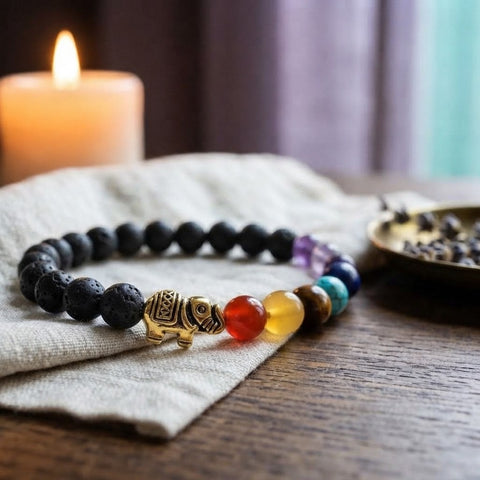 Lava stone bracelet with metal charm
13,90 €