Moonstone: meaning, symbolic properties, care and how to spot a fake
Moonstone is a feldspar with a milky, shifting sheen called adularescence. It is fragile and often confused with white labradorite or with glass.
Key points
| Colour | White, cream, grey or peach, with a shifting blue sheen |
|---|---|
| Mineral family | Feldspar: orthoclase and albite in fine lamellae |
| Mohs hardness | 6 to 6.5, with perfect cleavage (fragile under knocks) |
| Optical effect | Adularescence: a milky glow that seems to float beneath the surface |
| Sources | Sri Lanka (main source), India, Myanmar, Madagascar, Swiss Alps |
| Birthstone | June, in most modern lists |
| Traditional association | Sacral or third-eye chakra, cycles, intuition |
| Care | Quick rinse in lukewarm water; protect from knocks |
What is moonstone?
Moonstone is a feldspar, from the same large family as amazonite or labradorite. More precisely, it is a variety of orthoclase (a potassium sodium aluminium silicate) closely intergrown with albite. As they cool, these two minerals separate into extremely fine lamellae that scatter light: hence the milky, bluish glow that seems to float beneath the surface, known as adularescence.
The name comes from Adula, a massif in the Swiss Alps, where the mineral was first studied. Today most moonstones on the market come from Sri Lanka; Myanmar long supplied the finest bluish pieces, and it is also mined in India and Madagascar. Its hardness is 6 to 6.5, but it has perfect cleavage: a sharp knock can split it cleanly.
The Romans are said to have seen solidified moonbeams in it. At the end of the 19th century and the beginning of the 20th it enjoyed great success in Art Nouveau jewellery, notably with René Lalique. A word of caution: the “rainbow moonstone” sold everywhere is in fact labradorite, a different feldspar, in its white form.
Traditional symbolism
Its changing glow recalls the phases of the moon, and the stone has become the symbol of cycles, gentleness and intuition. In tradition it is associated with the night, dreams and emotions, and it is recommended for people who are sensitive to the rhythms of the moon, to femininity or to the passing of time.
These are cultural images, kept alive by poetry and jewellery: they have nothing medical about them. Many people simply wear it as a discreet lucky charm, and that is a very good use.
Traditional correspondences
| Area | Association cited | Note |
|---|---|---|
| Chakra | Sacral or third eye | Depends on the author; see the sacral chakra |
| Element | Water | A very common association |
| Sign | Cancer (ruled by the Moon), sometimes Libra, Scorpio | See Cancer |
| Month | June | Along with pearl and alexandrite; see June |
How to use it
- As jewellery: pendants, rings, cabochon earrings: the shape that best brings out the glow.
- With the moon’s rhythm: some people like to place it by a window on full moon nights, a ritual gesture rather than a scientific one.
- In meditation: hold the stone and move it slowly to shift the glow, breathing calmly before sleep.
- As a gift: a birthstone gift for June, or a poetic present.
It pairs well with amethyst, selenite or labradorite.
Care and cleansing
Its hardness seems adequate, but its cleavage makes it vulnerable: a sharp knock or a fall can crack it.
- Cleaning: a quick rinse in lukewarm water, with a little mild soap if needed, then drying at once with a soft cloth.
- Avoid: ultrasonic cleaners, steam, acidic products, strong heat and sudden temperature changes.
- Sunlight: do not overdo it; an occasional exposure will not harm it.
- Storage: wrapped in a cloth, apart from harder stones.
The moon is, quite logically, its favourite light for symbolic cleansing. See our guide.
Recognising a genuine moonstone
- Natural: a soft bluish glow that shifts with the angle, small “cock’s foot” cracks (characteristic inclusions), and a white, grey or peach body colour.
- White labradorite: sold in shops as “rainbow moonstone”, it is beautiful but a different species, with multicoloured flashes. It is only fair to say so.
- Glass or “opalite”: a milky glass made with a uniform bluish effect, sometimes sold as moonstone. It lacks the typical cracks and looks very regular.
- Other imitations: quartz or chalcedony treated to mimic the milky look. Ask for the exact species.
How to choose
The beauty of a moonstone is judged by the intensity and sharpness of its glow, its transparency and the absence of large cracks. The most sought-after are almost colourless with a strong blue sheen; they are rare and expensive. White or peach stones with a soft glow, which are more common, are very pleasant and affordable.
A well-polished cabochon with a gentle shape is the best choice. If you wear it, prefer a setting made with care. Find our moonstones in the jewellery range and the tumbled stones.
Frequently asked questions
Is moonstone the same as labradorite?
No. They are two different feldspars. Classic moonstone has a milky bluish glow; the “rainbow moonstone” sold in shops is white labradorite.
Is moonstone fragile?
Yes, more than people think: its hardness is 6 to 6.5, but it cleaves easily. Protect it from knocks and falls.
What is the June birthstone?
In most modern lists, June has pearl, alexandrite and moonstone.
Can I clean it with water?
Yes, briefly and in lukewarm water. Dry it straight away and avoid ultrasonic cleaners and heat.
How do I avoid fake moonstones?
Look at the glow from several angles and check for small natural imperfections. Perfect regularity and an identical sheen everywhere suggest glass.
Also read
The meanings mentioned belong to tradition and symbolism. They are neither promises of results nor medical advice. Back to Guide to stones.
In the shop
Moonstone: our products
 Raw rainbow moonstone on a black metal stand: 13 cm mineral specimen
27,90 €
 Polished moonstone obelisks and points
59,90 €
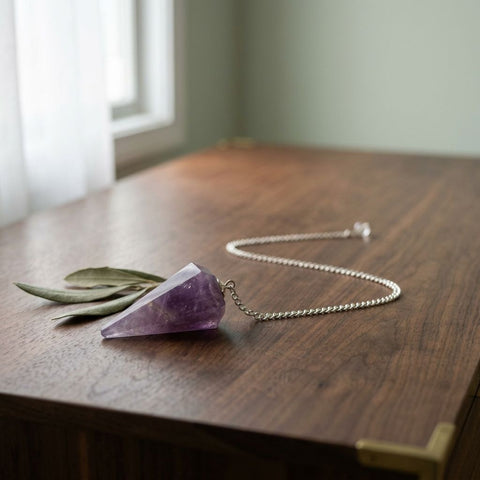 Cut stone pendulum, approx. 4 cm, silver-tone chain
16,90 €
 Rainbow moonstone runes: 25 milky stones engraved in gold
59,90 €
 Rainbow moonstone chips: bluish, by the kilo
37,90 €
 Moonstone chips: pearly, by the kilo
34,90 €
 Four stone shapes – rainbow moonstone
14,90 €