Lava stone: meaning, uses, care and essential oil diffusing
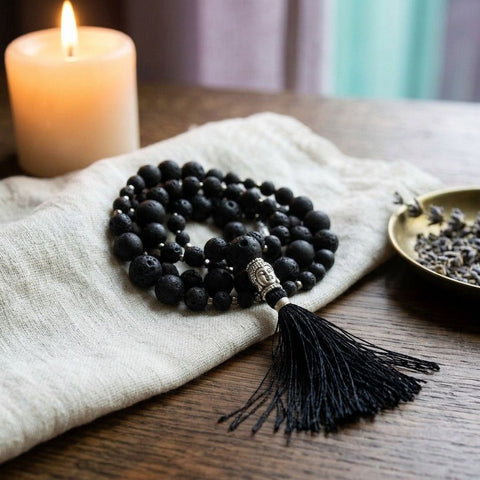
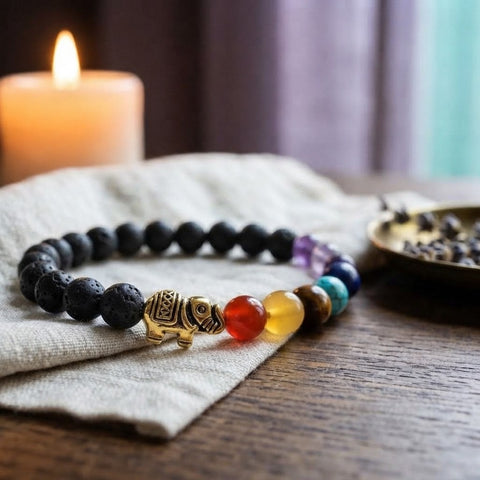
Lava stone is a porous, lightweight, dark volcanic rock. Very popular as diffuser bracelets, it is cared for dry: here is how to recognise it and how to use it.
Key points
| Colour | Black to very dark grey, sometimes brownish-red |
|---|---|
| Nature | Porous volcanic rock (basalt), not a mineral |
| Mohs hardness | Variable (it is a rock, so there is no single value) |
| Sources | Volcanic regions: Auvergne, Etna, Hawaii, Iceland, etc. |
| Feature | Pores that hold liquids and fragrances |
| Common use | Essential oil diffuser bracelets; dyed beads also available |
| Traditional association | Root chakra, grounding, fire and earth elements |
| Care | Dry brushing; avoid soaking |
What is lava stone?
Lava stone is a volcanic rock, not a mineral in the strict sense. It forms when lava cools quickly: the gases escaping from it leave small cavities called vesicles, which give the rock its honeycombed texture and its lightness. It is generally classed as basalt, a volcanic rock made mainly of feldspar (plagioclase), pyroxene and olivine. For the same reason it has no single Mohs hardness value, because that scale applies to minerals rather than to rocks made of several minerals.
It is found wherever there are volcanoes: in France on the Chaîne des Puys in Auvergne (the same family as Volvic stone), in Italy around Etna, in Hawaii, Iceland and the Canary Islands. In shops you will find it as beads, tumbled stones, small pebbles, figurines and decorative objects.
Do not confuse it with enamelled lava, a lava rock coated in enamel for tiles, worktops and street signs. That is an industrial product with no connection to the jewellery stone.
Traditional symbolism
Born from the fire of the earth, lava stone naturally suggests raw strength, transformation and grounding: a molten material that becomes solid. In contemporary tradition it is linked with stability, patience and the energy of the earth, and it is often recommended during times of change.
This symbolism is modern and poetic, not a proven property. Its current popularity owes more to its practical use as a fragrance carrier than to any ancient tradition.
Traditional correspondences
| Area | Association cited | Note |
|---|---|---|
| Chakra | Root | Common association; see the root chakra |
| Element | Fire and earth | Obvious given its origin |
| Sign | Aries, Scorpio, Capricorn | Varies between authors |
| Intention | Grounding | See the grounding page |
How to use it
- As a diffuser bracelet: place one or two drops of essential oil on a bead, which absorbs it and releases the scent gently. Follow the safety instructions on the bottle (skin, children, pregnancy, animals).
- As a pocket stone: a small smooth stone to hold in the hand, with a pleasant texture for refocusing.
- As decoration: a dish of lava stones near the entrance or on a desk.
- In meditation: feel the rough surface under your fingers, breathe, and return to the present moment.
For a fuller grounding practice, pair it with hematite or black obsidian.
Care and cleansing
Lava stone is porous, and that is what determines how it should be cared for.
- Cleaning: dry brushing with a soft brush, or a dry cloth. Avoid soaking: water stays in the pores and can seep out later or go mouldy.
- Essential oil: the scent fades within a few days, so renew it. To change fragrance, let the stone dry in the open air for a few days; a mix of scents often remains noticeable. The oil can stain light fabrics and some varnished surfaces.
- Knocks: the rock is brittle and can crumble or chip if dropped.
- Sunlight: no particular risk to the rock; heat is not a problem.
Symbolic cleansing: smoke, moonlight, earth. See our guide.
Recognising genuine lava stone and avoiding surprises
- Natural: honeycombed, grey to black, very light, with a rough surface.
- Coloured beads: bright red, blue or green are dyes applied to the rock. They can rub off onto skin or clothing, especially in contact with sweat or essential oil.
- Smooth, very regular beads: some beads are manufactured (moulded paste or ceramic) and simply sold as lava stone. A natural stone shows small irregularities and pits.
- Enamelled lava or building slag: same volcanic origin, but not intended for jewellery.
See our guide for the vocabulary (natural, dyed, manufactured).
How to choose
For a diffuser bracelet, choose beads of even size, a clean drill hole and a strong elastic cord. If you are sensitive to fragrances, prefer an undyed stone, which is more neutral. A stone that is too smooth will hardly absorb any oil.
Lava stone is very affordable, and one of the best ways into the world of stones. Find it in our bracelets and our tumbled stones.
Frequently asked questions
Is lava stone a real stone?
It is a natural volcanic rock (honeycombed basalt), not a mineral. It is therefore “real” in the geological sense, but it has no single Mohs hardness value.
How do I scent a lava stone?
Place one or two drops of essential oil on the dry stone and let it absorb. Follow the safety instructions on the bottle, and renew the scent when it fades.
Can I get lava stone wet?
It is better to avoid it: the pores hold water and the stone can take a long time to dry. Dry brushing is enough.
Why do my lava beads bleed colour?
Coloured beads are dyed, and the dye can come off with sweat or essential oil. Natural black beads bleed far less.
What is the difference from pumice?
Both are porous volcanic rocks. Pumice is lighter and paler, while the lava stone sold in shops is darker and denser.
Also read
The meanings mentioned belong to tradition and symbolism. They are neither promises of results nor medical advice. Back to Guide to stones.