Root Chakra (Muladhara): Location, Symbolism, Stones, Practices
The root chakra, or Muladhara, is the first of the seven chakras: located at the base of the spine, associated with earth, red and themes of stability.
Key points
| Sanskrit name | Mūlādhāra (“support of the root”) |
|---|---|
| Traditional position | Base of the spine, perineum area |
| Element | Earth |
| Seed syllable (bija) | Laṁ (“lam”) |
| Lotus petals | 4 |
| Colour (modern Western usage) | Red |
| Symbolic themes | Stability, belonging, sense of security |
| Stones often associated | Hematite, red jasper, garnet, black tourmaline |
What is the root chakra?
The Sanskrit word chakra means “wheel” or “disc”. In certain traditions of Indian yoga and tantra, it designates a “subtle centre” imagined along the axis of the body and represented as a lotus flower. The root chakra is the first of the seven, the one placed at the very bottom. Its name, Mūlādhāra, combines mūla (root, foundation) and ādhāra (support): it means “the support of the root”.
In classical texts, it is imagined at the base of the spine, near the perineum. It is depicted as a four-petaled lotus, at the centre of which sits a square, the traditional sign of earth. The animal that accompanies it in images is often an elephant, a symbol of mass and patience. It is also, in these texts, the place where the energy called kundalinī is said to lie, described as asleep, coiled upon itself.
A useful point for beginners: this is a symbolic and contemplative framework, not an organ. The root chakra does not show up on an X-ray; it is an imaginary map that practitioners use to organise their attention.
The traditional profile at a glance
| Reference | In the tradition |
|---|---|
| Name | Mūlādhāra |
| Location | Base of the spine, perineum |
| Element | Earth (prithvī) |
| Seed syllable | Laṁ |
| Petals | 4 |
| Symbolic form | Square |
| Western colour | Red (modern convention) |
The colours associated with the chakras vary from one text to another. The red seen today in almost every diagram is a recent Western convention (see below); several Indian texts describe other shades for the lotus or for the square of earth.
Symbolic themes of the root chakra
As its name suggests, it is linked to everything that concerns the base: stability, the feeling of having a place, material security (having a home, food, work), the relationship with the body and the earth, and family and the clan of origin. Contemporary authors often say that this centre represents “the ground beneath your feet”.
It works as a language of symbols: we say “my roots”, “being grounded”, “losing your footing”. These everyday expressions show why the image speaks to so many people. We are talking about symbolic themes, not a condition that could be diagnosed or corrected. If a worry, fatigue or distress is on your mind, it is a matter to discuss with a health professional.
From Indian yoga to the West: a modern adaptation
The system of the seven chakras as it is presented today in the West (seven wheels, seven colours of the rainbow, lists of qualities) is a modern adaptation of an Indian tradition that is much older and more varied. Medieval Indian texts do not always count the same number of centres depending on the school. The “six centres plus the summit” model comes from the Ṣaṭ-cakra-nirūpaṇa, translated into English by John Woodroffe (under the name Arthur Avalon) in The Serpent Power (1919). Theosophists, then authors such as Charles Leadbeater (1927), linked the centres to the colours of the rainbow and to lists of qualities, well beyond the original descriptions.
Some details of this history remain debated among sources. If the subject interests you, read annotated translations rather than simplified charts: the root chakra of the Western diagram and the Mūlādhāra of the texts overlap only in part.
Stones associated by modern tradition
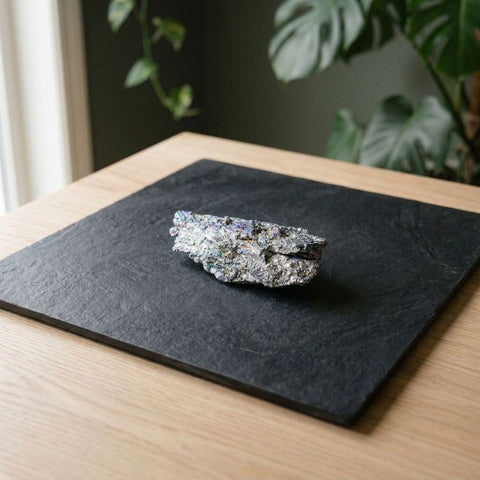
The link between stones and chakras is not Indian: it dates from New Age circles and recent Western esoteric literature. It rests mainly on colour and on the impression of dense matter. For the root chakra, the stones most often cited are red, brown or black:
- Hematite: metallic grey, very dense; its name comes from the Greek for “blood”, because of its red powder.
- Red jasper: an opaque variety of quartz, associated with earth and perseverance.
- Garnet: the colour of pomegranate, a symbol of vitality.
- Black tourmaline and black obsidian: dark stones linked, in esoteric practice, to the idea of a boundary.
These are correspondences from modern tradition, not proven properties, and authors do not always agree: some prefer smoky quartz, others place black tourmaline elsewhere. Simply choose a stone that you like. For care, see the guide to choosing and caring for your stones.
Gentle practices for grounding
Nothing below is a treatment or a promise: these are simple habits, used to focus attention on the theme of grounding.
- Breathing: seated, both feet on the floor, breathe in slowly through the nose letting the belly expand, then breathe out more slowly. Five to ten breaths are enough; stop if you feel dizzy or uncomfortable.
- Posture: standing, feet apart at hip width, knees soft, feel the weight of the body spread between heels and toes (the “mountain pose” in yoga). A slow walk, barefoot on dry, warm ground, has the same intention.
- Meditation: imagine a red or raw sienna light at the base of the spine, stretching out like roots into the ground. Some people softly hum “lam” on the exhale. Ten minutes is enough to begin.
- Colours and atmosphere: a red or brown cloth, a candle, a stone placed on your work table.
Intense breathing techniques or “awakening” of kundalinī are traditionally practiced with an experienced teacher: we offer none here.
What does science say?
No study has demonstrated the physical existence of the chakras or a way to measure them: they are a spiritual and symbolic model, not an anatomical fact. This does not prevent finding, in yoga or meditation, a moment of calm; but that calm comes from the practice itself and proves nothing about the chakras.
Frequently asked questions
Where is the root chakra?
In the tradition, at the base of the spine, near the perineum. It is a symbolic position, not an anatomical one.
What colour is the root chakra?
Red, in the modern Western convention. Ancient Indian texts describe other shades, which vary from source to source.
Which stone should I choose for the root chakra?
Hematite, red jasper, garnet and black tourmaline are often cited. These are traditional correspondences with no proven effect: choose a stone that you like.
What does Muladhara mean?
Mula means root or foundation, adhara means support: “the support of the root”.
Do chakras exist scientifically?
No evidence shows that they are structures of the body. They are regarded as a symbolic framework originating in Indian traditions.
Also read
The meanings mentioned belong to tradition and symbolism. They are neither promises of results nor medical advice. Back to Guide to the chakras.
In the shop