Amethyst: meaning, symbolic properties, care and how to choose
Amethyst is the violet variety of quartz, ranging from lilac to deep purple. Origin of the name, history, symbolism, heat treatment into citrine, imitations and care.
Key points
| Colour | violet, from pale lilac to deep purple |
|---|---|
| Mineral family | quartz (silica), SiO2 |
| Hardness (Mohs) | 7 |
| Cause of the colour | traces of iron and natural radiation |
| Origin of the name | Greek “amethystos”, meaning not drunk |
| Deposits | Brazil, Uruguay, Zambia, Madagascar, Bolivia, Russia (Urals), United States, France (Auvergne) |
| Common treatment | heating: turns yellow-orange (citrine) |
| Birthstone | February |
What is amethyst?
Amethyst is the violet variety of quartz (SiO2, trigonal system). Its colour, which ranges from lilac to purple, comes from traces of iron in the crystal, altered by natural radiation. Transparent to translucent, it has a hardness of 7: it stands up well to daily wear.
It is found in geodes and in cavities of volcanic rocks, where it forms pointed crystals or “caves” lined with violet. Brazil (Rio Grande do Sul) is the world's leading producer; Uruguay, Zambia, Madagascar, Bolivia, Russia (Urals), the United States, Canada and France (Auvergne, Alsace) also supply it.
The colour is stable under heat up to about 250 °C; beyond that it may fade. On the other hand, it does not cope well with long exposure to sunlight, which lightens it.
History and the myth of the name
The name comes from the Greek amethystos, meaning “not drunk”. This stone, the colour of wine diluted with water, was believed to protect against intoxication, and the Greeks and Romans happily drank from amethyst cups. Pliny the Elder, however, was sceptical.
An ancient myth, later taken up by Renaissance poets, tells how a nymph, pursued by Dionysus (Bacchus), was turned into stone to escape him. The god, repentant, is said to have tinted the stone the colour of wine. There are several versions of the story.
Amethyst was rare and precious in antiquity: the great discoveries in Brazil and Uruguay in the 19th and 20th centuries made it common. It is named in Revelation among the foundation stones of the New Jerusalem, and it traditionally adorned the ring of Catholic bishops.
Traditional symbolism
In the stone tradition, the violet colour is linked to serenity, intuition and meditation. The idea of “sobriety” comes directly from its Greek name: it is associated with clarity of mind and moderation.
These are ancient and modern symbols, and we present them as such. Amethyst has no demonstrated effect on sleep, mood or addiction, and it does not replace medical advice or support.
Traditional correspondences
| Area | Association cited | Note |
|---|---|---|
| Chakra | third eye and crown | violet is the colour of the crown chakra |
| Element | air or water | views differ |
| Astrological sign | Pisces, Aquarius, Libra | according to books |
| Birthstone | February | see February birthstones |
See the pages on the third eye and the crown chakra.
How to use it
- As jewellery: rings, pendants, beaded bracelets. Its hardness (7) suits everyday wear. See the guide to gemstone jewellery.
- As a geode or point: an amethyst geode makes a lovely decorative object, kept away from direct sun. See the raw stones and geodes collection.
- As a meditation stone: to hold in the hand or place in front of you.
- By the bed: some people place it on the bedside table. This does not replace good sleep habits.
Care and purification
- Water: lukewarm water with a little mild soap, then dry immediately.
- Sun and heat: avoid. They can fade amethyst. Store it in the shade, away from radiators.
- Salt and household products: avoid; salt is abrasive on a polished surface.
- Smoke: harmless to the stone.
- Knocks: the points of a geode are fragile.
See also the guide to purifying and recharging your stones.
Recognising real amethyst, treatments and imitations
- Heating: at around 500 °C, amethyst turns yellow-orange and is sold as citrine. This is common: much of the citrine on the market is heated amethyst. Partial heating of a stone produces ametrine.
- Synthetic: lab-grown amethyst (grown in an autoclave) has the same composition. It must be identified as such.
- Violet glass or dyed quartz: a violet that is too perfect and a very low price call for caution; glass may show bubbles.
- Misleading names: “Oriental amethyst” (violet spinel or sapphire) or “amethyst root” (violet fluorite) are terms to avoid.
Real amethyst has irregular areas of colour, darker in the points or in bands. Our guide to choosing and caring for your stones offers more pointers.
How to choose
- Colour: a clear violet, neither too pale nor too dark, is the most prized. Very pale violets cost less.
- Shape: a tumbled stone to start, a crystal or geode for decoration, beads or a cabochon for jewellery.
- Price: affordable for most pieces; it rises with size and depth of colour.
- Pairings: it goes with clear quartz (rock crystal) or with selenite.
Frequently asked questions
Why is amethyst violet?
Because of traces of iron in the quartz crystal, altered by natural radiation.
Can amethyst go in the sun?
No, avoid it: long exposure can fade it. Store it in the shade.
What is the difference between amethyst and citrine?
They are two varieties of quartz. Most citrine on the market is heated amethyst, which turns yellow-orange.
What does the name “amethyst” mean?
It comes from Greek and means “not drunk”. The stone was believed to protect against intoxication, an ancient belief.
What is the birthstone for February?
Amethyst, in the modern list of birthstones.
Also read
The meanings mentioned belong to tradition and symbolism. They are neither promises of results nor medical advice. Back to Guide to stones.
In the shop
Amethyst: our products
 Open amethyst geodes: 1 kg packs, lilac crystals
34,90 €
 Set of about twenty raw amethyst druses, 1.9 kg
74,90 €
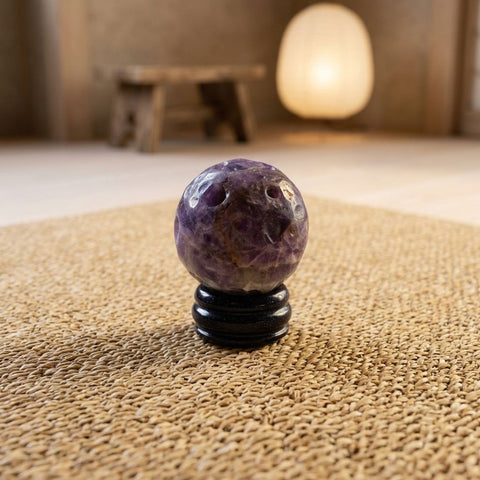 Stone planet with craters on a stand, 40 mm: three stones
27,90 €
 Amethyst bracelet
10,90 €
 Thin 6 mm stone bead bracelet, stretch, wrist size 17 cm
12,90 €
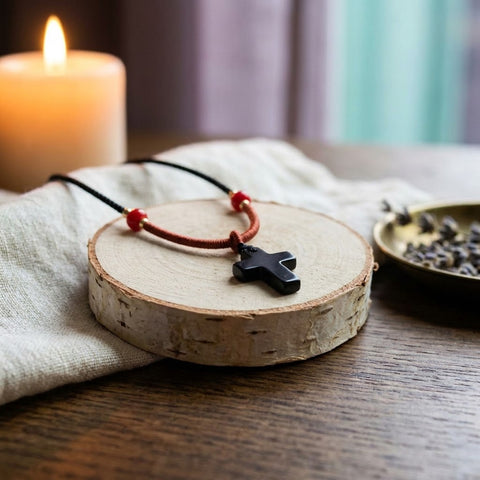 Adjustable cord necklace with small carved stone
21,90 €
 Choker of long stone chips and round beads, 44 cm
20,90 €
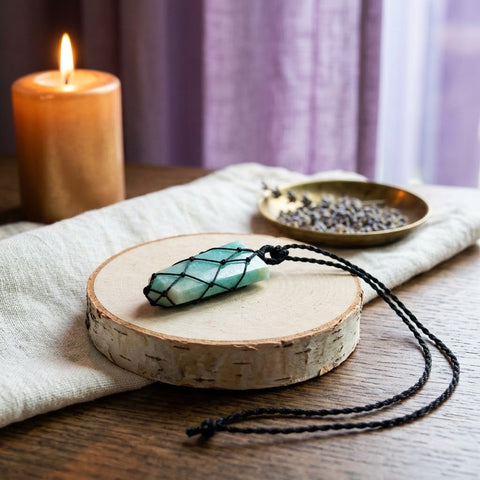 Necklace with flat stone point in a black cord net, adjustable cord
19,90 €