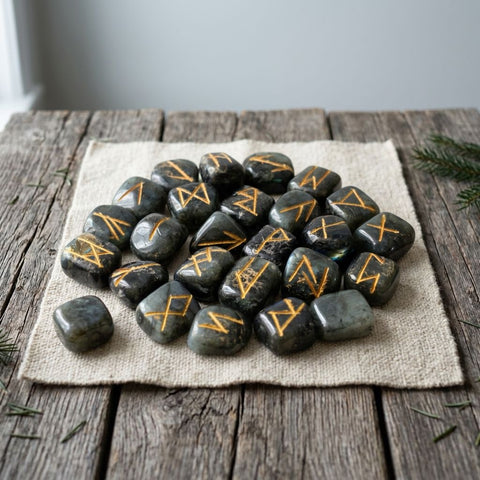
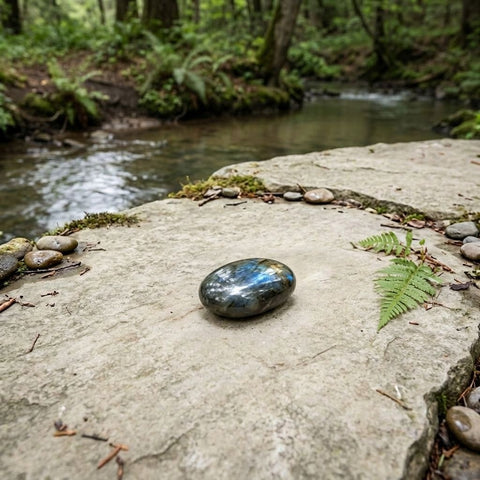
Labradorite: Meaning, Flashes, Symbolic Properties and Care
Labradorite is a dark grey feldspar whose blue, green or golden flashes appear when you tilt it. Origin, symbolism, care and how to choose one.
Key points
| Colour | Dark grey to grey-blue, with blue, green, golden or coppery flashes |
|---|---|
| Mineral family | Plagioclase feldspar (a silicate of sodium, calcium and aluminium) |
| Hardness (Mohs) | 6 to 6.5 according to most sources |
| Special feature | Shifting metallic flashes depending on the viewing angle |
| Deposits | Labrador (Canada), Finland, Madagascar, Russia, Ukraine |
| Associated chakra (tradition) | Third eye, sometimes the throat |
| Care | Barely damp cloth, dry at once, avoid knocks |
What is labradorite?
Labradorite is a mineral from the feldspar family, more precisely a plagioclase: a silicate rich in calcium and sodium. In its raw state it looks like a fairly dull grey stone. But if you tilt it towards the light, one zone of the stone lights up in electric blue, green, and sometimes gold or copper. This play of colour is an optical effect: light is reflected between very thin layers stacked inside the crystal, a little like on a soap bubble. It is called labradorescence, although some mineralogists consider the word imprecise.
Its name comes from Labrador, a region of eastern Canada where it was first described in the 18th century. Sources differ on the exact date (around 1770 for the first description, 1780 according to others). What is certain is that Moravian missionaries working in the area made the first specimens known in Europe. It is also found in Madagascar, Russia, Ukraine and Finland, where an exceptionally colourful variety carries the trade name spectrolite.
Traditional symbolism
Because its flashes appear and disappear depending on the angle, labradorite has become, in the modern stone tradition, the stone of change, transformation and intuition. It is also credited with a kind of “screen” value: it is said to help you keep your inner space to yourself in moments of strong pressure.
These symbolic associations are recent, born of wellness practices in the 20th century, and are neither an ancient tradition nor a scientific fact. No study has shown any effect of the stone on health or destiny. Many people simply appreciate it as an object that invites you to observe, slow down and look at things differently: that is already a lovely use.
Traditional correspondences
Correspondences vary from one author to another. Here are the ones most often encountered:
| Area | Most common association |
|---|---|
| Chakra | Third eye (some authors add the throat) |
| Element | Water or air, depending on the source |
| Signs | Scorpio, Sagittarius, Leo depending on the author; no consensus |
| Themes | Transformation, intuition, imagination |
To understand the notion of chakra, see our page on the third eye.
How to use it
- As jewellery (pendant, ring, earrings): the cabochon cut, domed and polished, is the one that shows the flashes off best.
- On a desk or shelf, a tumbled stone or a small rough piece with one polished face catches the eye and invites a pause.
- In meditation: hold it in your hand and look for the angle where the flash appears. Some people use this exercise of attention as a focus aid.
- As a gift: its look changes with the light, which makes it a much-appreciated present.
These uses are gestures of enjoyment and personal ritual, with no guaranteed effect. For jewellery, our guide to gemstone jewellery covers settings and care.
Care and cleansing
With a hardness of 6 to 6.5, labradorite resists everyday scratches, but it has cleavage planes: directions along which it can split if it takes a knock. So avoid dropping it or banging it against things.
- Water: a barely damp cloth is enough; dry it immediately. Avoid prolonged soaking and ultrasonic cleaners, which can worsen any existing cracks.
- Sun and heat: prolonged exposure is not recommended, as sudden temperature changes can weaken the stone.
- Salt: avoid on polished stones.
- Smoke and sound: passing it through incense smoke, or the sound of a singing bowl, poses no risk to the stone.
For symbolic “purification”, see our guide to purifying and recharging your stones.
Recognising genuine labradorite
Genuine labradorite shows flashes that appear from a single angle and then fade: over the rest of the stone, the colour is grey. If a stone looks “multicoloured” from every side, under any light, stay cautious: it may be glass or a coating.
- Finnish spectrolite, very colourful (nearly every colour of the spectrum), is an exceptional labradorite, rarer and more expensive.
- The name “rainbow moonstone” is a common trade term for a pale labradorite with bluish flashes.
- Glass, or pieces covered with a glossy film to imitate the flashes, are sometimes sold. Always ask for the exact material.
To compare it with a close cousin, see moonstone, another feldspar with flashes.
How to choose your labradorite
First look at the intensity and spread of the flash: the wider and brighter the area that lights up, the more the stone will be valued. A vivid blue flash is the most sought after; golden and coppery flashes are rarer. Then check that there is no visible crack, as the stone does not cope well with knocks.
Labradorite is generally affordable as a tumbled stone or a bead; pieces with large flashes, fine spheres and spectrolite cost noticeably more. It pairs well, in a bracelet or on an altar, with amethyst, selenite or black tourmaline, for a contrast of colours.
Frequently asked questions
Why does labradorite change colour?
Its flashes come from light bouncing between thin layers inside the crystal. The colour you see depends on the viewing angle, hence the effect that appears and disappears.
Is labradorite fragile?
It is moderately hard (6 to 6.5), but it can split along its cleavage planes if it takes a knock. Avoid falls and store it apart from other stones.
Can labradorite go in water?
A quick wipe with a damp cloth is fine. Avoid prolonged soaking and dry the stone straight away.
What is the difference between labradorite and spectrolite?
Spectrolite is the trade name for a Finnish labradorite with very varied, vivid flashes. It is the same mineral family, but an exceptional quality.
Which chakras are associated with labradorite?
Mainly the third eye, sometimes the throat. This is a correspondence from modern tradition, which varies between authors.
Also read
The meanings mentioned belong to tradition and symbolism. They are neither promises of results nor medical advice. Back to Guide to stones.