Rose Quartz: Meaning, Symbolic Properties, Care
Rose quartz is a pale pink variety of quartz (silica), often milky. In tradition it is associated with tenderness and self-love. Hardness 7, it tolerates water well.
Key points
| Colour | Pale pink to deep rose, from milky to translucent |
|---|---|
| Mineral family | Quartz, silicon dioxide (SiO2) |
| Mohs hardness | 7 |
| Cause of the colour | Most often tiny fibres included in the stone (dumortierite-type) for massive rose quartz; irradiation in the rare small, clear crystals |
| Deposits | Brazil (Minas Gerais), Madagascar, United States (Maine), Poland, France (Haute-Vienne) |
| Old names to avoid | “Bohemian ruby”, “Silesian ruby” (rejected by the trade) |
| Traditional chakra | Heart |
| Cleansing | Lukewarm water is possible; avoid prolonged strong light |
What is rose quartz?
Rose quartz is a variety of quartz, the most common mineral in the Earth’s crust, made of silicon dioxide (SiO2). It is recognised by its pink tint, sometimes barely perceptible, sometimes vivid, and by its usually milky appearance: it is found mostly in compact masses rather than as clear points. Its hardness of 7 on the Mohs scale (the scale that ranks minerals from 1, very soft, to 10, diamond) makes it resistant to everyday scratches.
The origin of its colour has long been debated. Titanium or manganese traces were once suspected. A 2001 study published in the journal American Mineralogist extracted tiny pink fibres from massive rose quartz from many deposits: these are thought to be responsible for the colour, and they resemble dumortierite, another mineral. More recent work confirms a fibrous substance close to dumortierite, while leaving some questions open. For the rare small, clear rose crystals, the colour is more likely due to natural irradiation.
The largest masses come from Brazil (state of Minas Gerais), which produces them by the tonne. Madagascar, the United States (Maine) and Poland also supply it, and France has a known deposit at Saint-Ouen-sur-Gartempe, in Haute-Vienne; according to the authors, the finest stones come from Madagascar and Brazil. Some polished pieces show asterism: a six-rayed star that appears under a single point of light, caused by fine needles inside the stone.
A very ancient history of use
It is often said that rose quartz beads were found in Mesopotamia (present-day Iraq) and date from about 7,000 BCE, and that Assyrian craftsmen made rose quartz jewellery around 800 to 600 BCE. These dates are repeated on many websites, but we have not been able to link them to a precise archaeological source: treat them as common claims rather than established facts.
What is better documented is that quartz was worked as an ornamental stone in antiquity, carved into seals, beads and small objects. Rose quartz has also carried misleading trade names, such as “Bohemian ruby” or “Silesian ruby”, which the International Confederation of Jewellery (CIBJO) now prohibits: a rose quartz is not a ruby.
In Greek mythology, this stone is readily linked with Aphrodite and love. This is a modern association rather than an attested ancient tradition.
Traditional symbolism
In modern esotericism, rose quartz is the stone of tenderness. It is associated with self-love, gentleness towards others, friendship and peaceful relationships. It is the stone often given for a birth, a wedding anniversary, or to someone you want to surround with affection.
These meanings are recent and symbolic traditions. No study has shown that a stone can change mood, love or health. Think of this stone as a support: an object that is pleasant to look at and to hold, and that reminds you of the intention you give it.
Traditional correspondences
| Area | Common association |
|---|---|
| Chakra | Heart (see the heart chakra) |
| Element | Water or earth, depending on the author |
| Signs | Taurus and Libra are the most often cited (planet Venus); the lists vary |
| Intention | Love and relationships, gentleness, calm |
For a reading by intention, see the page love and relationships.
How to use it
- As a bracelet or necklace: close to the heart or the wrist, as a discreet reminder of your intention.
- Placed in a room: a tumbled stone or a small sphere on a bedside table or a desk.
- In meditation: held in the hand while breathing slowly, for a moment of calm.
- As a gift: a tumbled stone in a small pouch is a simple and sincere gesture.
To wear your stones every day, see the guide to stone jewellery.
Care and cleansing
- Cleaning: lukewarm water, mild soap and a soft cloth. With a hardness of 7, rose quartz is not harmed by water.
- Light: the colour of some pieces may fade after long, repeated exposure to sunshine or strong light. As a precaution, do not leave it in full south-facing sun on a windowsill.
- Heat: avoid intense heat sources, which can also lighten it.
- Knocks: rose quartz masses are often fractured. Do not let it fall.
- Symbolic cleansing: incense smoke, moonlight, or resting it on selenite (see the selenite page). Our cleansing guide details each step.
Recognising genuine rose quartz
Natural rose quartz rarely shows an even, vivid pink: it is usually pale, often milky, with small fractures or lighter zones. A very saturated piece, bubblegum pink and of a perfectly even tone, should make you cautious.
- Dyeing: colourless or fractured quartz can be dyed pink. The colour then collects in the cracks. Pink glass sold as a stone also exists.
- Synthetic rose quartz: it exists, made in laboratories; it is rare in everyday jewellery.
The safest step is to ask the seller whether the stone is natural, dyed or reconstituted. An honest seller answers plainly. Our guide to choosing and caring for your stones sets out the steps to follow.
How to choose your rose quartz
The shape depends on how you plan to use it: a tumbled stone suits a pocket or a gift, a sphere suits decoration, beads suit a bracelet. Prefer a soft, natural tint rather than an overly bright colour. Small clear, well-formed crystals are rarer and more expensive than milky masses, which remain very affordable.
It pairs well with clear quartz, which visually lightens it, or with rhodonite and rhodochrosite, two other pink stones from the same colour family. Find our stones in the tumbled stones section.
Frequently asked questions
Does rose quartz fade in the sun?
It is reported that the colour of some pieces may fade after long exposure to strong light. As a precaution, store it in the shade or away from direct light.
Can rose quartz get wet?
Yes. With a hardness of 7, it tolerates lukewarm water and mild soap. Simply dry it with a cloth.
What is the difference between rose quartz and rhodonite?
Rose quartz is a quartz (silicon dioxide), often milky. Rhodonite is a manganese silicate in a deeper pink, streaked with black veins of manganese oxide.
Is a very pink rose quartz fake?
Not necessarily, but a vivid and perfectly uniform pink can point to dyeing or imitation. Ask the seller whether the stone is natural.
Which chakra is associated with rose quartz?
In tradition, the heart chakra. This is a symbolic association, with no proven effect.
Also read
The meanings mentioned belong to tradition and symbolism. They are neither promises of results nor medical advice. Back to Guide to stones.
In the shop
Rose quartz: our products
 Polished natural stone mini obelisk, 5 cm
15,90 €
 Rose quartz bracelet
10,90 €
 Thin 6 mm stone bead bracelet, stretch, wrist size 17 cm
12,90 €
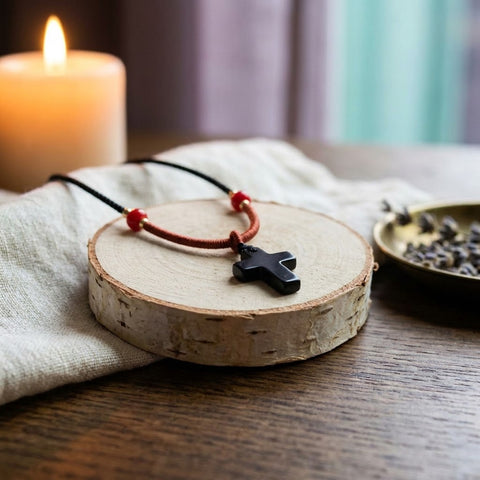 Adjustable cord necklace with small carved stone
21,90 €
 Choker of long stone chips and round beads, 44 cm
20,90 €
 Necklace with drop-shaped stone in a black cord net, adjustable cord
19,90 €
 Stone chip Tree of Life pendant on a black cord, 3 cm
14,90 €
 Glass vial necklace filled with stone chips, silver-plated chain
22,90 €