Aura quartz: meaning, how it is made, care and main varieties
Aura quartz is a quartz crystal coated in a laboratory with a thin, iridescent layer of metal. It is not a natural stone: here is how to choose and care for it.
Key points
| Colour | Metallic iridescent reflections: blue, purple, pink, gold, green |
|---|---|
| Mineral family | Quartz (silica), surface-treated |
| Mohs hardness | 7 for the quartz; the surface layer is more fragile |
| Manufacture | Vacuum vapour deposition of metal (gold, titanium, niobium, etc.) |
| Nature | Treated stone, never natural; made since the late 20th century |
| Varieties | Aqua aura, angel aura, titanium aura, flame aura, opal aura, rainbow aura |
| Association | Recent symbolism, mainly aesthetic (brilliance, inspiration) |
| Care | Quick rinse; no rubbing, no ultrasonic cleaners |
What is aura quartz?
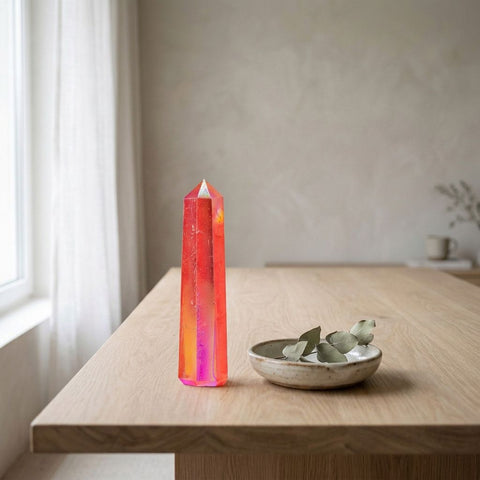
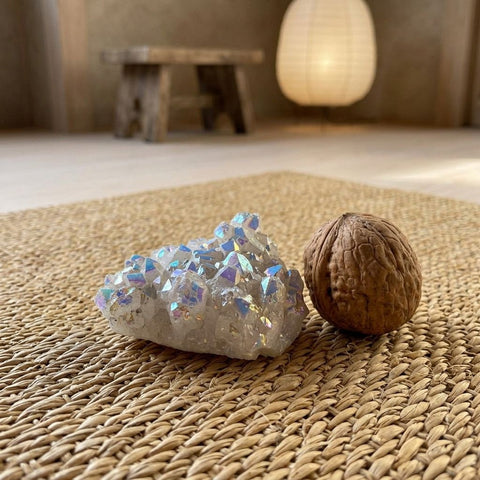
Aura quartz is a transparent quartz crystal (rock crystal) whose surface has been coated, in a laboratory, with a very thin layer of metal. This layer, extremely fine, produces iridescent colours through optical interference, similar to those of a soap bubble: blue, purple, pink, gold, green.
The process uses vacuum vapour deposition: the quartz is heated to about 871 °C in a vacuum chamber while metal (gold for the “aqua aura”, but also indium, titanium, niobium or copper depending on the colours) is heated until it vaporises and settles on the crystal. The result is a quartz that is surface-treated: the colour is not natural.
The trade names vary: aqua aura (blue, with gold), angel aura (pearly, iridescent), titanium aura or rainbow aura (rainbow, with titanium), flame aura (coloured flames), opal aura (opal-like reflections). Our supplier describes them with terms such as “Enhanced Quartz” or “Man made Quartz”, meaning improved and man-made quartz. They have existed since the late 20th century.
Traditional symbolism
There is no ancient tradition for aura quartz, since it was invented recently. The meanings attributed to it are modern and largely aesthetic: it is associated with brilliance, inspiration and the joy of colour. Stone lovers sometimes see in it a symbol of light and novelty.
It is only fair to say so: aura quartz is chosen first for its beauty. If you are interested in the symbolism of quartz, you can also apply that of rock crystal, the material it is made from, with the idea of clarity.
Traditional correspondences
The correspondences below are recent practices that vary from one seller to another. Authors do not agree.
| Area | Association cited | Note |
|---|---|---|
| Chakra | Crown, third eye, throat depending on the colour | No consensus; see the crown chakra |
| Element | Air, water | Modern usage |
| Sign | No consensus | Depends on the seller |
How to use it
- As a pendant or point: a raw or cut point whose colour changes with the light.
- As decoration: on a shelf or near a window, where the reflections show better.
- In meditation: watch the colour change with the angle as an exercise in attention.
- As a gift: lovers of shiny objects appreciate it greatly.
For points, spheres and figurines, see our dedicated range.
Care and cleansing
The base quartz is hard (7), but the metal layer is very thin and can wear: that is the part to protect.
- Cleaning: a quick rinse in lukewarm water, then gentle drying. Do not rub the surface; use no abrasive product, no ultrasonic cleaner and no steam.
- Sunlight and heat: avoid prolonged exposure: the layer can dull or peel.
- Storage: kept apart from other stones, in a soft cloth, to prevent scratches.
- Salt and chemical products: avoid.
For symbolic cleansing, gentle smoke or selenite is suitable. See our guide.
Recognising an aura quartz and avoiding surprises
- Aura quartz: iridescent metallic reflections, even across the surface, with colours sometimes on one face only. Under a loupe you may see areas where the coating did not take well: whitish edges between facets, small white scratches, pits.
- Naturally iridescent quartz: quartz can also show small rainbows naturally from internal fissures; this is a different phenomenon, more subtle, and it is seen inside the stone.
- Iridescent glass or plastic: objects imitating aura quartz also exist; they are lighter.
- Imprecise sellers: an unspecified “rainbow quartz” can be aura quartz. Ask for the exact nature.
There is nothing wrong with buying aura quartz, as long as you know what it is. See our guide.
How to choose
Choose a piece whose reflections are even, with no white areas or scratches, and whose colour you like in daylight. A well-formed crystal or point gives the best effect. For jewellery, the coating wears faster: prefer a pendant worn gently to a ring.
The price depends on the metal (gold costs more than titanium) and on size, but remains reasonable. Our stones and minerals range presents our pieces; a dedicated page specifies the nature of each one.
Frequently asked questions
Is aura quartz natural?
No. The quartz crystal is natural, but its metal coating is added in a laboratory. It is a treated quartz, not a natural stone.
Does aura quartz lose its colour?
The layer can wear over time, especially with friction, chemical products or strong heat. It holds up well if these risks are avoided.
Can I wash aura quartz in water?
Yes, a quick rinse in lukewarm water is enough. Avoid rubbing, abrasive products and ultrasonic cleaners.
What is the difference between aqua aura and angel aura?
Aqua aura is quartz coated with gold, in an aqua blue; angel aura is transparent quartz with pearly reflections. The names come from the trade, not from science.
Does aura quartz have special properties?
It has no ancient tradition; its symbolism is recent and mainly aesthetic. No effect has been proven.
Also read
The meanings mentioned belong to tradition and symbolism. They are neither promises of results nor medical advice. Back to Guide to stones.
In the shop