Sodalite: Meaning, Symbolic Properties and Care
Sodalite is a deep blue mineral streaked with white, often mistaken for lapis lazuli. Its name refers to its sodium content.
Key points
| Colour | royal blue to deep blue, white veins; more rarely grey, green, pink |
|---|---|
| Mineral family | chlorinated sodium aluminium tectosilicate, feldspathoid family |
| Mohs hardness | 5.5 to 6 |
| Origin of the name | sodium (soda) and lithos, stone |
| Notable deposits | Canada, Brazil, Namibia, Greenland, Afghanistan, Italy, France (Cantal) |
| Special feature | may fluoresce under UV; the hackmanite variety changes shade in light |
| Traditional chakra | throat and third eye, depending on the author |
What is sodalite?
Sodalite is a mineral from the feldspathoid family (related to feldspars, but poor in silica). It is a chlorinated silicate of sodium and aluminium, crystallising in the cubic system. Its name combines “soda”, meaning sodium, and the Greek lithos, stone: it refers to its composition. The rock is often massive, a deep blue crossed by white or pale veins and patches (calcite or feldspar). More rarely, it is colourless, grey, green or pink.
It was scientifically described in the early 19th century, based on specimens from the Ilimaussaq massif in Greenland. Today, the fine blue blocks destined for cutting come mainly from Canada (Ontario, Quebec), Brazil and Namibia; it is also found in Afghanistan, in Italy (Vesuvius) and even in France, in the Cantal. It is carved into beads, cabochons, spheres and eggs, and used as a facing stone.
Sodalite is also one of the minerals that make up lapis lazuli, alongside lazurite and pyrite, but on its own it forms a clearly distinct stone.
A stone that responds to light
Some sodalites are fluorescent: under an ultraviolet lamp they can glow orange. One variety, hackmanite, is said to be photochromic: its pale or pinkish tint can change in light and then return in the dark. This is a well-known physical phenomenon, with no link to any kind of “energy”. It makes sodalite fun to observe, especially for children curious about mineralogy.
Traditional symbolism
The deep blue has long evoked the night sky and reflection. In the modern tradition of stones, sodalite is associated with clarity of thought, measured speech and sincerity. It is often suggested to people who study, prepare a presentation or want to bring order to their ideas.
These are symbolic associations: they have no scientific value and do not replace personal work or medical advice.
Traditional correspondences
| Element | Association cited |
|---|---|
| Chakra | throat and third eye, depending on the author |
| Element | water or air, depending on the source |
| Signs | authors disagree; Sagittarius is sometimes cited |
| Keywords | clarity, expression, logic, calm |
See also the throat chakra and the third eye chakra.
How to use it
- As a necklace or bead bracelet: sodalite is a classic jewellery stone with a clear colour.
- On a desk: a sphere or small tumbled stone next to your computer or notebooks.
- During meditation: held in the palm before speaking in public or to help focus.
- As decoration: polished bowls, eggs or slices in a lovely blue.
Care and cleansing
With a hardness of 5.5 to 6, sodalite can be scratched by a steel point and may shatter under a hard blow. It cleaves, although the cleavage is poor.
- Cleaning: soft cloth, slightly damp, then dry immediately. Avoid acids (vinegar, lemon, descaling products), which attack it.
- Avoid long soaking and ultrasonic cleaners.
- Light: as a precaution, do not leave it for weeks in full sun (some pieces may change shade).
- Symbolic cleansing: gentle smoke, a while in moonlight, or selenite placed alongside it. Salt is not recommended.
The page cleansing and recharging your stones explains these practices in detail.
Telling it apart from lapis lazuli and imitations
The most common confusion is with lapis lazuli: both are deep blue. Key points:
- Lapis lazuli contains golden flecks of pyrite and patches of white calcite; its colour leans towards ultramarine.
- Sodalite is more even, with white or grey veins and no golden flecks.
- White stones or other rocks (howlite, chalcedony) can be dyed blue to look like sodalite: a colour that is too vivid, with no natural veining, or one that bleeds onto a damp cotton swab are warning signs.
- Blue glass or glass paste can be identified by small bubbles and an overly perfect surface.
An honest seller states the name of the stone and any treatment it has undergone.
How to choose it
Choose a rich blue, harmonious white veining and an even polish. Sodalite is generally less expensive than lapis lazuli and remains very affordable. For beads, check that the holes are well centred and that there are no chips. It goes well with lapis lazuli, amazonite or clear quartz. For guidance on shapes and quality, see choosing and caring for your stones.
Frequently asked questions
What is the difference between sodalite and lapis lazuli?
Lapis lazuli contains golden flecks of pyrite and white calcite; sodalite is a single blue mineral, with white veins and no golden flecks.
Does sodalite tolerate water?
A brief contact will not harm it, but dry it at once; avoid soaking and acids.
Is sodalite a precious stone?
No: it is an ornamental stone, affordable and widely used for beads and carvings.
Why does sodalite glow under a UV lamp?
Some sodalites are fluorescent: they absorb ultraviolet light and emit an orange glow. It is a normal physical phenomenon.
Does sodalite change colour?
The hackmanite variety does: it fades or darkens depending on the light. Ordinary blue sodalite remains stable, except after very long exposure.
Also read
The meanings mentioned belong to tradition and symbolism. They are neither promises of results nor medical advice. Back to Guide to stones.
In the shop
Sodalite: our products
 Deep blue sodalite bracelet
10,90 €
 Thin 6 mm stone bead bracelet, stretch, wrist size 17 cm
12,90 €
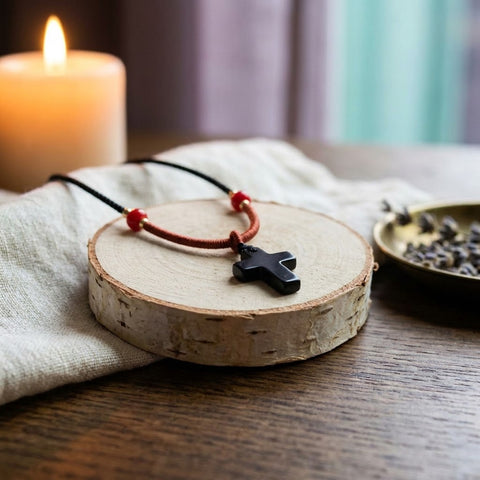 Adjustable cord necklace with small carved stone
21,90 €
 Necklace with drop-shaped stone in a black cord net, adjustable cord
19,90 €
 Stone chip Tree of Life pendant on a black cord, 3 cm
14,90 €
 Mini sodalite tree, 15 chips
14,90 €
 Small seated meditating alien, carved in stone
18,90 €
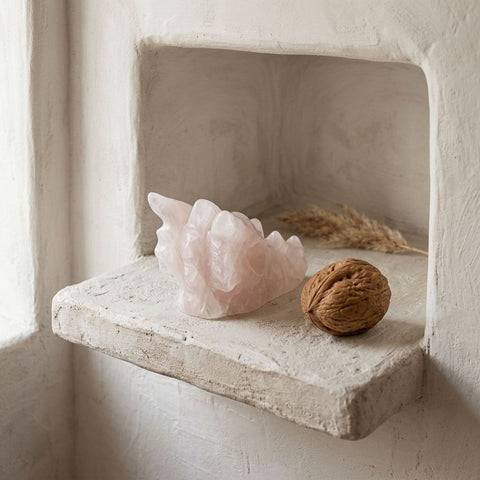 Carved natural stone dragon head
30,90 €