Turquoise: Meaning, Symbolic Properties, Care
Turquoise is a hydrated copper-aluminium phosphate in colours from sky blue to blue-green. It has been prized for millennia. It is soft, porous, and very often treated or imitated.
Key points
| Colours | sky blue to blue-green and green, with or without a brown or black matrix |
|---|---|
| Mineral family | hydrated copper-aluminium phosphate, triclinic system |
| Mohs hardness | 5 to 6, just under 6 for the finest qualities |
| Origin of the name | “Turkish stone”: it passed through Turkey on its way to Europe |
| Notable deposits | Iran (Nishapur), Sinai (Egypt), United States, France (Montebras) |
| Birthstone | December, in traditional lists |
| Traditional chakra | throat |
What is turquoise?
Turquoise is a hydrated copper-aluminium phosphate. It forms in dry regions: groundwater, laden with copper, reacts with rocks containing aluminium and phosphorus. It is cryptocrystalline, meaning it is made of tiny crystals invisible to the naked eye, so it is almost never found as fine crystals. Its hardness is a little under 6, barely more than glass.
Its colour ranges from sky blue (the most prized, sometimes called “Persian blue”) to greenish or greyish green. Remnants of the original rock form the matrix: brown or black veins or patches. A fine, net-like matrix is sometimes highly valued (so-called “spiderweb” turquoise).
A history spanning millennia
Turquoise has been used for thousands of years in Egypt, Persia, China, Mesoamerica, North America and Europe. The Egyptians mined it in Sinai (the region of Serabit el-Khadem), which they called the “land of turquoise”. The Aztecs called it chalchihuitl. In the American Southwest, several Native American peoples have worked it into jewellery for a very long time.
Its name comes from the old French turkeise (“Turkish stone”): the mines were in Khorasan, in Persia, but the stone reached Europe by way of Turkey. The best-known deposits are those of Iran (around Nishapur), Sinai, the American Southwest and, in France, Montebras (Creuse), presented as the largest deposit in Europe.
Traditional symbolism
In many cultures, turquoise is a lucky charm and a symbol of sky and water. It is traditionally associated with protection, travel and sincere speech. For some peoples it is a sacred stone; it should be treated with respect, without taking its symbols out of their cultural context.
No effect has been proven: it is a symbol, not a guarantee, and it does not replace everyday caution or medical advice.
Traditional correspondences
| Element | Association cited |
|---|---|
| Chakra | throat; third eye according to some authors |
| Element | water, air or earth, depending on the traditions |
| Signs | Sagittarius and Pisces are often cited; opinions differ |
| Birthstone | December (traditional list) |
See the throat chakra and the December birthstones.
How to use it
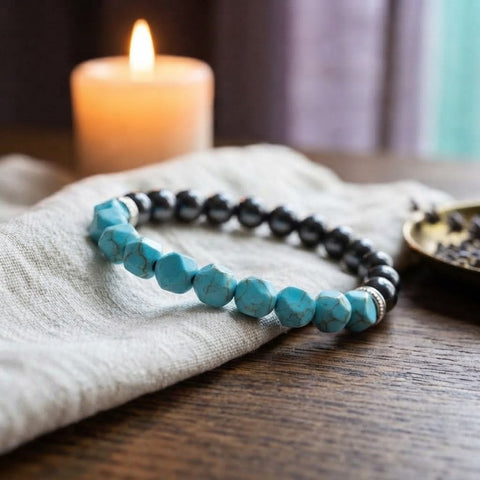
- As jewellery: ring, pendant, bead bracelet, earrings. Wear it for special occasions rather than for every activity.
- As a collector’s object: a matrix piece in a small case.
- In meditation: held in the hand, to accompany a moment of calm.
- As a travel gift: a symbolic lucky charm for a departure.
Care and cleansing
Turquoise is porous: it absorbs water, sweat, oils, creams and perfumes, which can dull it or turn it green. It does not like heat, chemical products or prolonged sun.
- Wipe it with a soft, dry cloth; if needed, use a barely damp cloth, then dry it at once.
- No soaking, no ultrasonic cleaning, no salt, no vinegar.
- Apply perfume and cream before putting on the jewellery, and take it off for swimming, sport and showering.
- Store it out of the sun, separately, in a soft cloth.
For symbolic cleansing, prefer gentle smoke or selenite; avoid water and salt. Read cleansing and recharging your stones.
Treatments, reconstituted stone and imitations
Turquoise is probably one of the most treated and imitated stones. This is not necessarily a flaw, but you should know about it.
- Stabilisation: the porous stone is impregnated with resin to harden it and fix its colour. This is very widespread.
- Reconstituted: turquoise powder bound with resin to form a block.
- Dyeing: a pale or greenish stone may be coloured blue.
- Imitations: howlite or magnesite dyed blue (“turquenite” is dyed howlite), glass, plastic. Variscite, a green natural mineral, is often confused with turquoise.
Warning signs: a very vivid, uniform blue, a matrix that looks like a printed pattern, a very low price. A reliable seller states “natural”, “stabilised” or “reconstituted”.
How to choose one
Look at the colour in daylight, the waxy lustre, and the evenness of the polish. Natural turquoise of fine colour with no treatment is rare and expensive; good-quality stabilised turquoise is an excellent compromise; reconstituted stones and dyed stones are the least expensive. Always ask what you are buying. It pairs well with white howlite, amazonite or lapis lazuli. See also how to choose and care for your stones.
Frequently asked questions
Where does the name turquoise come from?
From the expression “Turkish stone”: the mines were in Persia, but the stone reached Europe by way of Turkey.
Can turquoise change colour?
Yes: sweat, oils, creams or prolonged sun can dull it or turn it green. This is linked to its porosity.
How can I tell if my turquoise is genuine?
A laboratory can confirm it. At home: a very vivid stone sold cheaply, or one that leaves colour on a cotton cloth, is suspect. Ask the seller for the exact nature of the stone.
Is stabilised turquoise fake?
No, it is natural turquoise treated with resin. That treatment should be disclosed.
Can turquoise be exposed to water?
Not well: avoid baths and showers. Wipe it with a soft, dry cloth.
Also read
The meanings mentioned belong to tradition and symbolism. They are neither promises of results nor medical advice. Back to Guide to stones.
In the shop