Howlite: meaning, symbolic properties and care
Howlite is a white borate veined with grey, soft and porous. Very often dyed blue to imitate turquoise: here is how to recognise it.
Key points
| Colour | White, veined with grey to black; opaque to translucent |
|---|---|
| Mineral family | Hydrated calcium borosilicate, Ca2B5SiO9(OH)5, monoclinic system |
| Mohs hardness | 3.5 (3 to 3.5 depending on the source) |
| Density | About 2.6 |
| Discovery | Nova Scotia (Canada), by the chemist Henry How, in 1868 |
| Deposits | Canada, United States (California), Turkey and others |
| Common imitation | Blue-dyed howlite, sold under the name “turquenite” |
| Special feature | Porous: it absorbs dyes easily |
What is howlite?
Howlite is a white mineral, often crossed by fine grey or black veins that give it the look of marble. It is a calcium borosilicate, meaning a compound of calcium, boron and silica. It forms in evaporite deposits, where ancient salt lakes have dried up, often in contact with gypsum.
It was first described in Nova Scotia, Canada, where the chemist and geologist Henry How found it in gypsum quarries. It is named after him. It is also found today in California and in other countries. Before cutting, it often occurs as irregular nodules that resemble a cauliflower.
Its hardness of 3.5 places it among the soft stones: it can be scratched with the point of a knife. Its porous structure makes it very easy to dye, which leads to a common situation in the trade: most blue stones sold as howlite are not natural (see below).
Traditional symbolism
Howlite is a recent stone in crystal healing, with no ancient cultural history comparable to that of jade or turquoise. Modern books associate it above all with calm, patience and serenity. Its gentle whiteness, its discreet veins and its smooth feel explain this soothing image.
These are symbols, not proven effects: howlite does not treat insomnia or anxiety. If you are going through a period of stress or sleep problems, speak to a health professional. It can simply serve as a support for a moment of pause that you give yourself.
Traditional correspondences
| Area | Common association |
|---|---|
| Chakra | Crown, sometimes the third eye |
| Element | Air or water, depending on the author |
| Signs | Gemini, Virgo or Libra are cited; no list is unanimous |
For the chakra at the top of the head, see the page crown chakra. For stones associated with calm, see calm and serenity.
How to use it
- As a bead bracelet: howlite is very common in this form, as it drills and polishes well. Remember to take it off for showering, sport and washing up.
- In your pocket or on your bedside table: a tumbled stone serves as a reminder for a short pause before sleep, with no further expectation.
- In meditation: placed on the forehead or held in the hand, as a point of attention.
- As decoration: as a sphere or a heart on a desk or shelf.
For ideas on combining stones, see our guide to gemstone jewellery.
Care and cleansing
Howlite is soft and porous: it needs care.
- Cleaning: a soft cloth, barely damp, then dry immediately. No soaking, no ultrasonic bath.
- If it is dyed: water and rubbing can fade the colour or cause it to transfer to the skin or to fabric. Also avoid sweat, perfume, cream and household cleaners.
- Sun: avoid prolonged exposure, especially for a dyed stone, whose colour can fade.
- Salt: to be avoided, as the stone is porous.
- Symbolic cleansing: incense or sage smoke, moonlight, or placing it on a bed of selenite or quartz. See our cleansing guide.
Natural or dyed howlite: avoiding surprises
White howlite is entirely natural; it is its coloured versions that raise questions. Because of its porosity, it is dyed turquoise blue to imitate turquoise, sometimes sold as turquenite. It can also be dyed pink, green, violet or other vivid colours that do not exist in nature.
A few pointers:
- A very uniform, very vivid blue with clearly visible black veins, at a modest price, is very probably dyed howlite rather than turquoise.
- Intense pink, green, orange or violet are necessarily dyed.
- This dyeing is a common practice and perfectly legal. It is honest if the product listing declares it. The problem arises when it is presented as turquoise.
Magnesite is also very often dyed to imitate turquoise. In both cases, ask for the exact material. The gemstone glossary explains these terms.
How to choose
Choose according to how you plan to use it: for a bracelet worn every day, prefer well-drilled and well-polished beads, knowing that they will age and show wear faster than quartz. For a decorative sphere or heart, natural white howlite is a lovely, economical option.
As for price, it is an affordable stone, which is normal: a high price for a blue howlite would be a bad sign. It pairs well with dark stones such as black obsidian or black tourmaline, or with other white stones.
Frequently asked questions
Does blue howlite exist in nature?
No. Natural howlite is white with grey or black veins. Blue stones sold under this name are dyed, often to imitate turquoise.
What is turquenite?
It is the name given to howlite dyed blue to look like turquoise. It is not turquoise.
Does howlite dislike water?
Yes, because it is soft and porous. Wipe it with a barely damp cloth, without letting it soak or exposing it to steam.
Does howlite fade?
If it is dyed, the colour can fade under the effect of water, sweat or sunlight. Natural white howlite does not fade.
Which chakra is it associated with?
Most often the crown chakra. This association comes from modern tradition and varies between authors.
Also read
The meanings mentioned belong to tradition and symbolism. They are neither promises of results nor medical advice. Back to Guide to stones.
In the shop
Howlite: our products
 Choker of long stone chips and round beads, 44 cm
20,90 €
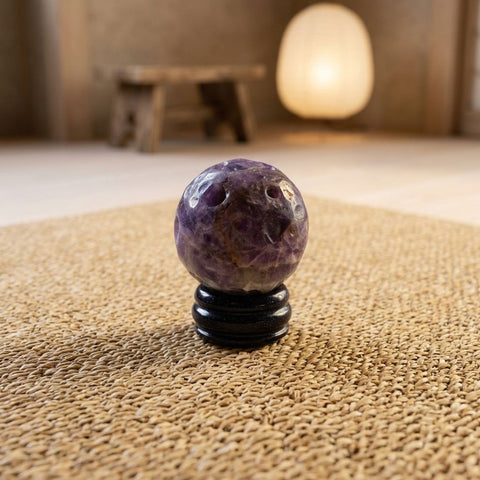 Stone planet with craters on a stand, 40 mm: three stones
27,90 €
 White howlite bracelet
10,90 €
 Thin 6 mm stone bead bracelet, stretch, wrist size 17 cm
12,90 €
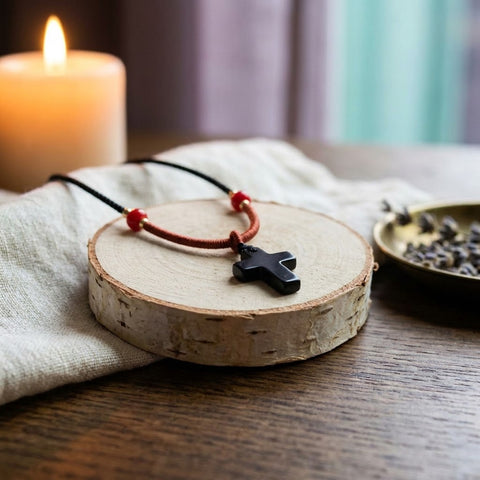 Adjustable cord necklace with small carved stone
21,90 €
 Necklace with hexagonal stone in a black cord net, adjustable cord
19,90 €
 White howlite: tumbled stones marbled with grey
19,90 €